
Nobody overtrades on the trades they planned.
They overtrade on the ones that showed up between the planned ones. The half-setup at the top of the hour. The re-entry after the stop. The sympathy play. The one where the thesis was assembled in the four seconds between clicking and filling. Add them up at the end of the week and they are not a strategy. They are a symptom.
The frame most traders bring to their own overtrading is a moral one. They believe they took too many trades because they lacked discipline, and the fix is to want it more. That frame has kept a lot of accounts small for a lot of years. It's wrong in a specific way, and the specific way it's wrong is worth naming.
THE REAL MECHANISM
Your body doesn't know it's a chart
The nervous system that's sitting in your chair was tuned over a couple hundred thousand years to respond to motion, threat, and reward. It cannot tell the difference between a small-cap running 40% on a filing and a predator moving in the grass. It sees color, speed, and consequence, and it dumps chemistry into you accordingly.
Dopamine isn't the reward for winning. That's the part most traders get backwards. Dopamine is the reward for anticipating. It fires hardest not when the trade closes green, but when you're clicking buy and don't yet know what happens next. This is why the loss doesn't cure you. The loss is downstream of the hit you already took at entry. By the time you're red, your body has already been paid.
Cortisol handles the other side. It shows up when you sit flat and watch someone else's ticker rip. That feeling in your chest when a runner goes without you — that's not weakness. That's a threat response to a missed resource. Your body is telling you that you failed to feed the tribe. It's wrong, but it's loud, and it's older than you are.
So when a trader says they can't stop overtrading, what they usually mean is: they cannot tolerate the physical sensation of not trading while the market is moving. That's not a strategy problem. You can't out-plan a chemistry problem with more rules.
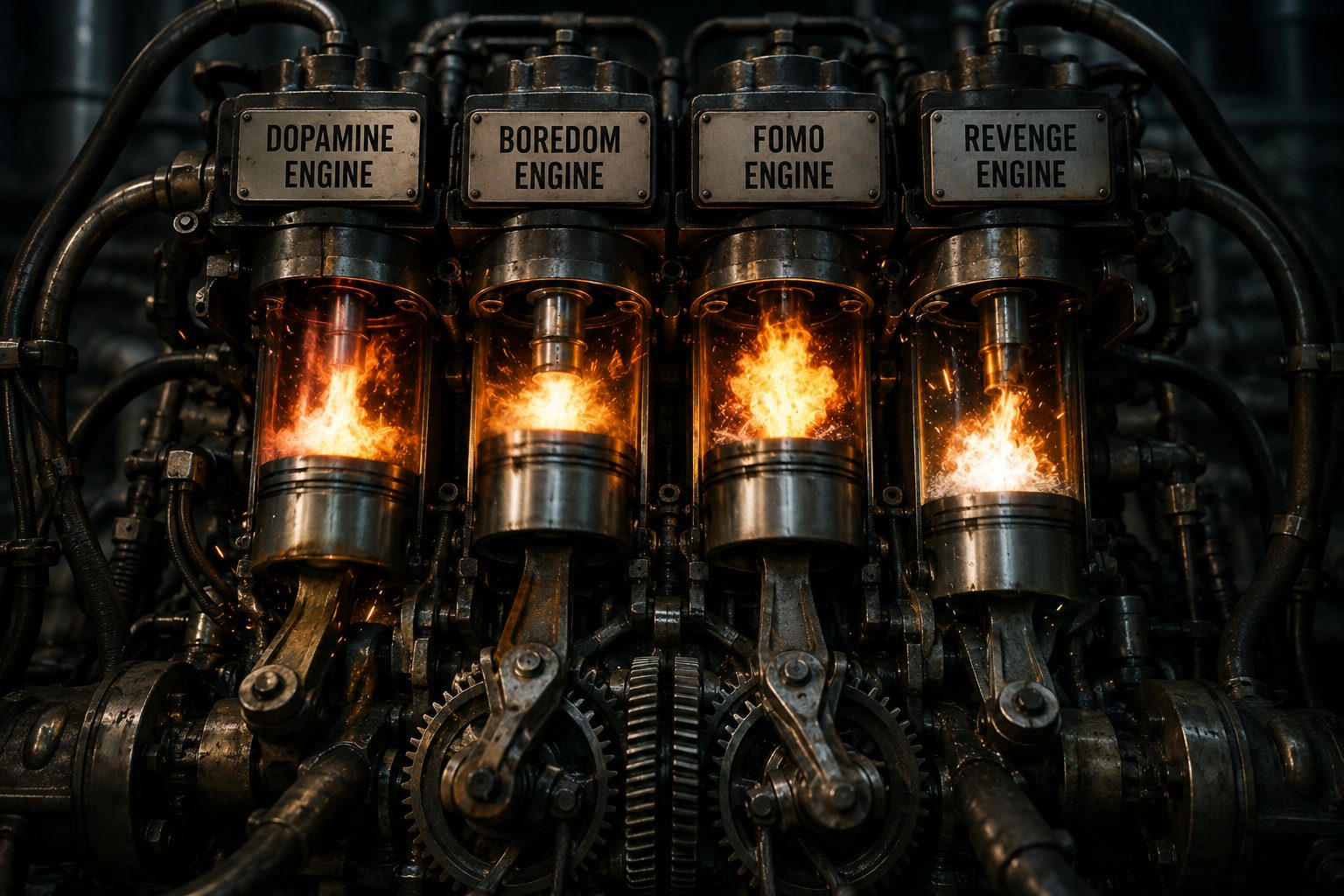
THE FOUR ENGINES
What's actually pulling the trigger
Overtrading isn't one thing. It's four separate engines that happen to produce the same output — too many clicks. Naming which one is running matters, because they don't respond to the same intervention.
- The dopamine engine. You trade because clicking feels good. Green or red is almost secondary. You'll notice this one on quiet days when you take a marginal setup just to feel engaged. The tell: you feel bored, then you feel busy, then you feel tired. Nothing in that loop was about edge.
- The boredom engine. Related but distinct. Dopamine trading is a hit. Boredom trading is a coping mechanism. You're avoiding something — the email you don't want to send, the thought you don't want to have, the fact that flat-and-patient is the correct trade for the next 90 minutes. The chart is a place to hide.
- The FOMO engine. The runner without you. The Discord alert you missed. The sympathy name up 18%. Your body reads this as loss even though nothing left your account. So you chase, and now you've converted an imaginary loss into a real one.
- The revenge engine. The red trade you refuse to let stand. This one wears a mask — it looks like conviction, it sounds like a thesis, it dresses up as "I see the setup, I'm just sizing back in." It isn't. It's your nervous system trying to close an open loop, and it will keep opening new positions until the loop closes on its terms or the account closes for you.
Most bad sessions run two of these at once. A revenge trade dressed as FOMO. Boredom dressed as opportunity. If you can't separate them at the end of the day, you can't fix them at the start of the next one.
You cannot out-plan a chemistry problem with more rules. You have to give the chemistry somewhere else to go.
WHY RULES ALONE FAIL
The rulebook a stressed body cannot read
Every trader who has overtraded for more than a year already has rules. Max three trades. No entries after 11:15. Walk away at down-2R. The rules are fine. The rules are usually excellent.
The rules fail because they were written by the calm version of you and they have to be executed by the activated version of you. Those are two different people using the same login. The calm one can read a rulebook. The activated one is running on a nervous system that has narrowed to threat and reward, and reading anything longer than a sentence feels like homework.
This is why post-mortems full of "I knew I shouldn't have" are so common and so useless. Of course you knew. Knowing was never the constraint. The gap is not between what you know and what you do. It's between the state you were in when you wrote the rule and the state you were in when you needed it.
The fix isn't more rules. The fix is fewer decisions made in the activated state, and more structure imposed by the calm one that survives contact with the activated one.
WHAT ACTUALLY WORKS
Interventions that survive a live tape
Some of these will sound obvious. They are obvious. The reason they still work is that obvious is not the same as easy.
- Pre-commit the count, not just the size. Deciding you'll risk 1% per trade doesn't cap your day. Deciding you get three entries and then the platform is closed does. The number of clicks is the real risk metric on a bad day, not the per-trade size.
- Put physical friction between you and the click. Move the hotkey. Log out between setups. Widen the confirm dialog. Any half-second of interruption gives the calm version of you a chance to reassert. Half a second is often all it takes.
- Name the engine before the entry. Out loud. "This is boredom." "This is revenge." "This is FOMO on the sympathy." Naming it doesn't kill it, but it moves the decision from reflex to conscious, and the conscious version of you passes on most of these trades on its own.
- Have a non-trading action ready for the flat hour. If sitting still is the thing your body can't do, don't ask it to. Give it a task. Journal the last trade. Screenshot the levels. Walk. The point isn't productivity. The point is metabolizing the chemistry somewhere that doesn't cost you money.
- Count. Every day. In writing. Not P&L. Trade count. Planned vs. unplanned. Most overtraders have no idea how many trades they actually take until they see the number, and the number is almost always the intervention by itself.
None of this is a personality transplant. You will still be the person who feels the chase. You're just building an environment that makes it slightly harder to act on the feeling, and slightly easier to notice it before you do.
THE SYSTEM QUESTION
What you're actually looking for
Read that list again. What you're describing, if you build it out honestly, is a system that watches your state, counts your clicks, flags the engine that's running, and gets between you and the trade you're about to regret. Not a chart tool. A behavioral layer.
That's the thing that's been missing. Every platform on earth will help you enter faster. Almost none of them will help you enter less. The whole industry is optimized against the exact intervention you need.
MAKETZO is built for the trader who has already accepted that the gap isn't knowledge — it's enactment. It counts what you're doing while you're doing it, names the state you're in before the state names your account, and puts the friction back in the places the broker took it out. If the honest read on your last month is that you knew the trades were bad while you were taking them, this is the layer that was missing.