
Nobody gives back profits when they're red. You give them back when you're green. That's the whole trick, and it's why the pattern is so hard to see — the wound gets opened by the win, not by the loss.
Go look at your last twenty sessions. Not the P&L column. The intraday high versus the close. I'll wait.
If you're like most retail traders I've watched, you'll find something ugly: on the days you finished red, you were also green at some point. Not just kissed-green. Meaningfully green. Bank-it-and-walk-away green. And then you kept trading. And then you weren't.
This isn't a losing problem. It's a winning problem.
THE MECHANISM
Winning changes your brain more than losing does
Everyone talks about tilt after a red day. Fewer people talk about tilt after a green one, and it's the more expensive of the two. When you take a loss, your nervous system braces. You get defensive. You tighten up. When you take a win, especially two or three in a row, your nervous system opens. You stop bracing. You start looking.
Looking is the killer word. A trader who is looking for setups is a trader who is going to find them whether they're there or not.
The market does not distinguish between a trade you took because of your plan and a trade you took because you were bored, warm, and up six hundred bucks. Your account doesn't either. Only you know the difference, and by the time you know it, you're already in.
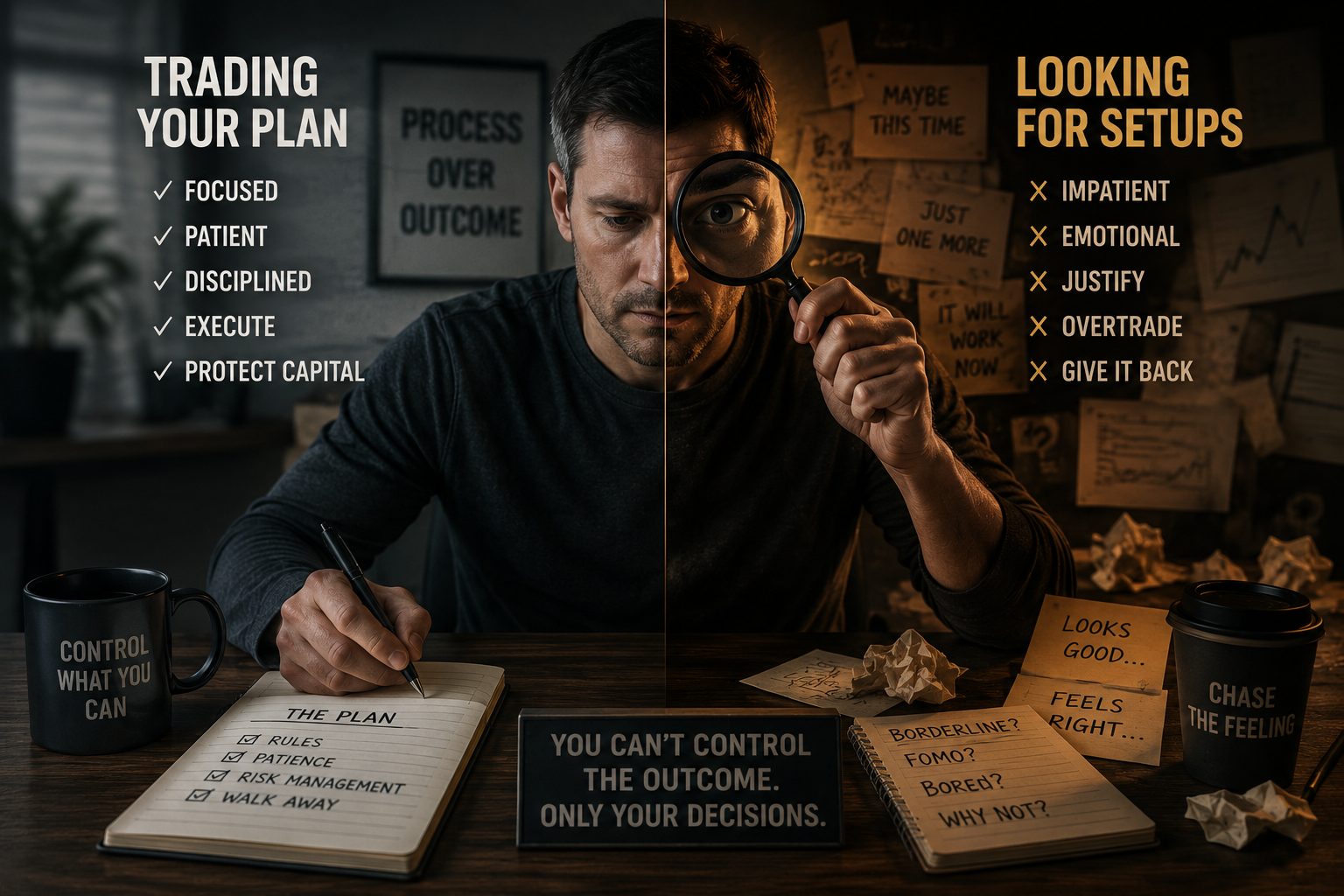
THE STACK
Confidence tipping into entitlement
Here is how a green day dies. See if the sequence looks familiar.
- You take a clean trade in your A-setup. It works. You're up.
- You take a second, slightly less clean one. It also works. You're up more.
- A third setup shows up. It's a B-setup, maybe a C-. But you're hot. You size normal.
- It doesn't work. You give back some. Fine, you're still green.
- Now you're annoyed. Not at the market. At yourself, for that last one. You want to earn it back before lunch so the morning doesn't feel wasted.
- The next trade is not a setup at all. You'd have laughed at it at the open.
The stack has a name. It's called confidence tipping into entitlement. Confidence says the setup is real. Entitlement says the outcome is owed. One is a read. The other is a demand. The market only pays the first.
You didn't lose the money. You refunded it, one impatient click at a time.
THE QUIET COST
Fatigue is a position size
The second, quieter reason profits leak: you're tired and you don't know you're tired.
Focused execution is a metabolic activity. Four solid trades before eleven cost you more mental capital than you feel. By early afternoon your read is worse, your patience is thinner, and your definition of setup has quietly loosened. You're not making bad decisions. You're making the same decisions with worse hardware.
Anyone who's rolled hard in the first two rounds of an open mat knows this. Round three, your technique doesn't disappear — your access to it does. You reach for the same submission and your grip is at sixty percent. The other guy postures out. You tell yourself he got lucky. He didn't. You got tired.
In trading, fatigue doesn't show up as a bad trade. It shows up as a slightly worse version of your normal trade. One that used to be a full winner and is now a scratch. One that used to be a scratch and is now a small loss. Multiply by four or five clicks after lunch and you've refunded the morning.
Confidence says the setup is real. Entitlement says the outcome is owed. The market only pays the first.
THE FIX
Mechanical, not motivational
You can't willpower your way out of give-back. I've tried. Every trader I've talked to about this has tried. It doesn't work because the same brain that got you into the trade is the one you're asking to talk you out of the next one, and it's outvoted.
What works is mechanical:
- A green-day rule written down before the open. Not "I'll stop when I'm up enough." A number. If you're plus X by mid-morning, half comes off the day. If you hit plus two-X, you're done.
- A hard afternoon cutoff on green days. The afternoon is where give-back lives. If the morning gave you the day, take the day.
- A forced pause after any winning streak of three. Ten minutes. Stand up. Water. Not to celebrate — to interrupt. Streaks are where entitlement forms.
- A one-line prompt between trade four and trade five. Not after the session. Between. "Am I still in a setup, or am I in a mood?"
None of this is exciting. None of it will make you a hero on Twitter. All of it works.
THE HANDOFF
The system you're already describing
Notice what you just read. A rule that fires at a P&L threshold. A forced pause after a streak. A prompt that interrupts you between trades, not after. An honest read on whether your decisions are still coming from your plan or from your afternoon self.
That's not a mindset. That's a system. A trader running that system is a boring trader, and boring traders keep their mornings.
The problem is you can't be the system and the trader at the same time. The version of you sitting there up twelve hundred at 11:34 is not the version who is going to enforce the plus-one-thousand rule the sober morning version wrote down. Something outside you has to hold the line.
That's what MAKETZO is built for. Threshold rules that fire without asking your afternoon self for permission. Streak-aware prompts that interrupt before the give-back trade, not after. A record of every day you were green at the high and what you did next, so the pattern stops hiding inside the closing P&L and starts showing itself where you can actually work on it. You already know how to make the morning green. What you need is something standing between you and the refund window.