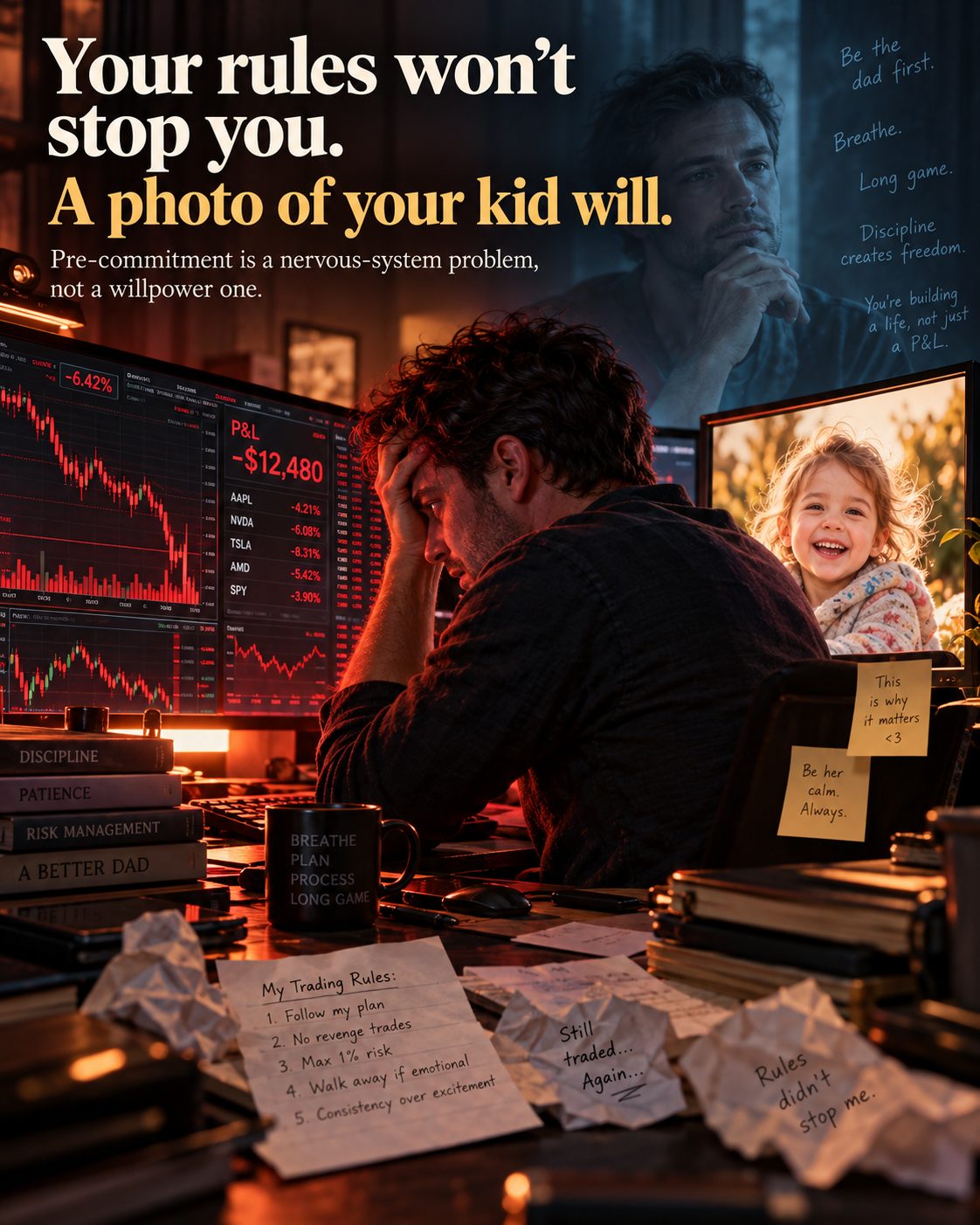
Nobody breaks a rule they wrote on a calm Sunday. They break the version of that rule their 11am brain remembers, which is a shorter, friendlier, more negotiable version. By the third red trade, the rule has quietly become a suggestion. By the fourth, it's a mood.
This is not a character problem. It's a storage problem. The part of you that wrote the rule and the part of you about to break it are not the same brain. One is cold, articulate, future-tense. The other is hot, inarticulate, and extremely interested in getting even with the market right now.
You cannot out-argue the hot brain with text. It doesn't read. It doesn't want to. And every retail trader learns this the expensive way, usually several times, before they stop blaming themselves for having insufficient discipline.
THE MECHANISM
Why text-based rules fail at the moment of truth
Rules live in language. Language lives in a part of the brain that goes offline under stress. When your P&L flips red and your heart rate climbs, the prefrontal cortex, the one that drafted your risk plan, gets quietly outvoted by older machinery that evolved to handle sabertooth tigers, not slippage.
What stays online under stress is sensory. Faces. Smells. The sound of a specific voice. Images you've looked at ten thousand times. This is not mysticism. It's just where the brain stores the stuff it refuses to lose access to.
So when a trader tapes a note to their monitor that says MAX 3 TRADES, they're writing to the part of themselves that won't be in the room when it matters. The note is a letter to someone who isn't home.
A rule is a letter from your Sunday self to a stranger. A photograph is a hand on your shoulder from someone your nervous system actually listens to.
An anchor image works differently. It bypasses language entirely. You don't read it, you feel it. The photo of your daughter at the park, the one from the hospital day, the shot of your mom at the kitchen table, these don't argue with the hot brain. They interrupt it.
PRE-COMMITMENT
The oldest trick in behavioral economics, retooled for a 9:47 setup
Pre-commitment is the discipline of binding your future self to a decision your present self can still make clearly. Odysseus and the mast. The alcoholic who doesn't keep liquor in the house. The dieter who doesn't walk down the snack aisle.
Traders are terrible at pre-commitment because the trading platform itself is the snack aisle. The mast is also the ship. You cannot not-walk-down-it. So the pre-commitment has to happen one level up, not at the platform, but at the nervous system.
That's what an anchor image is for. It's a pre-committed interruption. You decide, in a calm moment, that this specific image will be the thing you have to look at before you click size you didn't plan. You don't have to trust your 10:30 self to remember your rules. You only have to trust that your 10:30 self will see the picture.
- The image must be one you have an involuntary emotional response to. Not aspirational. Not a vision board. Something that already lives under your skin.
- It must be positioned where your eye lands when you're about to act, not in a drawer, not on your phone, not three tabs away.
- It must be paired with a specific trigger: the make-back trade, the size-up, the fourth trade of the morning. Otherwise it becomes wallpaper.
Wallpaper is the enemy. Any image you look at every day for a month without a trigger attached becomes part of the room. The anchor only works if the hot brain still registers it as a thing happening right now.
THE RED DAY TEST
What actually happens when the image is in the right place
Picture the moment. Two losses in. You're down more than your plan allows but less than your ego can tolerate. A setup appears that would have been a pass twenty minutes ago. Now it looks like a reason.
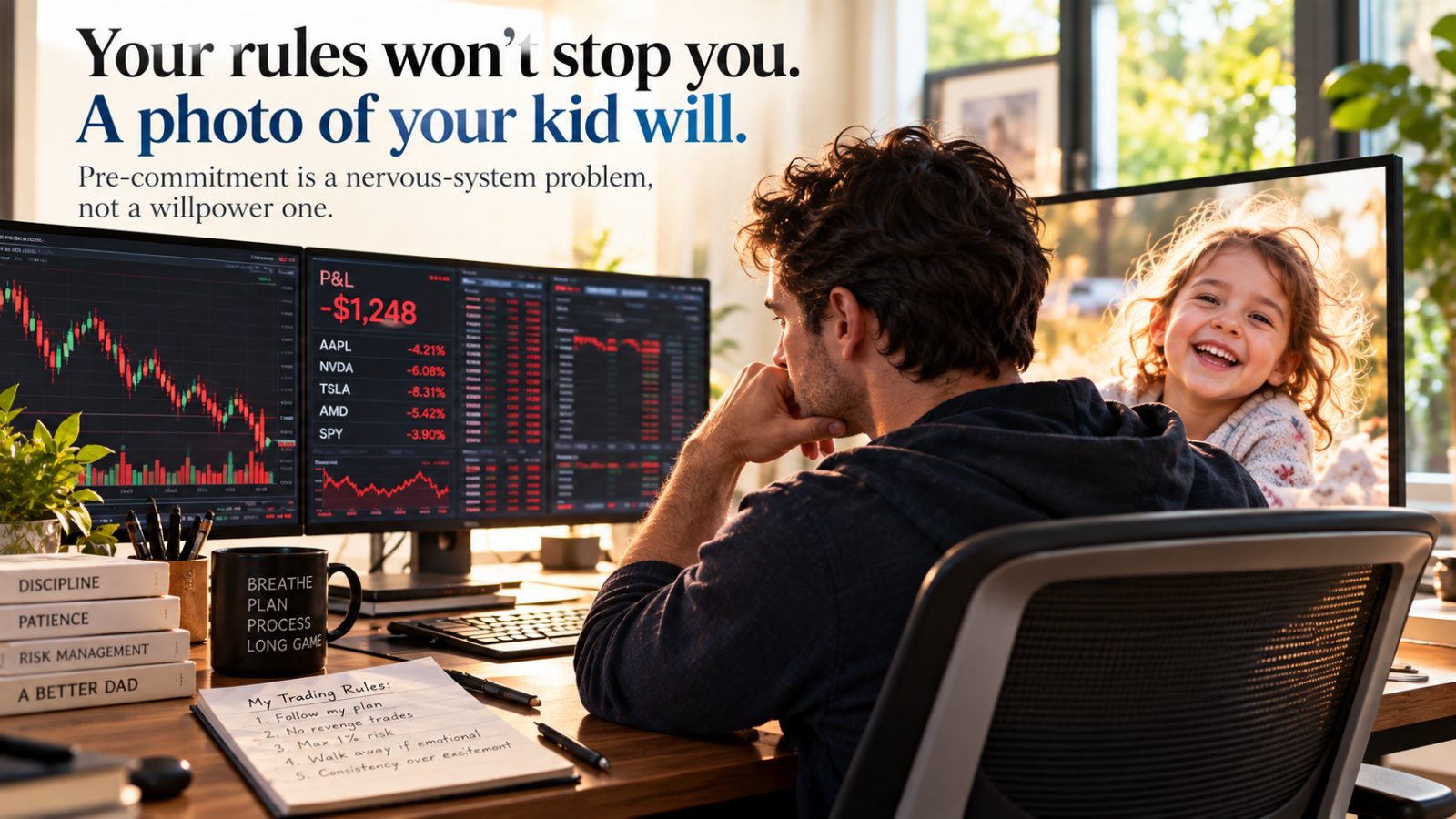
Your finger is on the mouse. You glance up to size the position. And there, between you and the order ticket, is a photo of your six-year-old asleep in the car on the way home from somewhere.
You still might take the trade. Anchor images are not magic. But in the half-second between seeing the photo and clicking buy, something happens that would not have happened otherwise: the trade becomes a choice again instead of a reflex. That half-second is the entire game.
Every revenge trade I've ever taken was a trade I didn't consciously decide to take. It happened to me. The anchor image doesn't stop every bad trade, it stops the ones that would have been automatic. And the automatic ones are the expensive ones.
WHY MOST TRADERS NEVER DO THIS
It feels embarrassing. That's a feature.
A grown adult taping a picture of their kid to a second monitor feels sentimental in a job that prides itself on being unsentimental. Traders are supposed to be cold. Mechanical. Edge-maximizing machines.
But the cold mechanical trader is a myth retail sells itself. The actual winners I know are weirdly sentimental about the thing that keeps them in the chair, a kid, a parent, a sobriety date, a photo of the apartment they were living in when they almost quit. The sentimentality isn't a weakness. It's load-bearing.
The embarrassment is also the moat. If anchor images felt sophisticated, every trader would do them, and the small edge they create would disappear. They feel soft. They feel like therapy. They feel like something a serious person wouldn't need. That's exactly why they work, because the hot brain has no defenses against them.
THE SYSTEM
You already know what image. The question is whether anything will put it in front of you.
Every trader reading this already knows which photo it would be. You thought of it two sections ago. The gap is not knowledge, it's enactment. The photo lives on your phone, not on the screen you're trading from. It shows up when you scroll, not when you size.
What you actually need is a layer that sits between you and the moment of impulse. Something that knows which trade is the make-back trade. Something that knows you've already hit two losses and the next click is probably not strategy. Something that doesn't ask you to remember, it reminds you, with the one input your nervous system can't ignore.
That's what the Focus Room is built to be. Not another rule you'll negotiate with. A pre-committed interruption that uses the image you already chose, surfaced at the exact moments your rules go quiet. The system you've been describing in your head for the last three minutes already has a name.