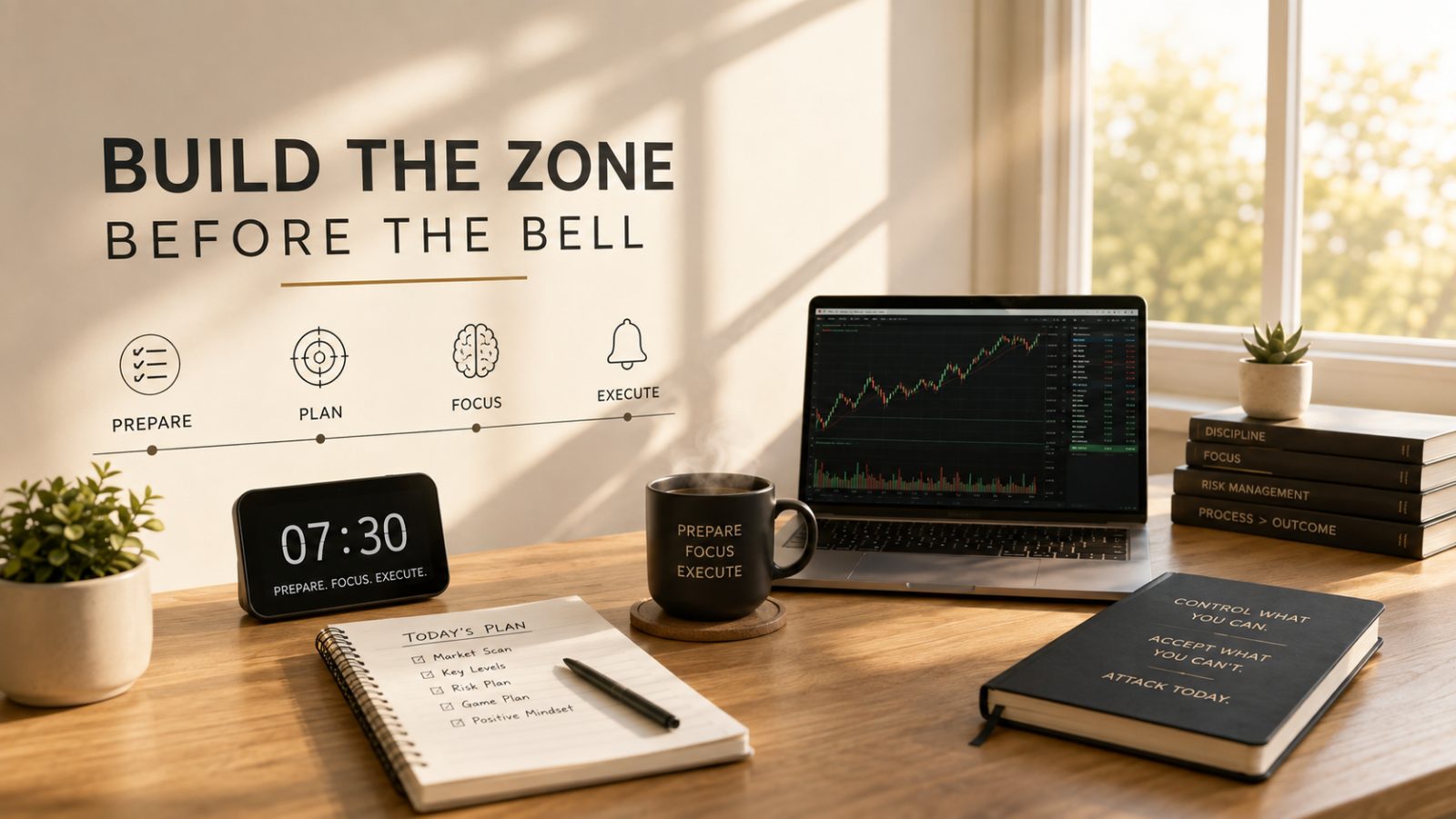
Nobody who had a bad open had a good pre-market. I don't mean they read the news and skimmed a watchlist. I mean they sat down, ran a sequence, made decisions, and closed the laptop for ten minutes before the bell because everything they needed to do was already done.
The traders who miss that sequence talk about "getting in the zone" like it's weather. Some days it shows up. Some days it doesn't. On the days it doesn't, they trade anyway and wonder why they took a fill they can't defend by 9:45.
The zone isn't a mood. It's an assembly. There's a version of you that shows up to the bell already inside it, and a version that spends the first thirty minutes trying to catch it while the market takes real money from you. The difference between those two versions is the two hours before the open.
THE MYTH
"Getting in the zone" is not a vibe
Ask ten retail traders what their pre-market looks like and eight of them describe atmosphere. Coffee. A specific playlist. Sitting down early. Feeling ready. These are inputs to a mood, not a plan. They generate the sensation of preparation without any of the work of it.
The tell is what happens when the bell rings. If the first ten minutes feel like scrambling — flipping between tickers, resizing charts, deciding what to watch as it moves — the zone was never built. What was built was a feeling of being ready to look for readiness, which is a different thing.
A pre-market routine that produces a feeling instead of a plan is just a warm-up for improvisation.
Improvisation is what you do when the sequence failed. It's not a strategy. It's a fallback that some traders have turned into an identity because they've never actually run the sequence.
THE SEQUENCE
Four layers, run in order
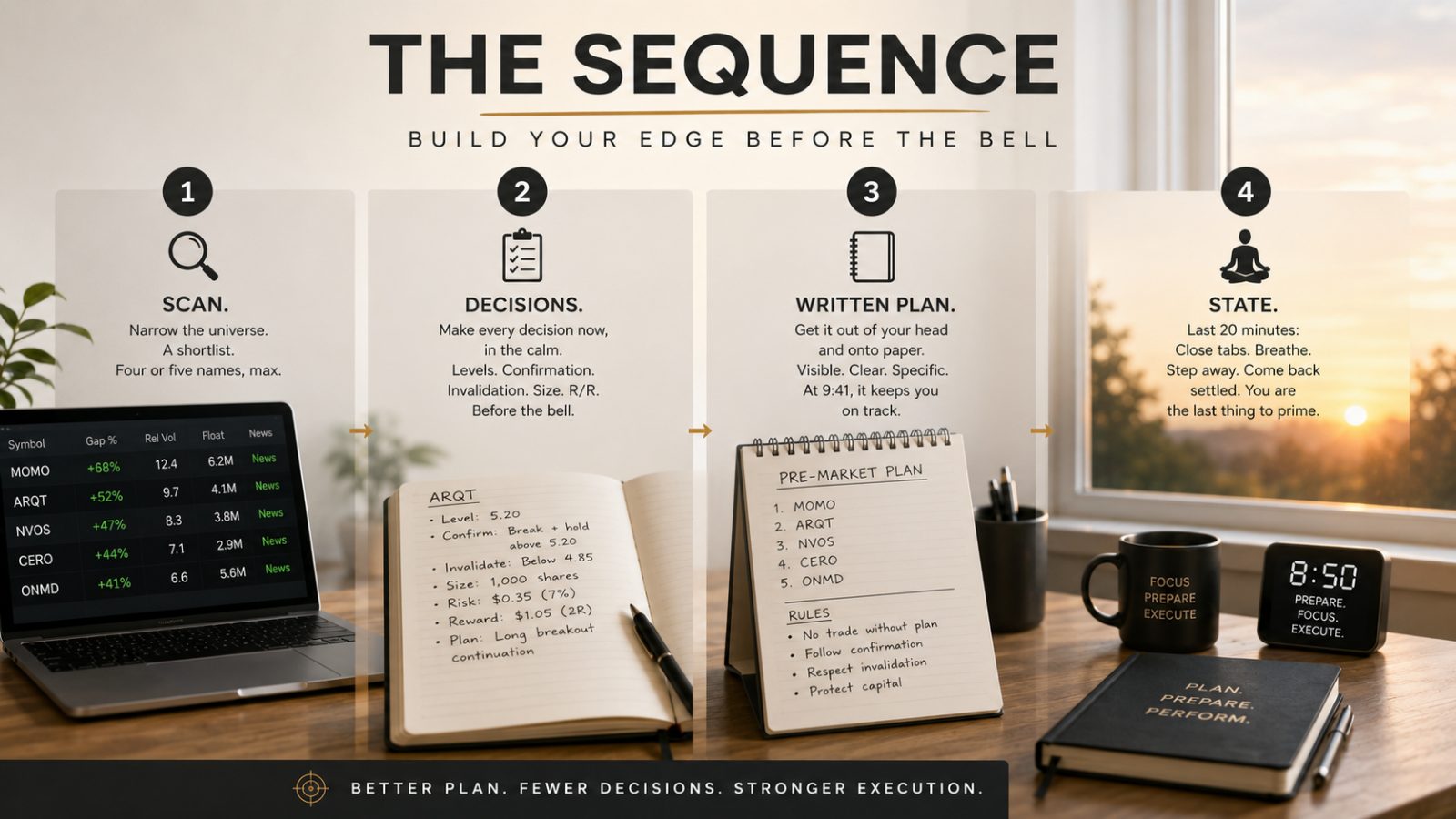
The pre-market hour has a specific job: it should end with a trader who has fewer decisions to make once price starts moving, not more. Every good pre-market routine I've watched — or eventually built for myself after blowing up the second time — runs the same four layers in the same order.
- Scan. The universe gets narrowed. Whatever criteria you trust — gap, catalyst, relative volume, the small handful of setups you've earned the right to trade — the output is a shortlist. Not "stuff to watch." A shortlist. Four or five names, max.
- Decisions. For each name on the shortlist, the decisions get made now, in the calm. Where's the level. What confirms. What invalidates. What size. What the trade is worth if it works and what it costs if it doesn't. All of this before the bell, when there is no P&L pulling on you.
- Written plan. The decisions leave your head and land somewhere your eyes can see them at 9:41 when your pulse is up. On paper, in a doc, in a journal — the medium is less important than the fact that it's external. If it's only in your head, it will get overwritten by the tape.
- State. The last twenty minutes are not for more research. They're for closing tabs, breathing, walking away from the desk, coming back settled. The plan is done. The trader is the last thing to prime.
Order matters. If you prime state first, you'll research inside a calm you'll lose the moment a name breaks a level. If you write the plan before making the decisions, you'll write vague garbage that reads well and helps nothing. The layers stack on each other. Skip one and the rest doesn't hold.
THE WAITING
The last fifteen minutes are the hardest part
Once the plan is written, there's a window where nothing needs doing. This is where most retail traders quietly sabotage themselves. They keep scanning. They add a name because it's moving. They resize a position they haven't taken yet. They tell themselves they're being thorough. They're not. They're eroding the plan they just made because sitting still with a finished plan feels weirdly worse than making a rushed one.
The pre-market plan you improve at 9:28 is almost always worse than the one you locked in at 9:10. The 9:28 version is written by a trader who is already feeling the bell coming and reaching for control by adding, not by waiting.
Deliberate friction here is the whole point. Some form of a waiting room — a place the trader goes that isn't the chart, isn't the scanner, isn't the Discord — for the last chunk of the pre-bell window. Not because the trader is fragile. Because a plan you keep touching is a plan you're negotiating with.
THE COST OF SKIPPING
What an unbuilt zone looks like on the tape
The tell is early. The first trade of the day is usually not on the shortlist. It's a name that flashed on the scanner between 9:31 and 9:34 and looked like it was going. It wasn't planned, it wasn't sized, and the level it broke wasn't a level you'd have respected in the calm.
The second tell is that the actual planned names, when they finally set up an hour later, get traded smaller than they should be. You've already given back the confidence budget on the improvised trade. The trades your pre-market was for get half-hearted because the trader taking them is no longer the one who wrote the plan.
This is what "a bad open" actually is. Not bad luck. Not bad tape. A trader arriving at the bell without the sequence run, then improvising the first thirty minutes, then trading the rest of the session as damage control.
The infrastructure most traders never build
The reason retail traders don't run this sequence isn't that they don't believe in it. It's that they don't have infrastructure for it. The scan lives in one place, the notes live in another, the plan lives in a head that forgets it by 9:33, and there's no built-in waiting room — nothing that says stop, the plan is done, prime state now.
Which is what MAKETZO exists to be. The Focus Room's Get-In-The-Zone track walks the sequence in order — scan, decisions, written plan, state — so the layers stack instead of collapsing into vibes. The Waiting Room is the deliberate friction between plan and bell, the part that stops you from re-negotiating the trade you already wrote. It's not a mood. It's infrastructure that ends with a trader who is genuinely ready, not one who feels almost ready and is about to prove it on the open.
If your pre-market has been a feeling, try running it as a sequence for a week and see what happens to your first trade.