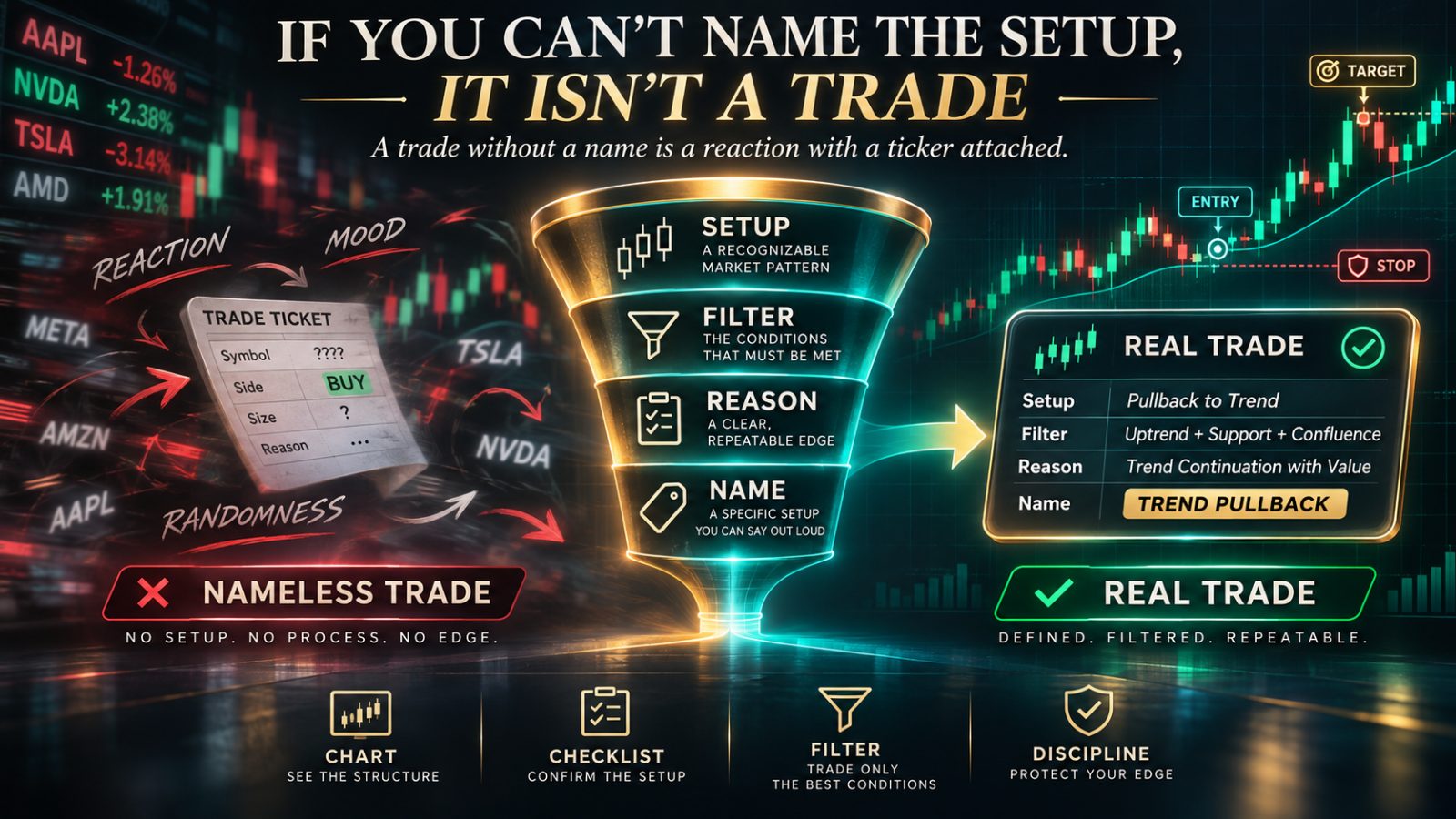
A trade without a name is a reaction with a ticker attached.
Ask a trader what they just took and listen to the answer. If it comes back as "it was running" or "I liked the tape" or "it felt like it wanted to go," you are not listening to a trade. You are listening to a mood that borrowed a shortcut key. The position is real. The P&L will be real. But the decision that put the shares on the book didn't pass through any filter the trader could describe in a sentence.
That is what randomness looks like from the inside. It almost never feels random. It feels decisive, even fast, even sharp. It feels like reading the market. The problem is that a real read and a reaction share the same muscle memory. The click is identical. Only the name is missing.
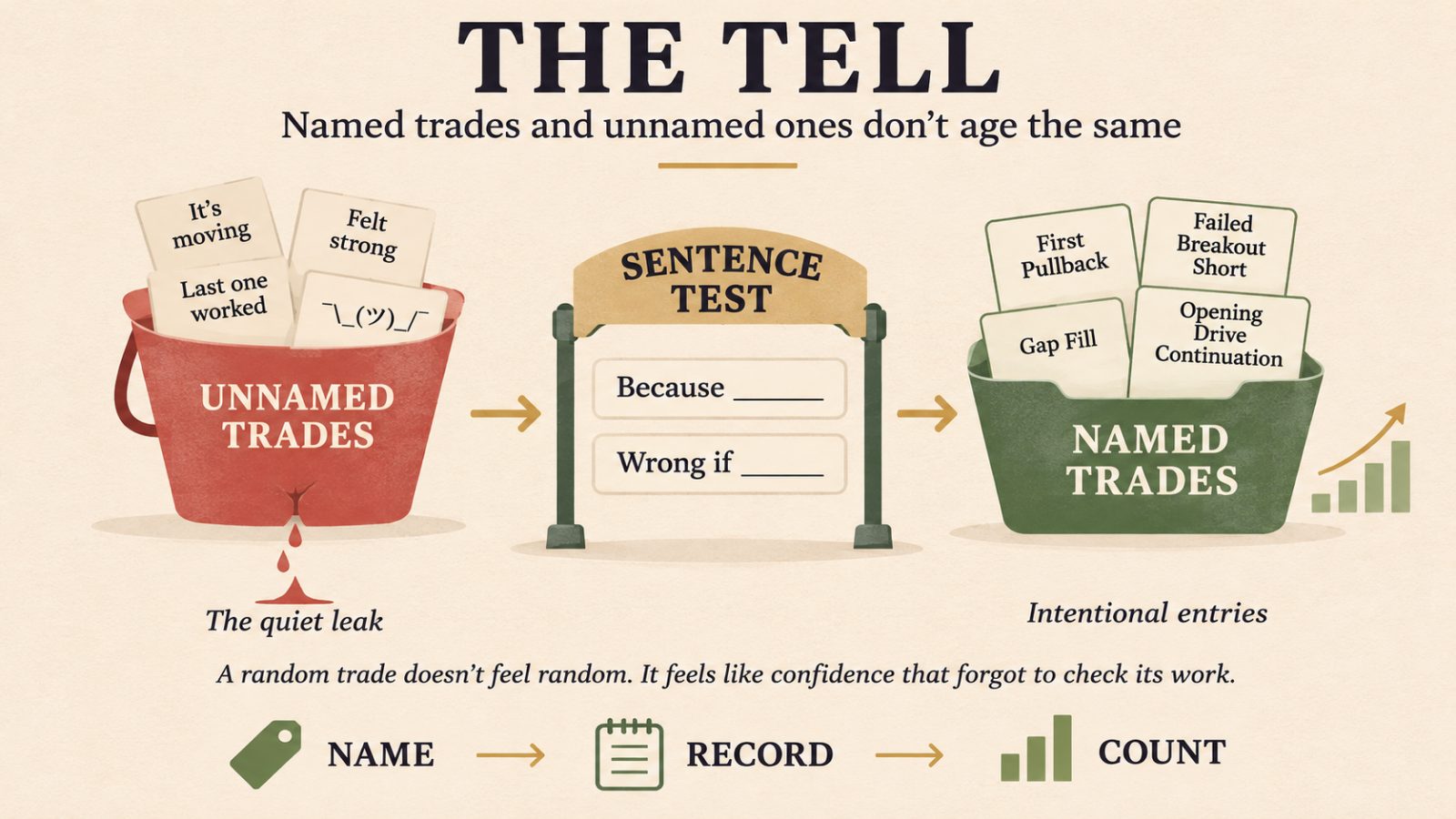
THE TELL
Named trades and unnamed ones don't age the same
Go back through a week of fills and try to label every entry. Not a story. A label. First pullback after a halt resume. Failed breakout short on the second push. Gap fill against premarket high. Opening drive continuation after a specific volume print. One phrase, the kind you'd use if another trader asked over your shoulder.
Some will label cleanly. Those are your trades. The ones you took on purpose. They tend to be your better statistics, sometimes by a lot, usually by enough to notice.
Then there will be a second pile. Trades where the honest label is a shrug. You saw it move. You were already on the name. You had size left. The last one worked so this one felt like it would too. That second pile is where the account bleeds, and it bleeds quietly, because no single entry in it looks catastrophic. It's a leak, not a hole.
WHY IT FEELS LIKE A DECISION
Pattern-matching is cheap. Filtering is expensive.
The brain is built to find shapes. Four years in, you can see a setup forming before your conscious mind has words for it. That is a real skill. It's also a trap, because the same machinery that finds the A+ pattern also finds the lookalike, and it fires both signals with roughly the same voltage.
A filter is the second step. The filter is the part that says close, but not quite. The filter costs effort. It costs the small ache of watching a move happen without you in it. Under fatigue, under drawdown, under the hum of a slow session, the filter is the first thing the brain quietly turns off.
A random trade doesn't feel like gambling. It feels like confidence that forgot to check its own work.
So the shape still gets seen. The click still happens. But the trade that gets taken is the shape without the filter, which is a different trade than the one that earned its place in your playbook. Same chart. Different trade. Different expectancy. The screen doesn't warn you.
THE FILTER
The sentence test
Before the click, out loud or in your head, finish this sentence: I am taking this because ___, and I'm wrong if ___.
Two blanks. If either one takes longer than three seconds to fill, the trade isn't ready. It might become ready in a minute. It might never be. But the position doesn't go on until both halves of that sentence exist.
- The because is the name. It matches something you've traded before, deliberately, enough times to have an opinion about.
- The wrong if is the invalidation. Not a mental stop. A price, or an event, that converts the thesis from alive to dead.
- If the because is it's moving, you are describing the market, not a setup. That isn't a reason. That's a weather report.
This is not a mindset exercise. It's a gate. You can take ten trades a day through that gate and you will still have fewer random trades than a trader who takes four without it.
THE TALLY
Randomness is only visible in the aggregate
Any single random trade can win. Half of them probably do, which is the exact reason they survive your attention. You remember the ones that paid. You forget the ones that cost a small bite and then another small bite and then a third while you were distracted by the one that worked.
The way to see randomness is not to catch yourself in the act. You almost never will. The way to see it is to count. At the end of the week, bucket every fill by name. Count the unnamed bucket. Measure its expectancy against the named one. The gap is the tax randomness is charging you to feel active.
Most traders who run that count once don't need to run it twice. The number is embarrassing enough to change behavior on its own, which is the whole point. You cannot willpower your way out of a habit you can't see. You can only out-see it, and then the willpower part gets easier.
WHAT ACTUALLY CHANGES THIS
A system that remembers what you took and why
Nobody fixes random trading by promising to focus harder tomorrow. The fix is structural. You need a loop that asks for the name before the click, records the name with the trade, and shows you the bucket you've been avoiding looking at. A loop that treats an unnamed entry the same way it treats a broken stop, as a flag, not a shrug.
That is what MAKETZO is built for. A trade intelligence layer that makes the setup name part of the entry, not an afterthought in a journal you'll fill out on Sunday if you feel like it. An accountability layer that sorts your week into the trades you meant to take and the ones you reacted into, and tells you the honest difference between them. A focus layer that catches the moment your filter starts to slip and asks, before the fill, whether the sentence is ready.
The goal isn't fewer trades for its own sake. The goal is that every trade on the sheet is one you'd defend by name. Start a MAKETZO trial and watch what happens the first week you stop letting the unnamed ones through.