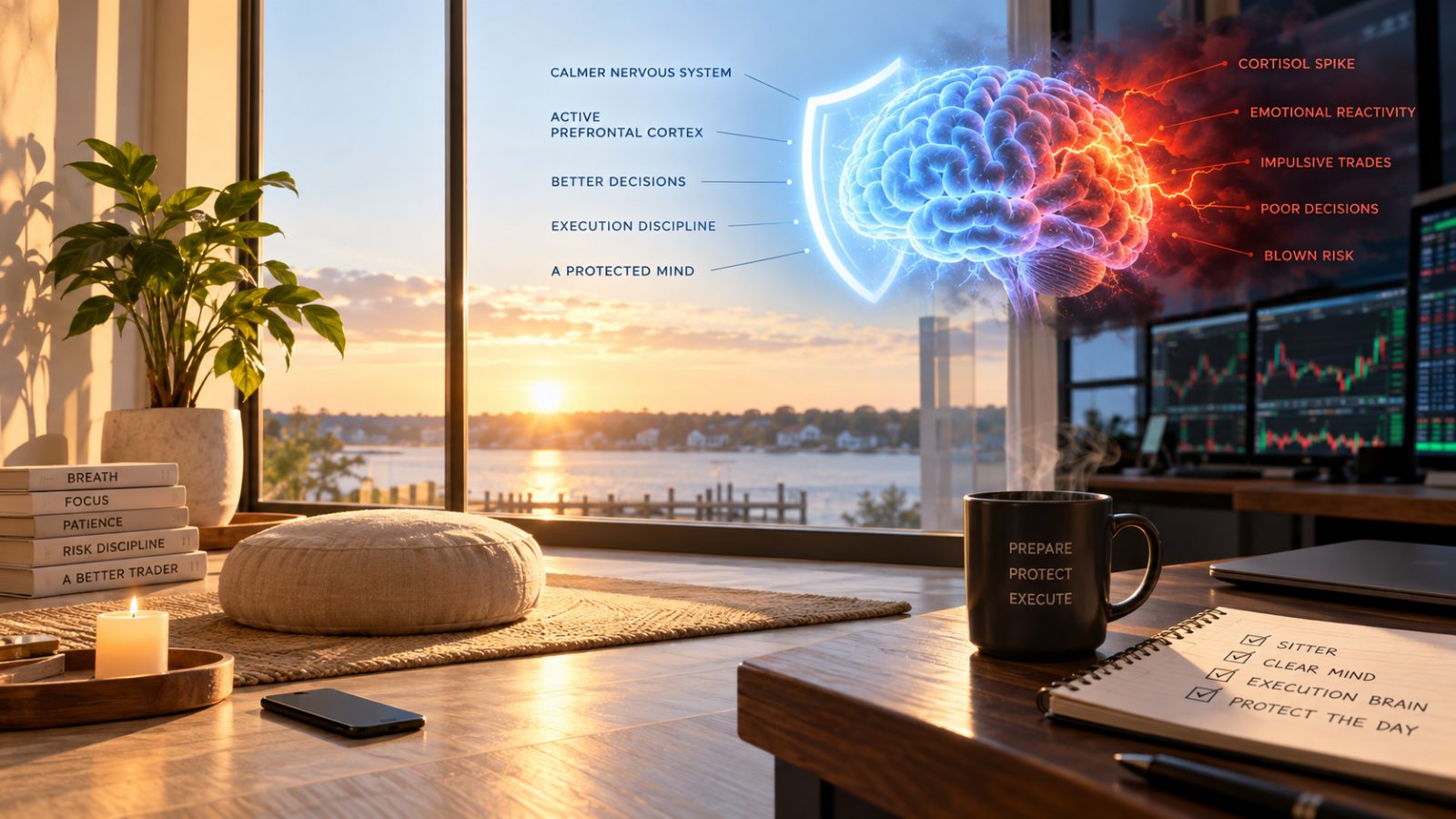
A trader sitting on the floor at 8:40 in the morning, eyes closed, phone face-down, isn't being spiritual. He's underwriting the next three hours. He's doing the only piece of risk management that happens before a single order ticket exists.
Most people around trading talk about meditation like it belongs on the same shelf as green juice and gratitude journaling. It doesn't. Meditation is a position you take in your own nervous system before the market gets a chance to take one for you. Everything else in your routine, the scanner, the levels, the premarket note, assumes a brain that still works at 10:08. The sit is what keeps that assumption true.
THE WELLNESS FRAME IS WRONG
You are not trying to feel better. You are trying to stay thinking.
The wellness framing of meditation sells you an outcome you don't actually need. Calm. Centeredness. Presence. Whatever. You are not meditating so that you feel good at the open. You are meditating so that at the third red trade of the morning, your decision-making brain is still physically available to you.
Because here is what nobody says out loud: by the time you are placing the make-back trade, you are not making a decision. You are reacting out of a body that has already decided. The hands move. The size doubles. The thesis is retrofit afterward in the journal. That isn't a discipline failure. That is a chemistry event.
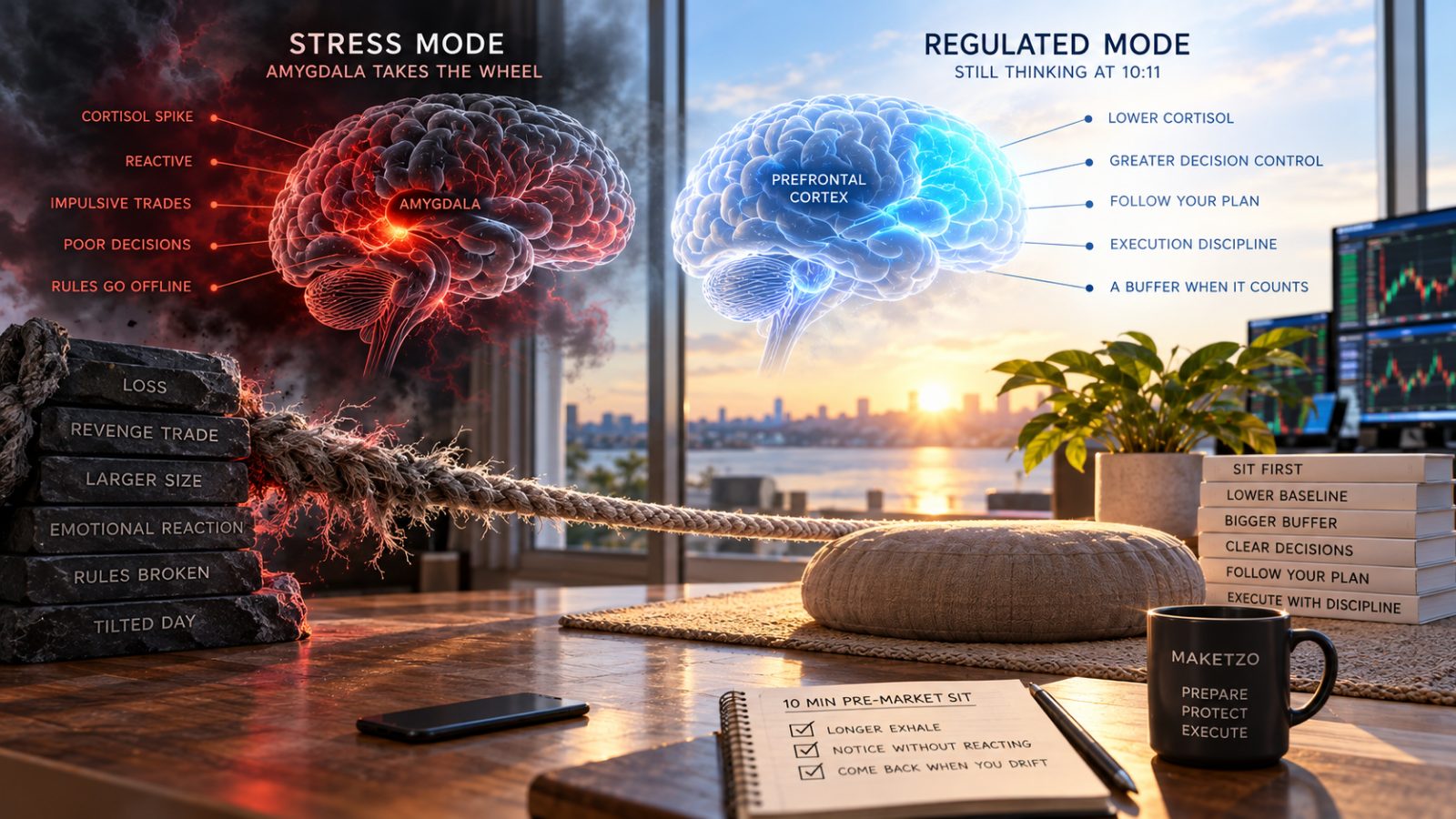
Cortisol and adrenaline do a very specific, very well-documented thing. Past a certain threshold of circulating stress hormone, the prefrontal cortex, the part of you that holds a plan, downshifts. The amygdala takes the wheel. You become faster, more reactive, more certain, and dramatically worse at anything that requires holding a rule in mind for longer than three seconds. You know this. You have felt it. You have watched yourself do it.
You cannot out-rule that state. You cannot out-journal it. You cannot out-affirmation it. You can only prevent it from arriving in the first place, or arrive at it with a lower baseline so the spike doesn't carry you over the edge.
THE SIT IS PRE-COMMITMENT
Ten quiet minutes is a trade you've already placed on yourself.
Pre-commitment is a thing economists understand better than traders do. Ulysses tied to the mast. The alarm clock across the room. The dessert you don't buy at the store because you know what you'll do with it at 10 PM. You cannot trust your 10 PM self, so your 7 PM self intervenes.
A pre-market sit is the same move. Your 8:40 self is calmer, slower, and more honest than your 10:11 self will be. Your 8:40 self can afford to breathe for ten minutes. Your 10:11 self cannot afford anything, which is exactly when it reaches for size it can't afford.
The calm trader doesn't make better decisions because he is centered. He makes them because his chemistry costs him less.
So the sit isn't a mood. It's a lowering of the water line. If your baseline nervous system is already two notches up when the bell rings, because you slept poorly, because you argued with someone, because the coffee hit wrong, because yesterday was red, the first loss carries you straight into reactive territory. If your baseline is two notches down, you have room. You have a buffer. That buffer is where your rules get to actually work.
WHAT THE PRACTICE ACTUALLY IS
You are training a specific physical skill, not a vibe.
The practice doesn't need to be exotic. It isn't a retreat. It isn't a cushion from Kyoto. It is three things, done daily, in whatever chair you already own:
- Lengthen the exhale past the inhale. This is the single most direct lever you have on your parasympathetic nervous system. Longer out than in, for a few minutes, measurably drops heart rate and cortisol. Your body treats it as a safety signal.
- Notice the breath without steering it. The point isn't to breathe correctly. The point is to practice the specific skill of observing your own state without immediately acting on it. That skill, that half-second gap between noticing and reacting, is the same skill you need at 10:11.
- Come back when you drift. You will drift. Every single sit. The returning is the rep. Not the staying. Nobody stays. The muscle you're building is the muscle of returning, which is identical to the muscle of coming back to your plan after a loss.
Ten minutes. Before the scanner. Before the news. Before the Discord. If you cannot find ten minutes, that is already the diagnosis. You are running the day as a reaction to inputs, which is the same way you'll run the open.
THE ROOM BEFORE THE ROOM
Infrastructure beats willpower. Every time.
Here is the honest problem with telling a trader to meditate: he agrees, nods, sets an alarm, does it twice, forgets on the third day because premarket got interesting, and now meditation is one more rule he's breaking. The practice becomes another line item on the stack of things he should be doing and isn't, which adds to the baseline stress load, which was the whole thing you were trying to lower.
This is why meditation has to be infrastructure, not discipline. It has to be a room you walk into, not a decision you make. The sit has to be as automatic as opening your trading platform. You don't deliberate about opening the platform. You just open it. That is the only form of a habit that survives a bad night's sleep and a tense Monday.
That is what the Focus Room is built for inside MAKETZO. The Meditation Zone is a sequence, not a suggestion. You walk in before premarket, you sit for the length that's been set, breath pacing is handled for you, and the system logs it against the day the way it logs every other piece of your preparation. Over time, the pattern surfaces: the days you sat first versus the days you skipped it, and what those days did to your execution. Not as motivation. As a mirror.
You stop having to decide whether today is a sit day. The infrastructure decided. Your prefrontal cortex, the one you'll need at 10:11, is grateful you built it.
If you have spent any amount of time wondering why your rules evaporate when the pressure arrives, the answer is probably not more rules. It is probably a lower baseline. A quieter morning. A nervous system that starts the day with room to absorb the first hit without reaching for the second. MAKETZO exists so that calm is a structure your platform holds for you, not a willpower project you lose by Wednesday.