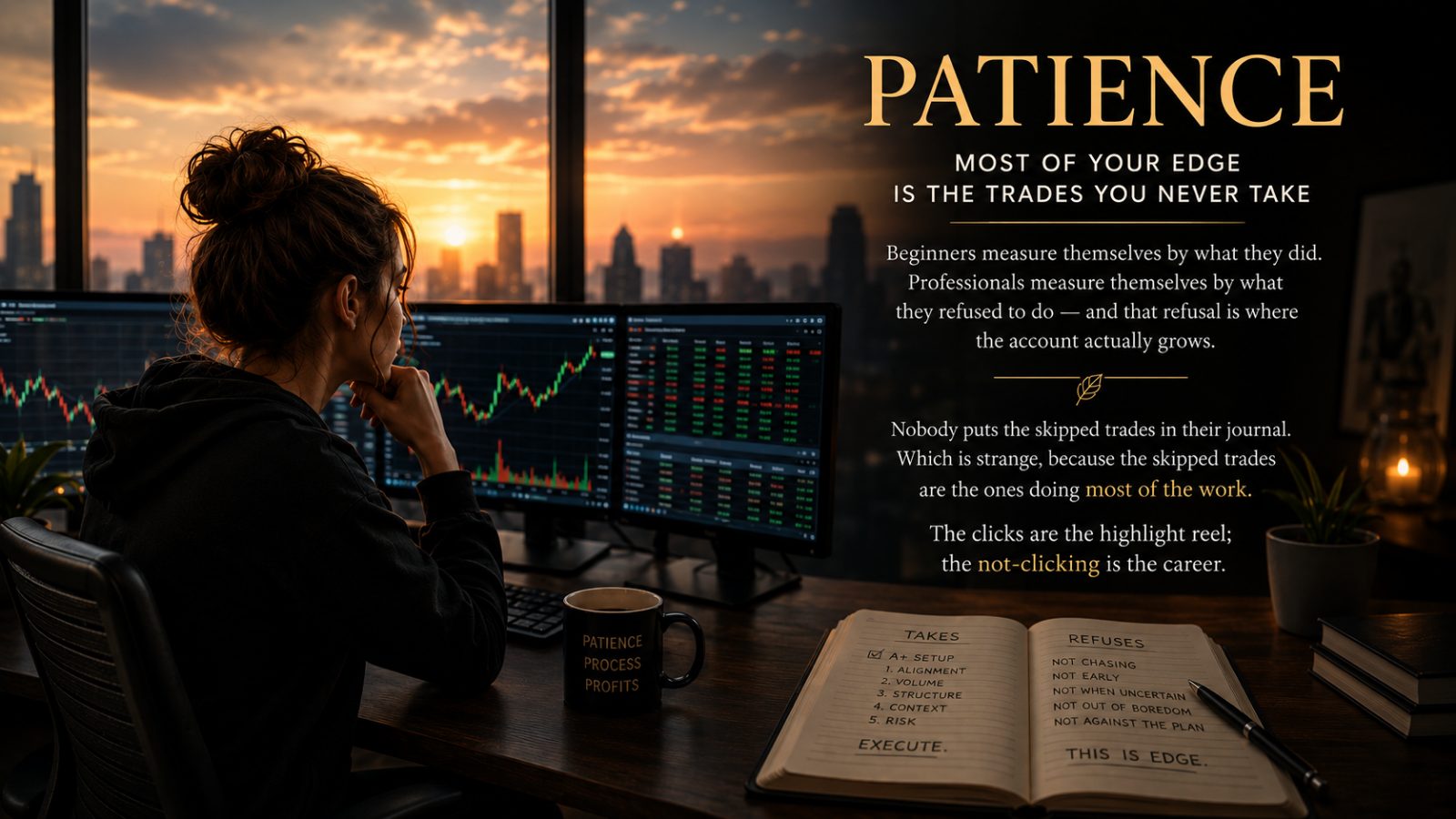
Nobody puts the skipped trades in their journal.
Which is strange, because the skipped trades are the ones doing most of the work. Every green account you've ever seen belongs to someone who is, right now, at their desk, not clicking. They are watching a setup form, watching it almost trigger, watching it fail — and doing nothing. That nothing is the job. The clicks are the highlight reel; the not-clicking is the career.
The problem is that nothing feels like nothing. It doesn't feel like work. It doesn't feel like edge. It feels like you're missing out, or being lazy, or wasting the morning. So the beginner fills the silence. And the account, quietly, drains into all the trades that were almost good enough.

WHAT YOU ACTUALLY GET PAID FOR
You are not paid per trade
A rookie thinks the job is to find trades. So they take trades. They take the A setup at 9:32, and then they take the B setup at 9:58 because it kind of rhymed with the A, and then they take a C setup at 10:22 because they're up on the day and feeling loose, and then they take a revenge trade at 10:41 because the C setup gave back half of the A.
By 11:00 they have four trades in the book and they are net red. The A setup — the one that actually worked — paid for the other three and then some. They didn't have a bad read on the market. They had a bad read on themselves. Their edge showed up at 9:32 and then they diluted it with three more trades that had no business existing.
Professionals invert this. They assume, going in, that the market will offer them one or two clean setups per session and everything else is noise dressed up as opportunity. If nothing shows, nothing gets taken. The P&L on a no-trade day is zero, and zero is a professional number. Zero is not failure. Zero is the default state you are choosing to leave only when the market gives you a reason.
The beginner's inversion
Watch a new trader's screen for an hour and you'll see the same pattern: they treat every candle as a decision. Should I buy this. Should I short this. Should I add. Should I trim. The market is asking them a question every fifteen seconds and they feel obligated to answer.
A professional's screen looks almost bored. They're waiting for one specific configuration — a float, a level, a time-of-day, a tape behavior — and until those things line up, the screen may as well be a painting. There is no decision to make because the setup they trade isn't on the tape yet. The market isn't asking them anything.
This is the switch that takes years, and it's the one nobody talks about because it's invisible. There's no course called How To Not Click. There's no YouTube video with a thumbnail of a guy pointing at nothing. But that skill — the skill of refusing 40 mediocre trades to preserve capital and clarity for the two good ones — is 80% of what separates the trader who's still here at year five from the one who quit at year two.
The market offers you one or two clean setups a session. Everything else is noise wearing the outfit of opportunity.
THE MARTIAL ARTS VERSION
White belts attack. Brown belts wait.
In jiu-jitsu, you can tell someone's rank by how much they move. White belts are a blur. Every second is an attempt at something — a grip, a sweep, a submission, a scramble. They think jiu-jitsu is a series of things you do to the other person.
Higher belts barely move. They set a frame, they get comfortable, and they wait for the other guy to hand them the position. When they do act, it's short and it's ugly and it works. The economy of motion isn't laziness. It's the recognition that every unnecessary action is an opening they've given the opponent for free.
Trading is the same sport. Every unnecessary click is an opening you've given the market. It costs you a spread, a piece of your attention, a slice of your emotional capital, and — this is the sneaky one — it costs you the clean read on your next trade because now you're not neutral anymore. You're up, or you're down, or you're annoyed, or you're trying to make something back. The A setup at 10:34 is going to be judged by a version of you who is no longer calm. That's the real cost of the throwaway trade at 9:52.
What selectivity actually feels like
Here is the part nobody warns you about: doing this correctly feels bad.
Selectivity does not feel like wisdom. It feels like boredom. It feels like your hands are itchy. It feels like everyone else on Twitter is posting green screenshots while you sat out the whole morning. It feels like you're not really a trader today, you're just a guy watching a screen. On the days you nail it — the days you skipped six mediocre setups and took the one clean one for a full R — you don't feel like a genius. You feel restless, because six-sevenths of your day was refusal.
This is why so few people actually run a selective book. Not because they don't know they should. They know. Every trader knows. They can quote the line about sitting on your hands. They just can't sit on their hands for four hours in a row while the market taunts them with almost-setups. The knowledge is there. The enactment is what breaks.
And the enactment breaks in a specific, repeatable way:
- You skip the first mediocre setup. Good.
- You skip the second. Still good, but now you're starting to feel like you're missing something.
- The third one you take, because three in a row felt like too many to pass on.
- The third one is the one that puts you red.
- Now the fourth, fifth, and sixth are no longer about the market. They're about the third.
You did not lose discipline on trade six. You lost it on trade three. The chain that ended your day started the moment you decided a setup was worth taking because you'd been patient long enough to deserve one. The market does not owe you a trade for good behavior.
You did not lose discipline on the sixth trade. You lost it on the third — the one you took because patience started to feel like punishment.
Building a system that rewards the skip
If your process only measures the trades you take, your process is telling you — every single day — that skipping is invisible. That doing nothing is not part of the job. Of course you overtrade. You're being graded on activity by your own tools.
A serious trader flips this. The skipped trade gets logged. The reason it was skipped gets logged. The version of the setup that would have qualified gets defined before the session, not rationalized after it. At the end of the week you can see, in black and white, that you refused 34 trades and took 6, and the 6 paid, and the 34 are the reason the 6 were clean. That's when patience stops feeling like punishment and starts feeling like a position you're already holding.
This is what MAKETZO is built to do. Not to give you more setups — you already see too many. To make the skipped trade visible, to hold you to the criteria you set before the bell, and to flag the moment your patience starts turning into permission. The goal isn't to help you trade more. It's to help you become the kind of trader whose account grows quietly, on the days nothing happened, because nothing was exactly what you were supposed to do.
Start there. See what a week of counted refusals looks like.