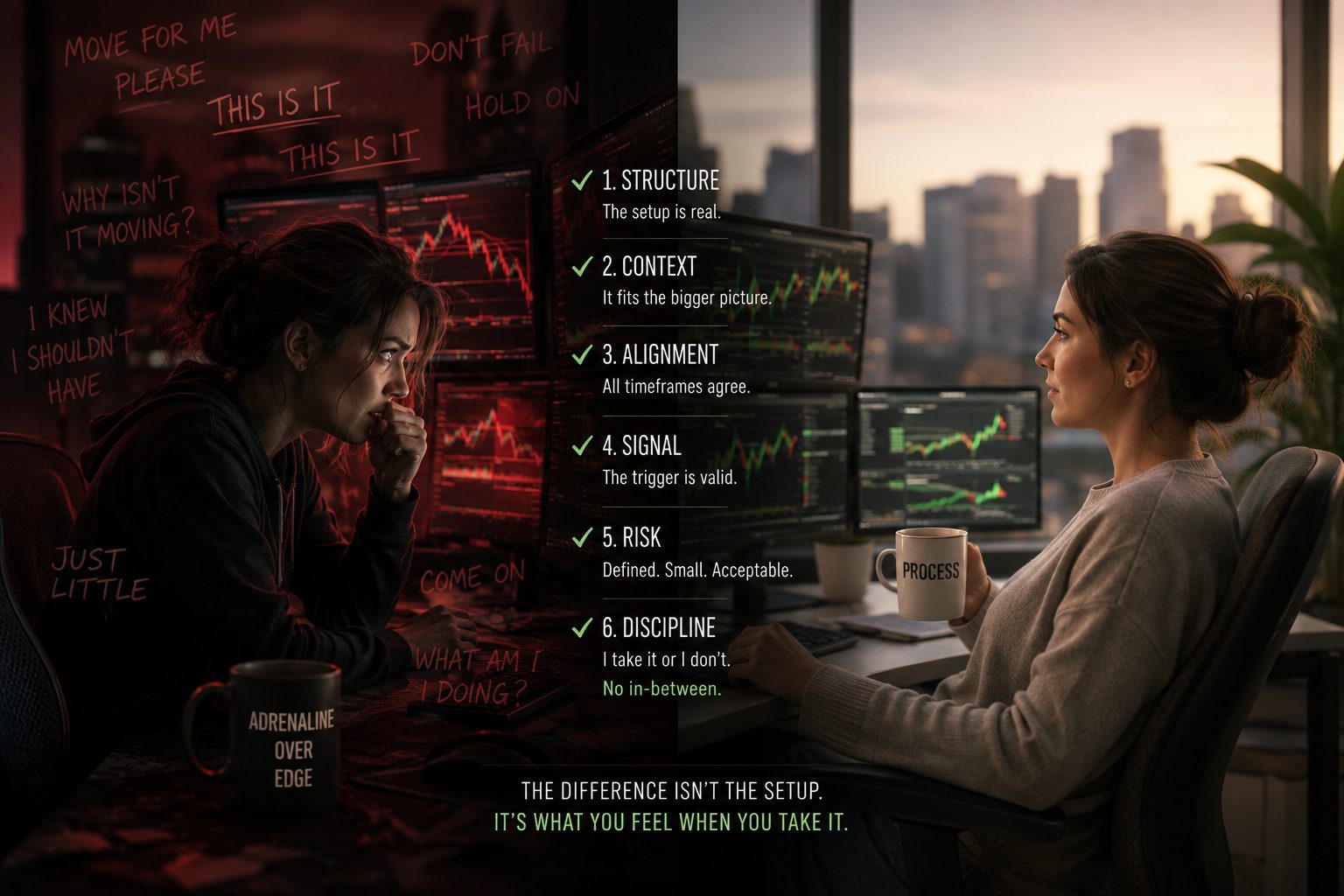
The entries you white-knuckle are the ones you should have skipped.
That's the whole thing. You already know which ones I mean. The trades where you're leaning into the screen, hand hovering, telling yourself this is it, this is it, and then you click and immediately you're negotiating with the position. Move for me. Please. Just a little.
Compare that to the entries you barely remember taking. You saw the thing, the thing was there, you clicked, you sat back. No adrenaline. No self-talk. The trade either worked or it didn't, and either way you weren't the one holding it up.
Those are two different animals. And most traders spend years trying to get better at the first one when the actual work is learning what makes the second one possible.
THE TELL
A clean entry is boring
That's the tell. If you feel like you're doing something brave, you're not entering — you're gambling on the possibility of an entry. The bravery is the signature of a bad setup dressed up as a good one. A real entry does not require courage. It requires that you be awake, present, and unattached enough to click when the conditions arrive.
The reason this matters is that most of the "psychology" problem in trading isn't psychology — it's forensics. You're feeling anxious inside the trade because you skipped steps before the trade. The fix is upstream.
THE STACK
Six things stacked behind the click
An entry that doesn't need defending has six things stacked behind it. Not five. Not seven. Six, in this order:
- The direction is not in question. You aren't guessing what side you're on. The day's tone, the sector, the name's own recent behavior — they point one way and you're aligned with them. If you have to squint to see the trend, there isn't one.
- Participation is real. The move has actual weight behind it. Not a print, not a wick, not a hopeful uptick. You can feel other people in the tape. If it's quiet, it's not your trade — it's a suggestion of a trade.
- The level exists for a reason. Prior high, prior low, gap fill, reclaim, breakdown retest — pick your language. What matters is that the price you're entering at means something to the other people in the name. A random price is a random click.
- Your risk is already defined. You know your invalidation before you click. Not "I'll see how it acts." If your stop is a feeling, you don't have a stop — you have a hope with a keyboard shortcut.
- The timing is the market's, not yours. You are entering when the setup completes, not when your patience runs out. These are different moments and they feel different in the body.
- You are the same person you were at the pre-market bell. Not tilted. Not chasing. Not down three and hunting for redemption. The version of you clicking the button is the version who wrote the plan.
Miss any one of these and the trade might still work. Miss two and you're inside a position that owes you nothing.
A real entry does not require courage. It requires that you be awake, present, and unattached enough to click when the conditions arrive.
THE LAYER NOBODY TEACHES
The sixth thing is the one that eats accounts
The first five are technical. Every book covers them. The sixth is the one that eats accounts.
You can have alignment, participation, structure, defined risk, and clean timing — and still enter badly. Because the person clicking is a different person than the one who wrote the rulebook. Tilted-you is not disciplined-you wearing a different shirt. Tilted-you is a whole other trader with worse instincts and no supervisor.
This is where most retail traders lose the game they think they're playing. They study setups for years, they can name every pattern, and they still hemorrhage capital, because setup identification is happening in one mental state and execution is happening in another. The signal is clean. The receiver is bent.
Tilted-you is not disciplined-you wearing a different shirt. Tilted-you is a whole other trader with worse instincts and no supervisor.
If you've ever taken a chart you'd normally pass on because you needed to feel active, you know what I mean. If you've ever cut a winner because you couldn't stand the discomfort of holding it, you know. The setup didn't fail. The state did.
THE CONFIRMATION TRAP
The uniform fear wears
One more thing about entries and then we can talk about what to do.
There's a version of "waiting for confirmation" that is discipline, and a version that is fear wearing discipline's uniform. The disciplined version waits for the setup to complete. The scared version waits for the move to already be happening, then chases the entry three ticks worse with a stop that's now too wide to make the math work.
If your confirmation is that the trade is already working, that's not confirmation. That's late.
The perfect entry is not the one taken at the perfect price. It is the one taken at the price your plan told you to take, in the state your plan requires you to be in. Everything else is variance you cannot control and shouldn't try to.
WHERE THIS LEAVES YOU
You already know the six things
You've known them for a while. The gap is not in the checklist — the gap is that nobody is standing next to you at the moment of the click asking if the sixth item is actually true right now, or whether you're about to enter a chart your calm self would have laughed at an hour ago.
That part has to live outside your head. Not because you're weak. Because everybody's judgment narrows under pressure and yours is no exception. You need an external record that tells you, in real time, whether the person about to click is the same person who wrote the plan. You need a system that flags the state, not just the setup. You need something between your finger and the button that isn't willpower — because willpower is exactly what's compromised when you need it most.
That's the whole reason MAKETZO exists. To hold the stack for you when you can't. To make the boring entry available on the days when your body is telling you to do something else.