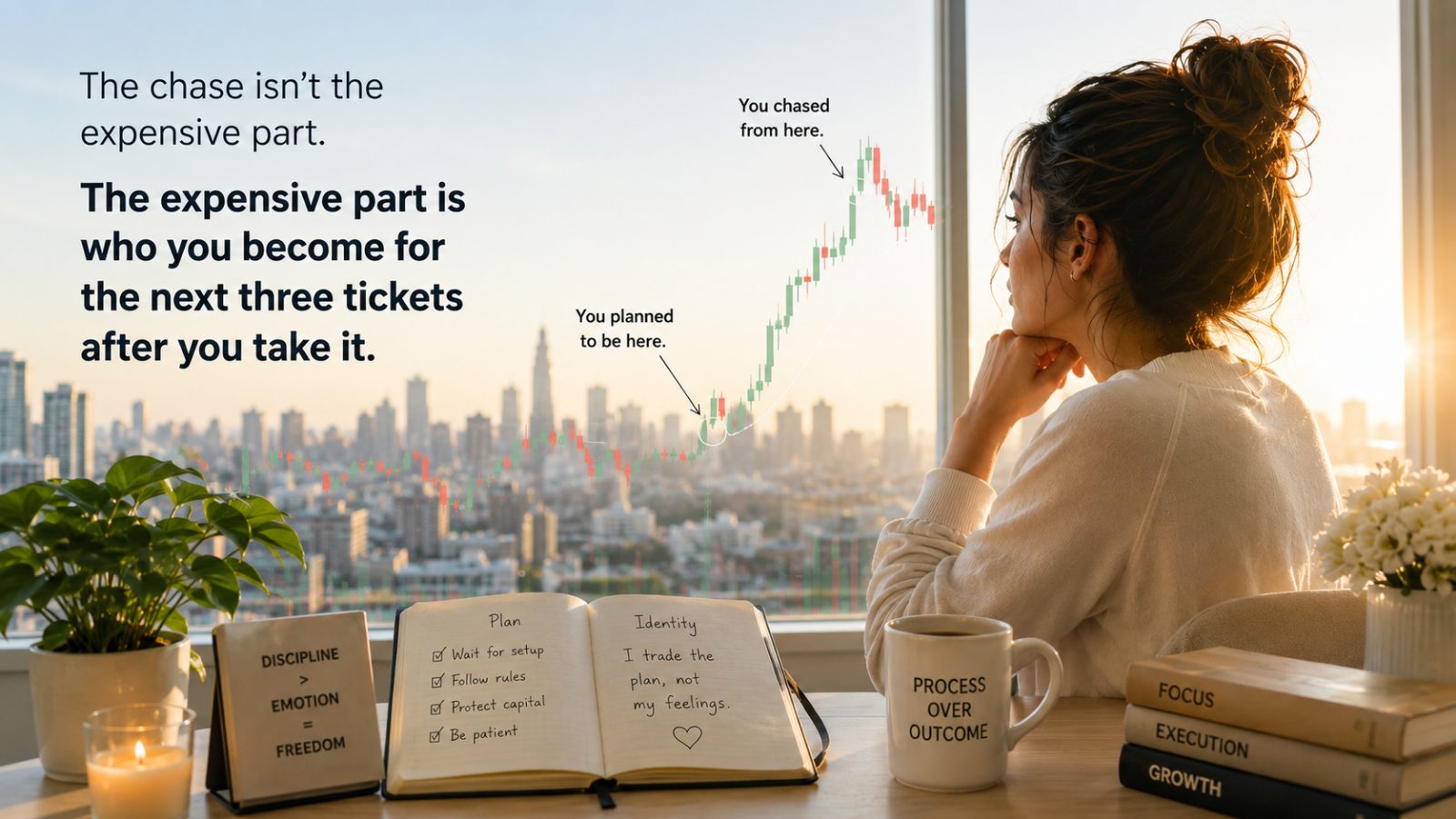
Nobody chases a stock they don't already wish they owned.
That's the part nobody says out loud. The move you jumped into at the wrong price wasn't a stranger to you. You'd watched it in premarket. You'd sized it in your head. You'd told yourself, quietly, that if it broke a certain level you'd be there. Then it broke the level while you were making coffee, or arguing with your risk plan, or waiting for one more confirmation. And by the time you clicked buy, you weren't entering a trade. You were paying admission to a party that had already peaked.
FOMO isn't a decision-making problem. It's a self-image problem wearing decision-making clothes. The trader you want to be caught that move. The trader you actually are didn't. Buying it late is how you close the gap between those two people.
THE STORY YOU WERE PROTECTING
The chase is a rescue operation
Every FOMO entry I've taken — and I've taken enough to pay serious tuition twice — has one thing in common. It wasn't rescuing money. It was rescuing an identity.
I'd watched the name on my second screen for forty minutes. I'd said out loud, to nobody, "if this holds the level." I'd said the words. And when it did exactly what I said it would do without me, something in me could not accept that the market had confirmed my read and then left me on the platform.
So I bought it eight percent higher. Not because the setup was still there. Because the setup being still there was the only story that let me keep being the trader who saw it early.
THE DELAYED BILL
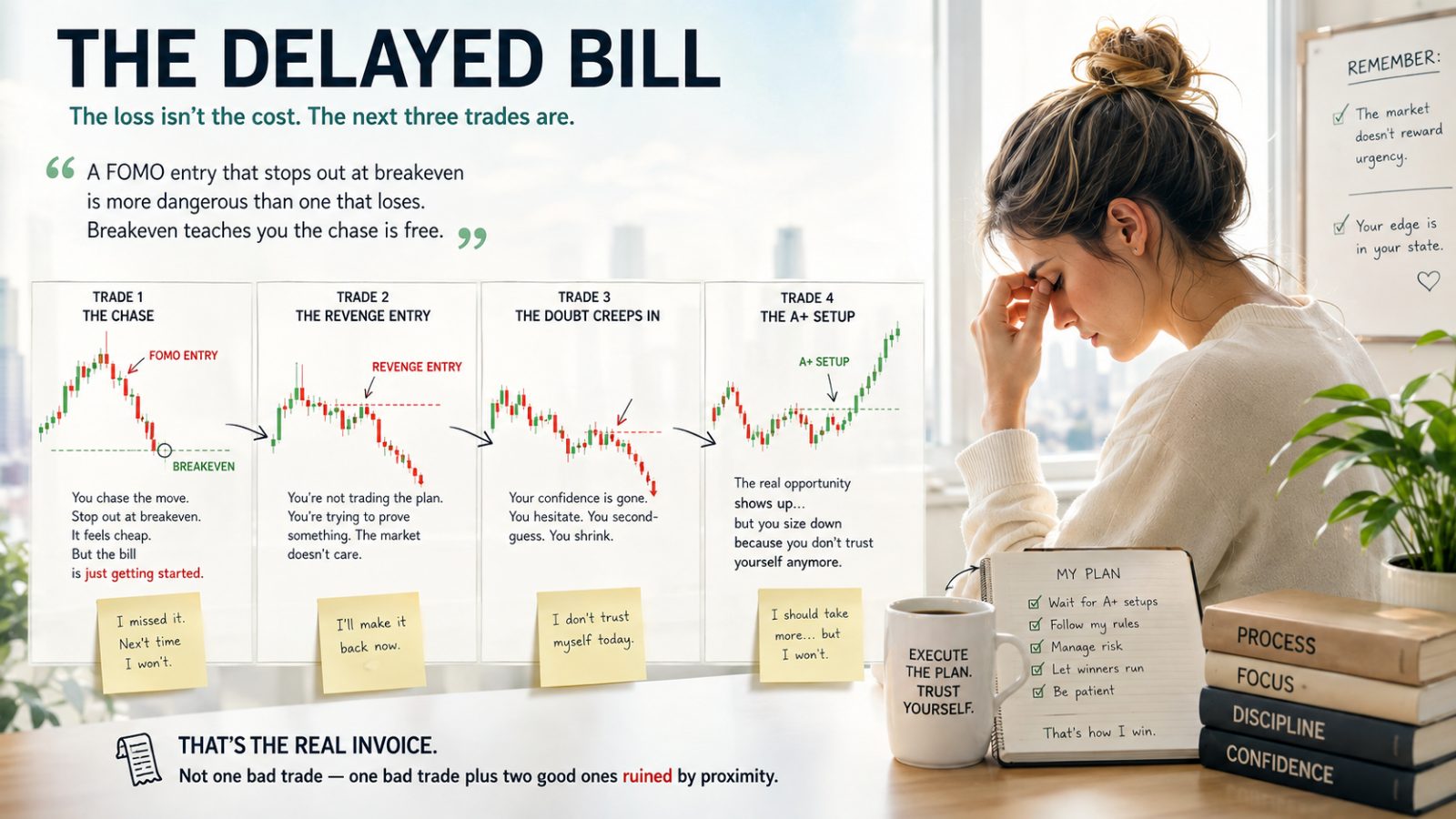
The loss isn't the cost. The next three trades are.
A FOMO entry that stops out at breakeven is more dangerous than one that loses. Breakeven teaches you the chase is free.
Here's the part I got wrong for two years. I thought the cost of FOMO was the red ticket. Buy at the top, stop out, minus whatever. Tuition, paid, next.
The actual bill shows up later.
Because the FOMO entry doesn't end when the position closes. It ends when your nervous system stops being the nervous system of a person who just chased. And that takes, in my experience, about three trades. During those three trades you are not the trader who wrote your plan. You are a slightly annoyed, slightly humiliated version who wants to prove something small and quiet to nobody in particular.
The chase costs you the chase. Then it costs you the revenge entry on the next name. Then it costs you the size-down on the actual A+ setup, because you're already red for the day and you don't trust yourself anymore. That's the real invoice. Not one bad trade — one bad trade plus two good ones ruined by proximity.
THE PATTERN
What the second blowup taught me that the first didn't
After the first account went, I built a list of rules. Don't chase. Wait for the pullback. Only enter at the base. The list didn't work because the list was solving the wrong problem. The list was for the trader who lost the money. The trader who chased the entry was a different animal — one who wasn't going to read the list at all.
The second account taught me the actual pattern:
- A setup I identified early runs without me.
- I feel a specific, physical thing — a tightness somewhere between my sternum and my throat.
- I convince myself the second leg is starting.
- I enter at a price I would have laughed at ninety seconds earlier.
Steps one and four are the ones the journal catches. Steps two and three are where the trade actually happened. If you don't catch the tightness in your chest, the fill on the ticket is just the receipt for a decision that was already made.
WHAT WORKS
Small habits that actually hold up
None of this is glamorous. The traders who don't chase aren't stronger. They just refuse to bid on a party that's already peaked. A short list, in order of how much they matter:
- Name the level before the bell. If you didn't identify the trigger price when your hands were still cold, you don't get to enter at it. This alone kills half of FOMO.
- If it left without you, it left without you. The next setup on that name is the pullback, not the continuation. You're allowed to wait for that. You're not allowed to invent it.
- Log the physical signal, not just the trade. Sternum, jaw, held breath, whatever your tell is. If your journal doesn't have a column for that, your journal is a P&L report, not a journal.
- After a chase, sit out three tickets. Not three minutes — three tickets. That is roughly how long it takes for your nervous system to become someone you can trust again.
- Read the setup out loud before entering. If you can't describe it in one sentence that doesn't contain the word "should," it isn't a setup. It's a wish.
The system the honest trader already wants
What I actually needed, both times, wasn't a rule. Rules I had. What I needed was something in the room with me that knew what my body was doing before my ticket did. Something that noticed I was hovering over a name I'd already missed. Something that made the three-ticket cool-off automatic instead of aspirational. Something that put the physical tell and the fill on the same page.
That's the system this post has been describing the whole time. Not a signal service, not another indicator, not a room that yells louder. A layer between the trader and the button — one that watches the trader, not the tape — and refuses to let the chase go unnoticed. That's the tool I wish had been in the room with me during both blowups. It's the tool MAKETZO is built to be.