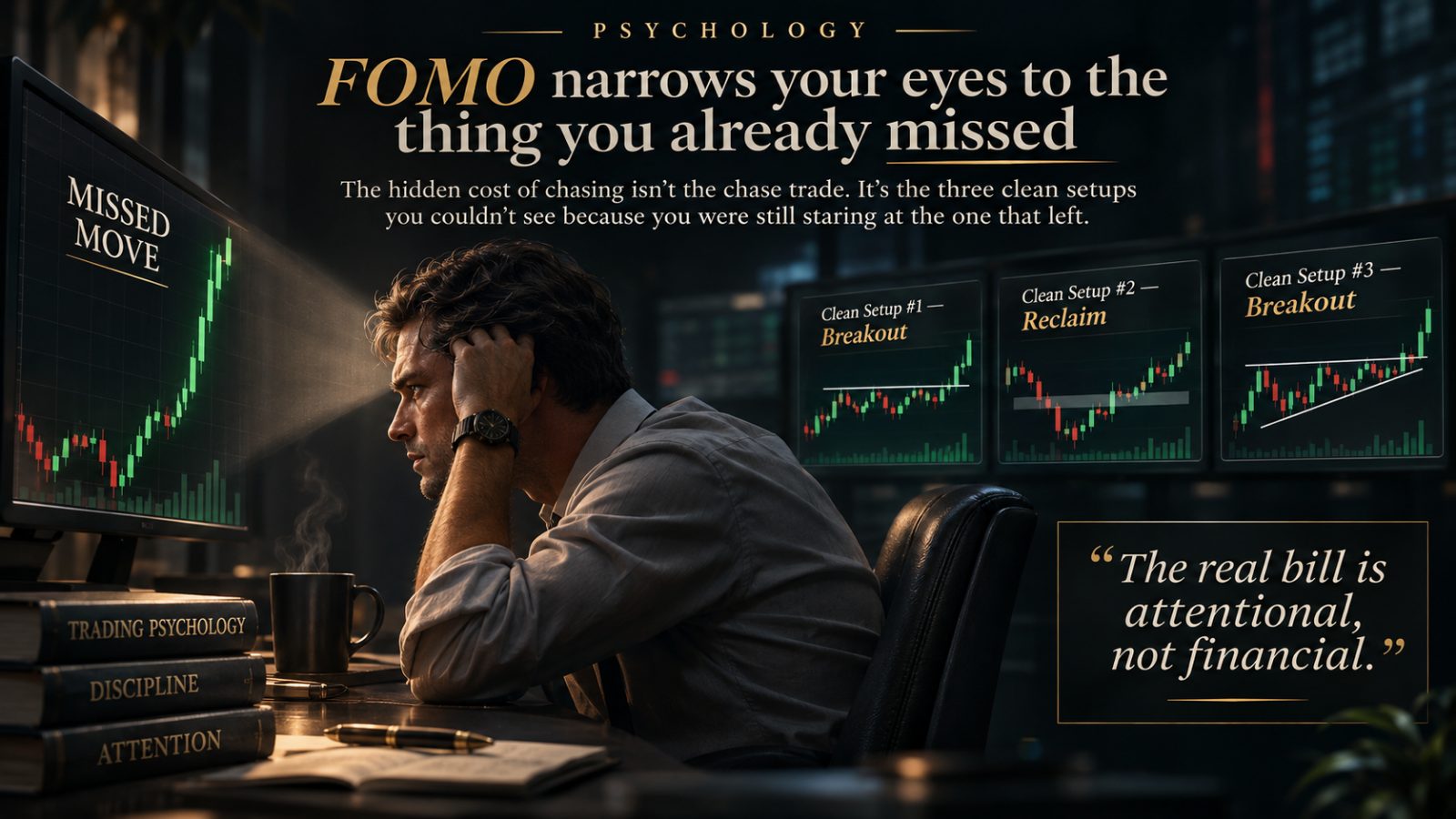
Nobody with FOMO is looking at the next setup. They are still staring at the one that left.
That is the whole post, in one sentence, and most traders will nod at it and then go back to doing exactly what the sentence describes. Because the common story about FOMO is that it costs you a bad entry on the thing that already ran. Chase the top. Get stopped. Move on. If that were the real bill, FOMO would be a rounding error. You take a small loss, you grieve for ten minutes, you reset.
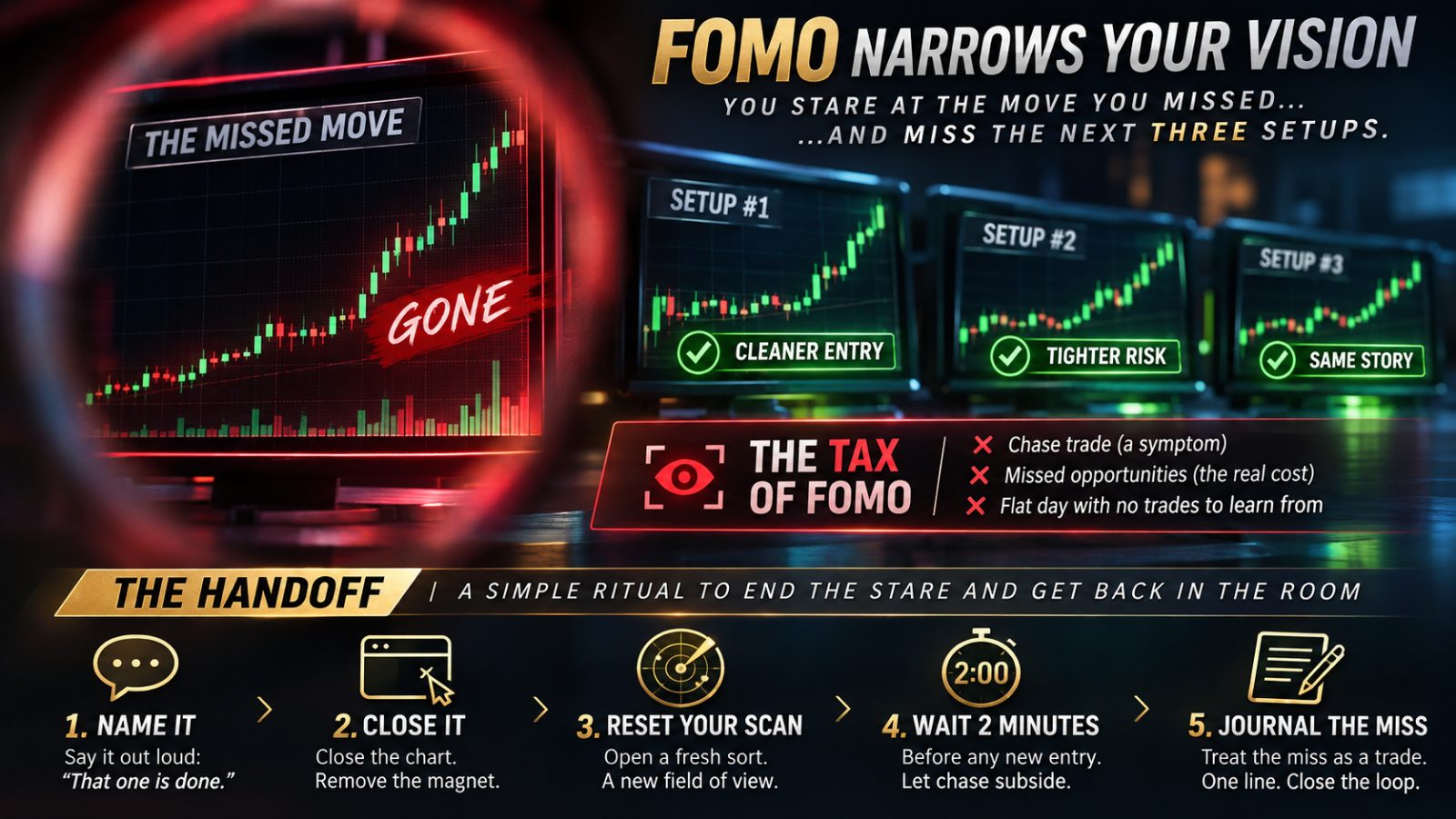
The real bill is attentional, not financial. FOMO narrows your field of vision to a single symbol you cannot trade anymore, and while your eyes are locked on that one chart, three cleaner setups walk past you unmarked. You do not miss them because they were unclear. You miss them because you were not in the room.
THE SETUP
The thing you missed is still on your screen
Small caps punish this specifically. The sector runs in packs. If a $4 float-rotator rips without you, there are usually two or three sympathy names that set up ten to twenty minutes later with a cleaner base, a tighter risk, and a story the first one already told the market. These are the trades you were supposedly waiting for. The ones you journaled about on Sunday as your actual edge.
You will not take them. Not because you don't see them on your scanner. You will see them. You will even say the ticker out loud. And then you will click back to the chart of the one that left, because your brain has decided that the open wound is more interesting than the open opportunity.
This is not weakness. This is a well-documented cognitive narrowing that happens under perceived loss. The missed move registers as a loss, even though no money moved. Your attention collapses around the source of the pain. Everything else in the room goes gray.
THE TAX
The chase trade is a symptom, not the disease
When traders talk about FOMO, they usually mean the one visible transaction. The late long. The fifty-cent chase. The stop at the exact wick. That trade is embarrassing enough that people write whole threads about it, and the embarrassment is useful because it leaves a mark you can learn from.
The expensive version of FOMO leaves no mark at all. There is no entry to review. There is no stop to critique. There is just the quiet, invisible absence of the three trades you should have been present for. Your journal shows nothing. Your P&L shows a flat day. And flat days where you were asleep at the wheel feel the same as flat days where you were sharp and selective, which is why the pattern lives for years without ever being named.
The missed move registers as a loss, even though no money moved. Your attention collapses around the source of the pain.
You can usually tell this happened to you by one tell. At the end of the session, you review the day's biggest movers and you say out loud, I would have taken that if I had seen it. You did see it. You scrolled past it. Your eyes were elsewhere.
THE THOUGHT LOOP
What the inside of this sounds like
If you record your own self-talk in the twenty minutes after a move you missed, you will hear some version of this on loop:
- It is already up 40 percent, there is no way I am chasing, but let me just watch it.
- If it pulls back to the half-dollar I will take a starter, just to be in it.
- I knew about this one at 7, I had it on the sheet, how did I not click.
- The next one that looks like this, I am taking without hesitation.
Every one of those sentences sounds like a plan. None of them are. They are the sound of your attention being held hostage by a trade that is already over. The sentence that would actually help you, the sentence that would turn the day around, is the one you are not saying: that is gone, show me what is next.
Professionals do not say that sentence because they are more disciplined. They say it because they have practiced the handoff until it is a reflex. The missed move gets acknowledged, named, and closed out as a complete event. Then the eyes move.
THE HANDOFF
How to end the hostage situation
You cannot talk yourself out of attentional narrowing in real time. The nervous system is faster than the self-lecture. What you can do is install a small ritual that fires the moment you notice you missed a mover, and that ritual has to be physical enough to interrupt the stare.
Here is a checklist that works for most traders. It is boring on purpose. Boring is what beats the stare.
- Name it out loud. Say the ticker and the words, that one is done. Not in your head. Out loud. The vocal cords are the interrupt.
- Close the chart. Not minimize. Close. If you need to review it in the post-market, you can pull it up then. During the session it is a magnet and you are made of iron.
- Open your scanner on a fresh sort. Not the leaderboard that still has the mover at the top. A different sort, a different window, a different field of view.
- Set a two-minute timer before any new entry. If a sympathy setup appears, you have to wait two minutes before clicking. Two minutes is long enough for your heart rate to drop out of chase range and short enough that a real setup will still be there.
- Journal the miss as a complete trade. One line. Saw it, did not take it, here is why. The miss is the trade. Treating it as a trade is what closes the loop.
None of this requires willpower. All of it requires that you decided, in a quiet moment before the open, that this is what you would do when it happened. Because it will happen. It happens most days.
The system you have been describing to yourself
If you read this and recognized the pattern, you already know what you need. You need something outside your own head that notices when your attention has collapsed around a chart you cannot trade anymore, and that nudges you back into the room before the next three setups walk past.
That is what MAKETZO is built to be. A behavioral layer that tracks what your eyes and clicks actually do during the session, flags the narrowing before it costs you the next clean entry, and keeps the handoff ritual from becoming something you only remember on the drive home. The gap between knowing this pattern and interrupting it in real time is where the account quietly bleeds. Closing that gap is the whole product.