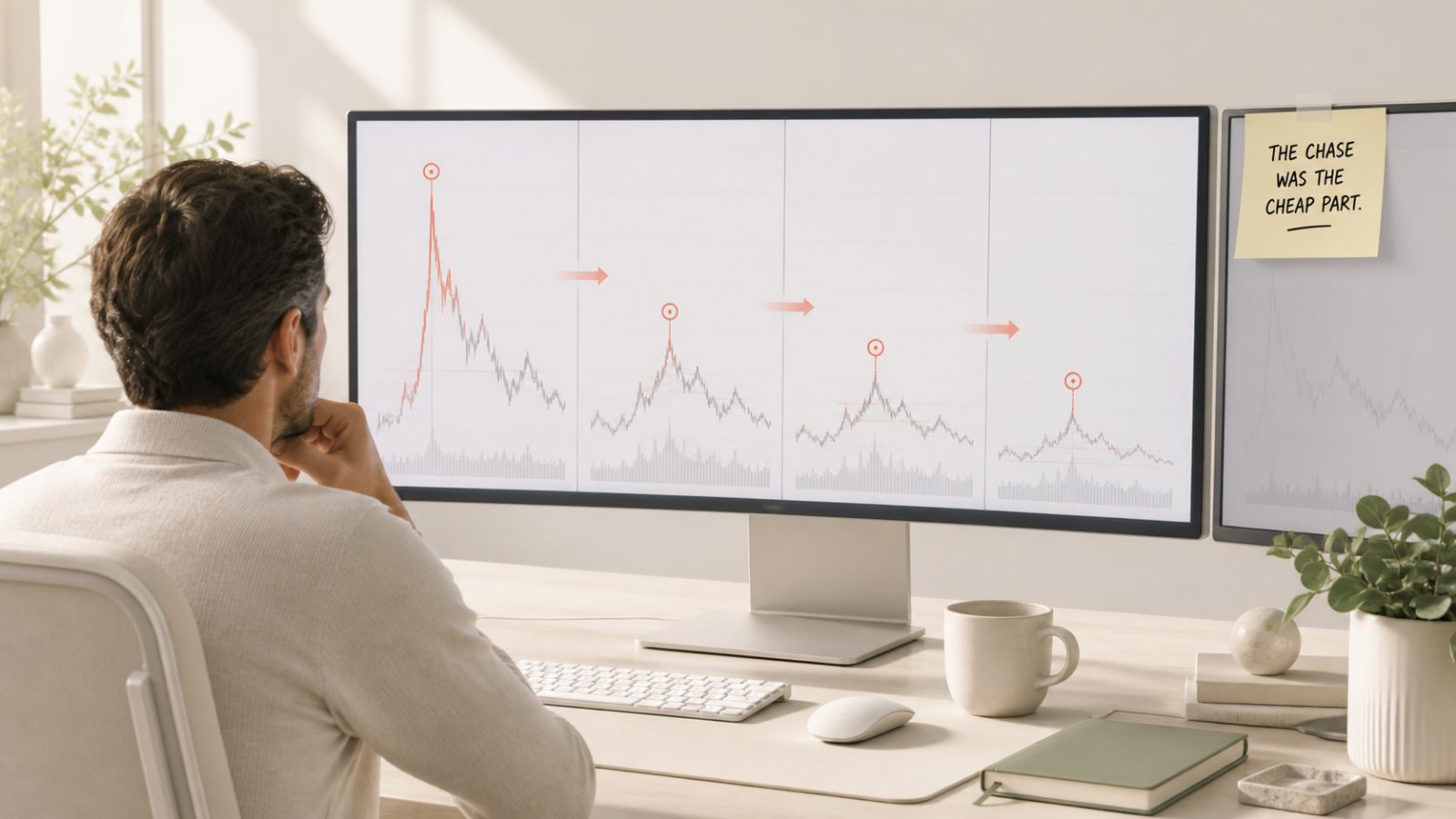
A trader I sit next to keeps a sticky note above his second monitor. It says: the chase was the cheap part.
He wrote it after a Tuesday where he paid up late on a small-cap runner, took the ninety-cent haircut, and then, over the next fifty minutes, proceeded to give back four times that amount on setups that had nothing to do with the ticker he'd chased. He wasn't revenge trading. He wasn't tilted in the loud way. He was just a slightly worse version of himself, making slightly worse decisions, on setups he'd normally pass.
That is what FOMO actually costs. Not the entry. The entries after the entry.
THE CHASE
The move you saw was already the move
Small-cap momentum has a specific FOMO signature. A low-float name gaps, holds, and breaks over premarket high. You see it on the scanner ten cents into the move. You debate. You resize the position twice in your head. You watch it print another forty cents while you're doing math. Then, at exactly the wrong moment, the moment your discomfort with missing crosses your discomfort with paying up, you click.
You didn't take a trade. You took a feeling. The trade was somebody else's, twenty minutes ago, at a level you're never going to see again on that name.
Every trader knows this. Nobody I've ever met has needed the concept explained. The problem was never that you didn't know chasing was expensive. The problem is what chasing does to the version of you who has to sit down and trade the next setup.
THE TAX
The bill arrives two trades later
Here's the part that doesn't get talked about, because it's harder to see than the P&L line on the chase itself.
When you enter late and get flushed, three things happen inside you at once, and none of them show up on the platform:
- Your baseline for "acceptable risk" recalibrates upward, because you just took a bigger loss than you planned, and now smaller losses feel like nothing.
- Your patience budget for the next setup drops to zero. You'll take a B-grade entry to feel productive again.
- Your relationship with the ticker changes. You start hate-watching it, waiting to be right about the top you didn't sell.
Two setups later, you're sizing bigger on a worse chart, holding through the level you would've cut at on Monday, and monitoring the original runner in a second window like a jilted ex. None of that is one decision. It's a cascade of micro-decisions made by someone whose nervous system is still processing the last one.
You didn't lose the money chasing the runner. You lost it trying to prove chasing wasn't the mistake.
This is why FOMO is a compounding cost, not a point-of-sale cost. The chase is the sticker price. The tax is everything the chase makes you do for the next hour.
THE PATTERN
The three thoughts that show up every time
If you audit your own head during a chase, and I'd argue this is the single most useful thing a small-cap trader can journal, you'll notice the same three sentences show up in roughly the same order:
- "It's still going." This one is descriptive and feels harmless. It's the anesthesia. It gets you to stop asking whether the setup is any good and start asking only whether the tape is still green.
- "I'll size smaller to make it okay." This one feels responsible. It isn't. Smaller size on a bad entry is still a bad entry, you just made the loss cheaper, not smarter. You've bought permission, not an edge.
- "I just need one to work." This one is the tell. The moment "one" enters your vocabulary, you're no longer trading a plan; you're trading an outcome. That's the sentence that funds the next three losses.
None of those sentences are stupid. They're all coping. The job isn't to stop having them, it's to notice which one you're inside of before you route the order.
THE FIX
What the traders who don't chase actually do
I've watched a lot of consistent small-cap traders up close. None of them have willpower I don't have. What they have is friction, deliberate, pre-built friction between the feeling of missing and the click that resolves it.
The specific mechanisms vary. Some pre-write the levels they'll take a name at and refuse to touch it above those levels, full stop. Some have a rule that any entry more than a defined distance from the trigger requires a verbal justification, out loud, to a partner or a recorder. Some simply close the scanner for a fixed cool-down window after a missed move, because they know their own eyes are the accelerant.
What all of them share is this: they don't fight FOMO in the moment. They've already lost that fight and they know it. They fight it before the bell, by making the chase either impossible or expensive enough that the feeling has to route around a rule instead of through their trigger finger.
CHECKLIST
Five questions, before the click, on any late entry
- Would I take this exact entry if the last twenty minutes hadn't happened?
- Am I sizing to the setup, or sizing to make the missed move feel less bad?
- What is the specific level where I'm wrong, and is it a level I would have respected an hour ago?
- If this fills and immediately goes against me, what am I likely to do next, cut clean, or double down to be right?
- Have I said the word "just" in my head in the last minute? ("Just a starter," "just to be in it," "just one that works.")
Any single "no" on 1–3, or any "double down" on 4, or any "yes" on 5, and the trade is not the trade. The trade is the feeling. Skip it, and go find the next setup that lets you be a trader instead of a fan of a ticker.
The system you already wish you had
What you're describing in your head, a way to notice which thought you're inside of, a friction layer between the missed move and the late click, a record of what the chase actually cost you across the next three trades and not just the one, that's a behavioral system. It's the layer between the chart and the click, and no chart is ever going to give it to you, because the chart is not the problem.
MAKETZO is built for that layer. It watches how you're trading, not just what you're trading, and it names the pattern back to you in the minute you're inside of it, before the chase becomes the tax on the rest of your session. If any of the sentences in this post sounded like they came from inside your own head, you already know what to do next.