
Nobody gives back a losing day. You can't. There's nothing to give back.
The green-to-red day is a specific animal. It requires a lead. It requires that you were, at some point, correct — early enough that the day felt handled. And then it requires that you kept trading after the day was already won.
That last sentence is the whole post. But you already know that. So let's talk about why you did it anyway.
THE SHAPE OF IT
Every give-back looks the same from the outside
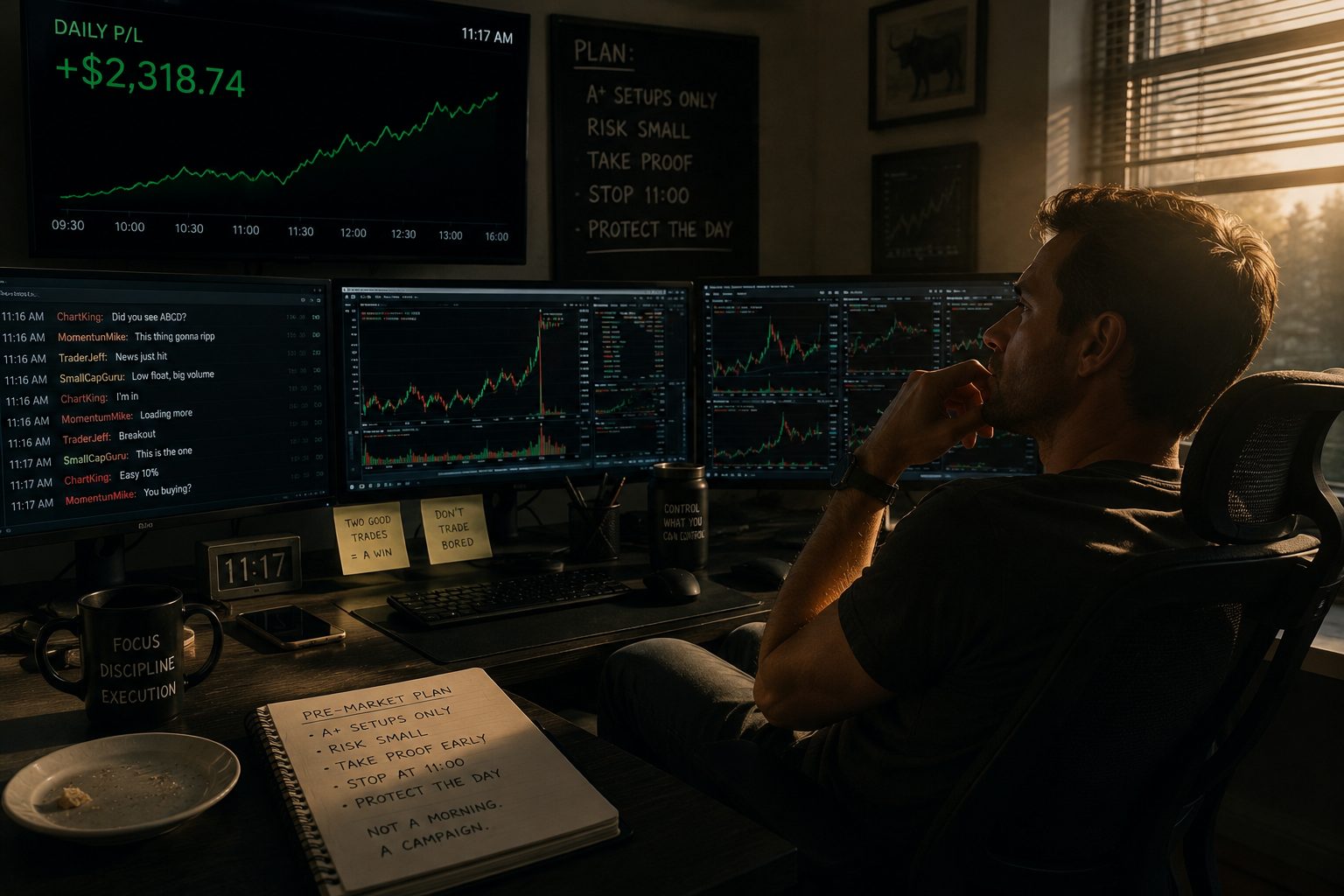
You take a clean setup in the first hour. It works. You're up a solid multiple of your average day. You sit back. You breathe. You think, briefly, about closing the platform.
You don't close the platform.
Instead you take a second trade — smaller, more marginal, a setup you'd have skipped on a flat morning. It chops you for a third of the gain. Fine. You take a third. The third one bleeds. Now you're annoyed, because a minute ago you were having a great day and now you're having a mediocre one, and the fastest way to fix a mediocre day is a fourth trade.
The fourth trade is where the account goes red. The fourth trade is never about the market. It's about the story you're telling yourself about the first trade.
THE MECHANISM
Confidence, greed, and fatigue are the same problem
Traders like to sort the give-back into causes. Was I greedy? Was I overconfident? Was I tired? Was I bored? The honest answer is usually yes to all four, and pretending they're separate is what lets the pattern keep working on you.
Here's what actually happens between the winning trade and the give-back trade:
- Your nervous system, which was locked in and slightly afraid at 9:45, is now flooded and slightly bored at 11:15.
- The number on the screen becomes the frame of reference, not the plan you wrote before the open.
- You start hunting. The screener, other tickers, a chatroom. You are looking for a reason to click.
- Every setup passes an easier bar now, because the money on the table feels like house money, and house money isn't real to you.
None of these are moral failures. They are what a human body does after a win. The market does not care that you feel handled. It will happily transact with a bored, flooded, slightly overconfident version of you all afternoon.
You didn't lose the day to the market. You lost it to the version of yourself that shows up after a good first hour.
THE MATH YOU'RE AVOIDING
Protection is not a mood. It's a rule you wrote when it was cheap to write.
Every trader I know has, at some point, said the sentence: I need to stop trading when I'm up. Almost none of them have written down what "up" means in a way their 11am self is obligated to respect.
The give-back is expensive because the rules are vague. "I'll stop when I have a good day" is not a rule. "I'll stop when I'm satisfied" is not a rule. Satisfaction is a feeling, and the feeling arrives late, usually one trade after you should have stopped.
What actually works, in the boring, unromantic way that things actually work:
- A number, written before the open, that ends the day. Not a hope. A hard line. If you hit 2x your average winning day in the first hour, you are done. The rest of the day is a threat, not an opportunity.
- A give-back ceiling. If you're up X and give back a third of it, you're done. The give-back stops when it's a haircut, not when it's a wound.
- A trade-count cap after a win. One more setup, max, and it has to clear a higher bar than the first one did. Not a lower bar. A higher one.
These rules are trivial to write on Sunday night. They are impossibly hard to invent on the fly at 11:20 when you're up and getting restless. That asymmetry — cheap in advance, expensive in the moment — is the entire argument for having a system that isn't you.
THE PART NOBODY WANTS TO HEAR
The green-to-red day is a tell about the rest of your process
If you give back a winning day, the problem is not the give-back. The give-back is the symptom. The problem is that your trading day has no defined end.
A trader with a defined end has a small number of setups they respect, a size that matches the setup, and a time or a P&L or a trade-count that closes the laptop. Everything else — the second-guess setups, the boredom trades, the "one more" — happens in the undefined space after the plan ended.
You are not undisciplined. You are operating without a shutoff. Those look identical from the outside and they are completely different problems. Undiscipline is a character issue. Missing a shutoff is a design issue. One of them takes a decade of therapy. The other takes an afternoon of writing rules and a system that enforces them when your judgment is compromised — which, on a green day, it is.
A green day is not a reward. It is the most dangerous state your account will be in all week.
WHAT ACTUALLY CHANGES IT
You need something that says stop when you can't
The reason the give-back keeps happening is not that you don't know better. You know better. You've known better for years. The reason it keeps happening is that the moment of decision — the click on trade four — happens in a body chemistry that will not, cannot, choose to stop.
You need a layer above yourself. Rules written when you were sober, enforced when you're flooded. A signal that flags when your behavior is diverging from the version of you that wrote the plan. A hard ceiling that closes the door before the second-guess setup becomes a full-size position.
That's what MAKETZO is built to be. Not motivation, not another journal to fill out, not a course on discipline. An operating layer that watches the shape of your day and tells you — plainly, unemotionally, before the fourth trade — that you already won, and the next click is not a trade, it's a give-back with a chart attached. If that's the layer you've been trying to build for yourself and failing, the free trial is downstairs.