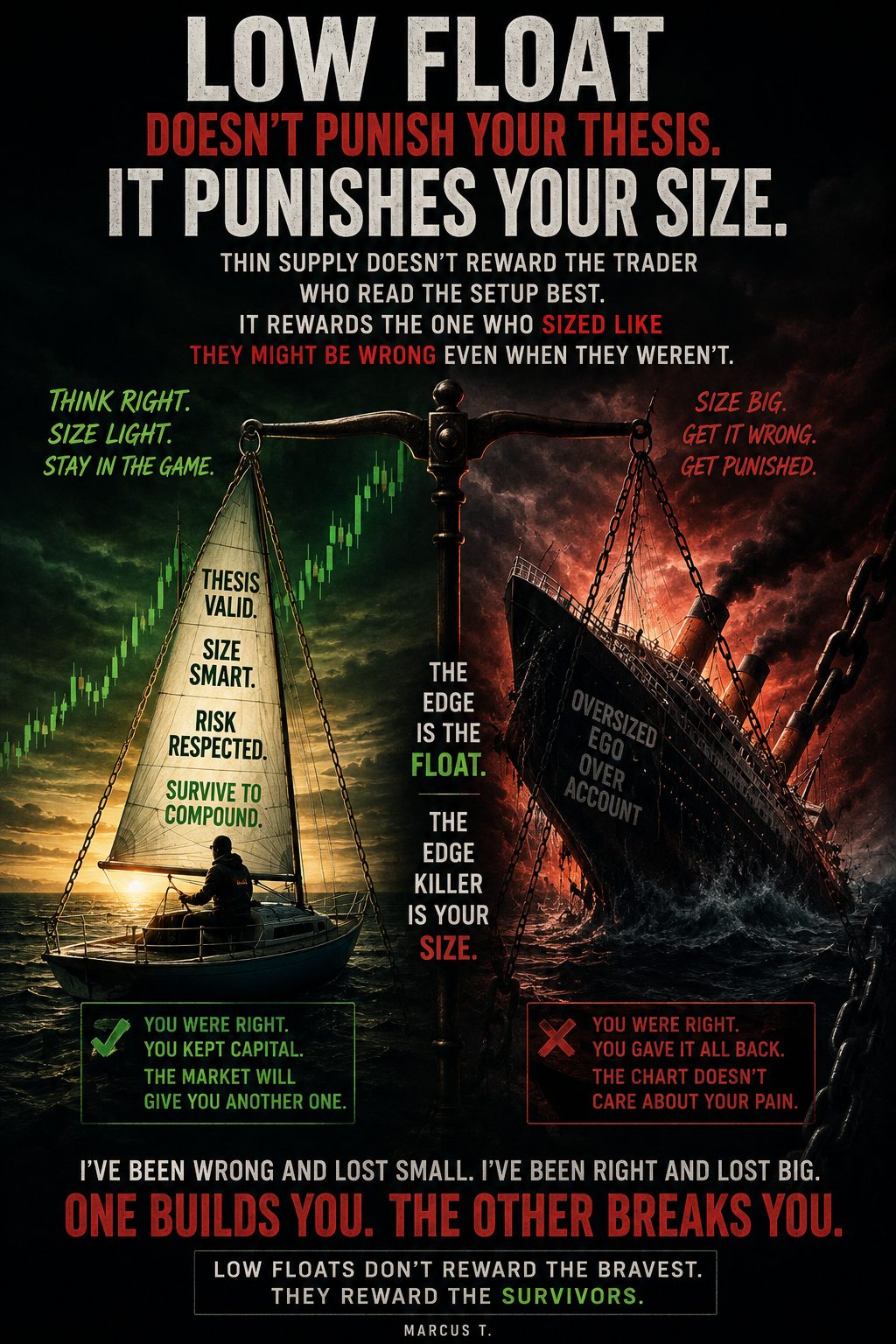
I've been wrong about a low float and stopped out clean. I've been right about a low float and given back a month. If you've traded small caps for more than a season you already know which one hurts more, and you already know why. You just haven't said it out loud yet.
The float is small. That's the whole edge and the whole trap. Everything else people write about low floats — the catalysts, the levels, the squeeze mechanics — is downstream of that one fact. A thin float doesn't reward analysis. It punishes size. Two different things. Most retail traders think they're the same thing, and that confusion is what empties the account.

WHAT THIN ACTUALLY MEANS
There is no one on the other side
When people say a stock is thin, they mean the book is empty. Between the price you see and the price the tape actually prints there is a stretch of nothing — no resting size, no patient sellers, no cushion. In a normal name your order lands in a pool. In a low float your order lands on concrete.
This is not a chart phenomenon. It's a physics phenomenon. Two hundred shares that would disappear into a large cap without moving the print will drag a low float twenty cents in a direction it wasn't going. And if you're the one placing the order, congratulations, you just paid twenty cents to nobody in particular for the privilege of being filled.
The squeeze that everyone romanticizes is the same physics running the other way. Supply has to come from somewhere, and if it isn't there, price has to travel until it finds a holder willing to part with it. That's not magic. That's just an auction with no participants, and the last bidder pays whatever the room asks.
THE FEELING
Being right feels like violence
Here is the part the textbooks skip. When you nail the setup on a thin name and it moves the way you called it, the first five minutes don't feel like validation. They feel like being strapped to something that is trying to shake you off. Green candles that print faster than you can process. A P&L that gains what took a whole week to earn in your normal book, in ninety seconds. Then a wick that erases half of it before your eyes finish tracking it.
The trade you were right about will still take money from you if you sized it like the trade you were sure about.
What happens next is the actual problem, and it is not a chart problem. You add. You add because the win is real and the fear of missing more of it is realer. You add at a price that would have looked insane to you thirty seconds ago. And now the position that was correctly sized when you entered is triple sized in an instrument where the tape moves in dollars, not cents.
Then the print you'd have shrugged off in a large cap — a routine pause, a two-minute consolidation — hits you like a stop out because your size made it one. You didn't lose on the thesis. You lost on the arithmetic. The two blowups I've had were both like this. Not the wrong stock. The wrong size on the right stock.
THE ONE VARIABLE
Size is the only lever you actually own
You do not control the float. You do not control the catalyst. You do not control who else has the same alert firing at the same second, or how many of them are three-times-normal-size right now for the same reason you're tempted to be. The list of things you don't control on a low float is the list of every reason it's moving.
What you control is one number. How many shares.
The trader who survives low floats treats that number as the entire trade. Not the entry, not the stop, not the exit plan — the share count. Because on a thin name the stop you drew on the chart is not the stop you'll actually get filled at. Slippage is not a rounding error there. It's the whole trade. If you sized as if your stop is a stop, you sized wrong. Size as if your stop is a suggestion the market may or may not honor, and suddenly the position that made sense on the chart doesn't make sense on the account.
- The right question isn't where's my stop. It's what's the worst fill I could get through my stop, and can I take that hit twice today without breaking?
- The right benchmark isn't dollar risk on a clean exit. It's dollar risk on a bad exit.
- The right time to decide size is before the alert fires, not while the first green candle is printing.
A low float is not a harder version of your normal trade. It is a different instrument that happens to look like your normal trade on the surface. Sizing it like your normal trade is the mistake. Not the entry. Not the read. The sizing.
WHAT SURVIVING LOOKS LIKE
The trade you can hold through the wick
The traders I know who make real money on thin names are almost boring about it. They size for the fill they'll actually get, not the one they hope for. They accept that they will leave money on the table on the ones they nail, because the ones they nail are the same shape as the ones that end careers, and you cannot tell which is which in the first ninety seconds.
You are not paid to be right on a low float. You are paid to still be here on Monday.
They also accept a thing that took me two blowups to accept: on a thin name, the wick you have to hold through is bigger than any reasonable person would draw on a chart. If you sized so that the reasonable wick stops you out, you will get stopped out by the unreasonable one every single time, and the unreasonable one is the one that resolves in your direction after it takes your shares.
The system underneath the discipline
Everything above is easy to write and hard to do at the moment your alert fires and the float is nine hundred thousand shares and someone in your chat is already up four figures. What retail traders actually need is not another explainer on float mechanics. They need something outside their own head telling them, in the second that matters, that the size they're about to enter does not match the instrument they're about to trade.
That is the exact gap MAKETZO is built for. A system that watches how you size against what you're trading, flags when your intended risk doesn't match the tape you're stepping into, and holds a mirror up to the pattern of your last twenty low-float trades before you place the twenty-first. Not analysis you already have. Enforcement you don't. If you've been the trader who was right and still gave it back, this is the layer that was missing.