A low float doesn't trade. It stampedes.
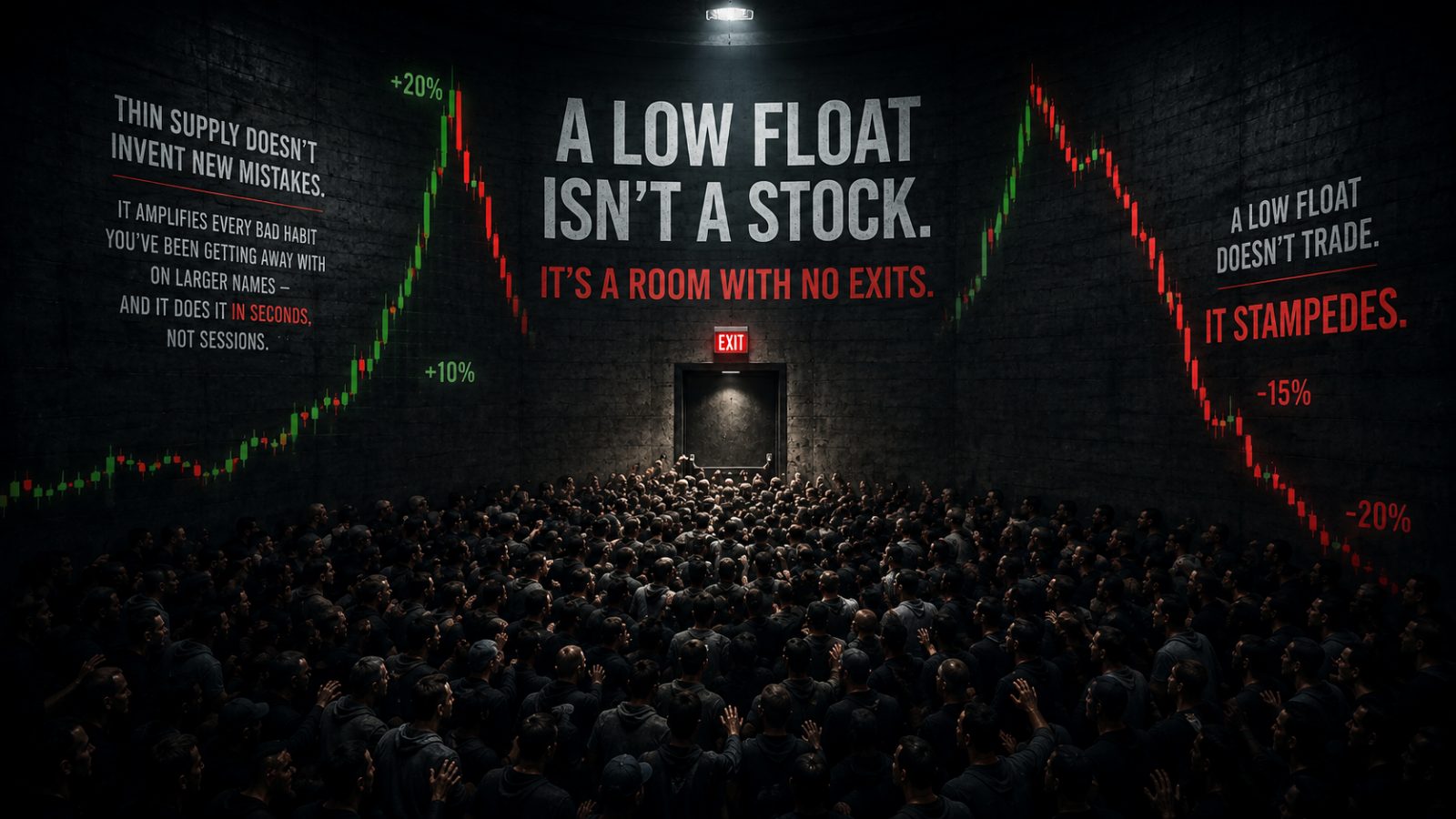
Everyone who has been in this game for more than a season knows the feeling. You're watching a name with three or four million real shares in float. Something catalyzes. The tape starts to breathe faster. Then it stops breathing altogether. Twenty percent in a candle. Fifteen back. Ten forward. You are not looking at price discovery. You are looking at a room with no exits, and a crowd trying to leave it at the same time.
The mistake most traders make with low floats is thinking of them as stocks that move faster. They don't. They move differently. Speed is a scalar. What a low float does to you is structural.
MECHANICS
Why the room is small
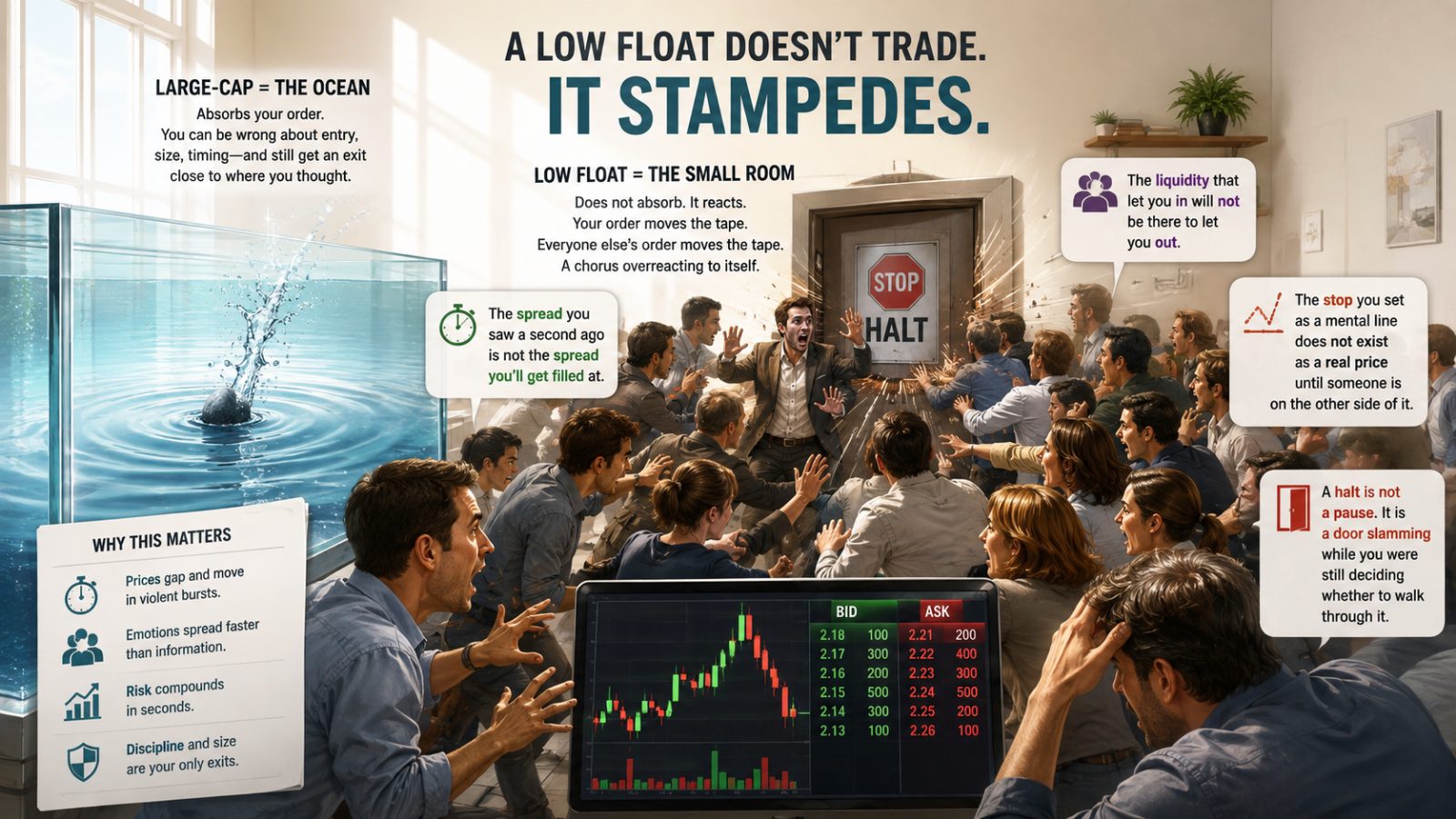
A large-cap absorbs your order the way an ocean absorbs a stone. You can be wrong about entry, wrong about size, wrong about timing, and the tape will forgive you enough to give you an exit at something close to where you thought you were.
A low float does not absorb. It reacts. Your order moves the tape. Everyone else's order moves the tape. In a name with real supply of a few million shares, the participants aren't trading against a market — they're trading against each other's reactions to each other's reactions. The tape becomes a chorus overreacting to itself.
This has practical consequences that every small-cap trader learns and then keeps forgetting:
- The spread you saw a second ago is not the spread you'll get filled at.
- The liquidity that let you in will not be there to let you out.
- The stop you set as a mental line does not exist as a real price until someone is on the other side of it.
- A halt is not a pause. It is a door slamming while you were still deciding whether to walk through it.
THE REAL DANGER
The float doesn't create your mistakes. It exposes them.
Here is the part nobody wants to hear. A low float isn't dangerous in the abstract. It's dangerous because it punishes, at high resolution and in real time, the exact habits you've been quietly getting away with on larger, more forgiving names.
Late entries. A large-cap will let you chase and give you a second chance. A four-million-share float will fill you at the top tick of the move and then remove the bid entirely.
Sized-up conviction. On liquid names, doubling up on a feeling costs you a manageable amount when you're wrong. On a thin name, the same emotional decision at the same emotional moment produces a loss that isn't proportional to your account — it's proportional to whoever else panicked at the same second.
Refusing to take a small loss because it's coming back. This is the habit that ends careers. On a large cap, it costs you a day. On a low float, it costs you the account, because there is no orderly path back to where you thought you'd get out.
A low float doesn't create new mistakes. It amplifies the ones you've been getting away with on names that were nice enough not to charge you for them.
Four years in, blown up twice, and both blowups happened in the same instrument category. Not because the category is evil. Because the category is honest. It bills you, in full and immediately, for every soft habit you'd been carrying.
THE SQUEEZE
Why squeezes feel personal
The reason squeezes rearrange traders — the reason people who have survived years of drawdowns still get destroyed inside them — is that a squeeze does not feel like a trade. It feels like being chosen.
Something happened to you, not by you. The move is bigger than your idea about it. That feeling — of being inside a thing that is larger than your reasoning — is the exact chemistry a discipline-broken trader is hunting on a red day. It's why the same setup that reads as a warning to a rested trader reads as an invitation to a frustrated one.
The float didn't change between those two readings. You did.
The trader who survives low floats is not the trader with the best entries. It's the trader who knows, before the day starts, which version of himself is at the desk — and whether that version has any business in a room this small.
WHAT ACTUALLY HELPS
You don't need a better watchlist
Most low-float education stops at the mechanics. Supply is thin, moves are violent, halts are risky, squeezes are dangerous. Fine. You knew that after your second week.
What none of that education addresses is the actual failure point, which is not information. It's the moment between recognizing a name is thin and clicking anyway. That moment is measured in seconds. Nothing you read the night before is going to reach you inside it.
What reaches you inside it is a system that already knows:
- What your last three sessions in this instrument category looked like.
- Whether you're on the kind of day where your good habits show up or the kind where they don't.
- Whether the setup in front of you resembles the ones you've historically executed cleanly, or the ones you've historically chased into halts.
- Whether the size you're about to type is proportional to the room you're about to enter.
You cannot self-diagnose this in real time. Nobody can. The interior noise of a live low-float move is louder than any pre-committed rule you brought with you. That is the entire problem. It's why traders who know better keep doing worse.
The room is small. Bring less of yourself into it.
The traders who make peace with low floats are not the ones who mastered the instrument. They are the ones who built a process that stands between them and the click when the room gets small and the exits close. A journal that sees patterns they can't. A checklist that fires before conviction does. A voice, external to their own head, that names what version of them showed up today.
That is not motivation. It is not mindset. It is infrastructure — the kind of accountability layer that exists specifically because willpower does not survive contact with a thin tape.
MAKETZO was built for exactly this gap: the distance between the trader you are when you're reading about low floats and the trader you become the second one starts moving. If that gap is where your account keeps bleeding, the trial is where to start.