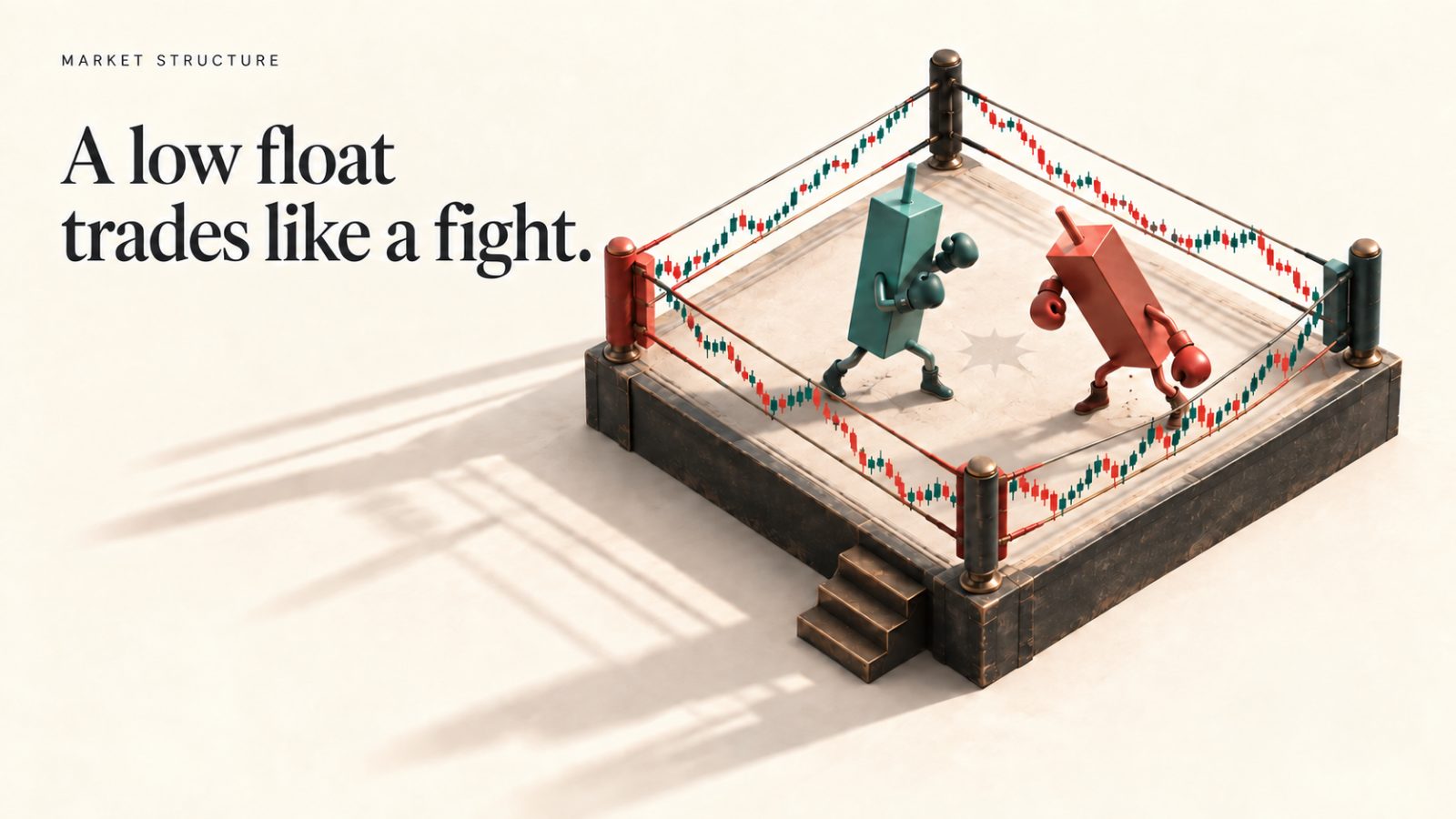
Ask any trader who's been folded in half by a low float what happened, and you'll get the same answer twice: it didn't move — it teleported. One second the tape was quiet. The next, you were down a dollar with no fill in between.
That gap between what you expected and what actually happened isn't a skill problem. It's a category error. You were trading a low float like it was a small version of a large cap. It is not. A low float is not a faster stock. It is a different animal in a different sport, and the rulebook that keeps you alive on liquid names will get you hurt here.
SUPPLY
Float is a leash length, not a size.
Float is the number of shares actually available to trade — public, unrestricted, not locked up by insiders or funds sitting on paper for years. When you hear "two million float," that is the whole pool. Not the pool per day. The whole pool.
Of those two million shares, on any given morning maybe a few hundred thousand are actually in the book at prices anyone will hit. The rest are held by people who are not selling to you at eleven-fifteen. They will sell higher. Or they will not sell at all until something breaks.
Now compare that to a large cap. Hundreds of millions of shares outstanding, a book so deep that a ten-thousand-share market order barely twitches the print. You can size wrong on a large cap and the market forgives you, because the market is fat enough to absorb your mistake. Low floats do not absorb. They react.
A ten-thousand-share market order on a thin two-million-float name can walk the price forty cents before it fills. Not because the stock "moved." Because you moved it, and there was nobody underneath to catch the fall on the way back.
GRIP
The squeeze is a grip fight, not a demand curve.
In jiu-jitsu, position gets decided before anyone taps. The person who establishes the grip and the angle first controls the scramble. Everything after that is just the other guy realizing he has no exit.
A low-float squeeze works the same way. It is not the arrival of new demand. It is the sudden removal of supply — shorts who have to cover, longs who refuse to sell into strength, market makers who back away from the bid because they cannot lay the risk off anywhere. The book empties from underneath, and price does not travel — it re-prints.
This is why halts happen on these names and not on your favorite liquid ticker. Limit-up, limit-down, T1 volatility halts. The exchange is literally hitting pause because there is no orderly two-sided market to make. That is the market telling you, out loud, that the normal rules of price discovery have stopped applying for the next few minutes.
A low float doesn't move. It gets moved. And on the days you're in it, you are one of the things moving it.
Most retail traders read the halt as a signal to guess direction. It isn't. It's a signal that the sport has changed. What resumes after a halt is not the same tape you were reading before it.
SIZE
Your risk isn't where your stop is. It's where your fill lands.
Here is the trap that eats accounts. A trader sizes a low float the way they size a large cap: risk equals stop distance times share count. Clean math. Comforting math. Wrong math.
On a liquid name, when you get stopped, you get filled roughly at your stop. Maybe a penny of slippage. Maybe two on a bad print. Your planned risk and your realized risk are close cousins.
On a two-million-float mover, when your stop triggers, the bid you were leaning on may not exist anymore. You get filled ten, twenty, forty cents lower — sometimes a full percent below where you "risked to." If you sized as if slippage were rounding error, you just took a two-R loss on a one-R plan.
This changes three things about how you have to operate:
- Position size is smaller than the math says. Not because you're scared. Because the math is lying about your true risk.
- Exits get scaled, not smashed. A single market sell of full size into a thin book is you paying yourself to slip.
- Stops are mental more often than resting. A resting stop on a thin name is an invitation to be swept in a five-second wick you never would have honored if you'd seen it in real time.
TEMPO
Coil, ignition, exhaust — and you are only allowed one of them.
Low-float names live in three tempos. They coil, they ignite, they exhaust. The trader's job is not to predict which one comes next. The trader's job is to know which one they are currently in, and to run only the rules that belong to that tempo.
Coil rewards patience and small size at the level. Ignition rewards adding into strength and hiding your stop behind structure, not price. Exhaust rewards nothing except getting flat — every dollar earned there is earned by refusing to give back the last four.
Nearly every account-ending loss on a low float comes from a rulebook mismatch. You ran ignition rules — add, hold, size up — during exhaust. Or you ran exhaust rules — take profit, tighten stop, get flat — during ignition, and watched the runner leave without you and dared yourself back in at the top.
The chart didn't fool you. Your inability to name the tempo out loud did.
The trader who survives these names isn't the best reader. They're the best switcher.
Every trader who has been in the game more than a couple of years can read a low-float tape reasonably well. That's not the edge. The edge is the person who, in the moment, knows which rulebook to run — and refuses to run the wrong one just because the setup looks like something they've traded a hundred times on a liquid name.
That is not a knowledge problem. You already know the difference between a large cap and a two-million-float mover. You already know slippage will bite. You already know the halt changes the tape. What you don't have, on the days it matters, is a system sitting next to you that names the animal before you size the trade — that flags the condition, the tempo, the thinness of the book — so the version of you that is one coffee in and slightly tilted doesn't get to pretend it's all the same sport.
That's the problem MAKETZO is built for. Not to tell you what to trade. To make sure the rulebook running in your head matches the market actually printing in front of you — so the low float you take today gets traded like a low float, not like a stock.