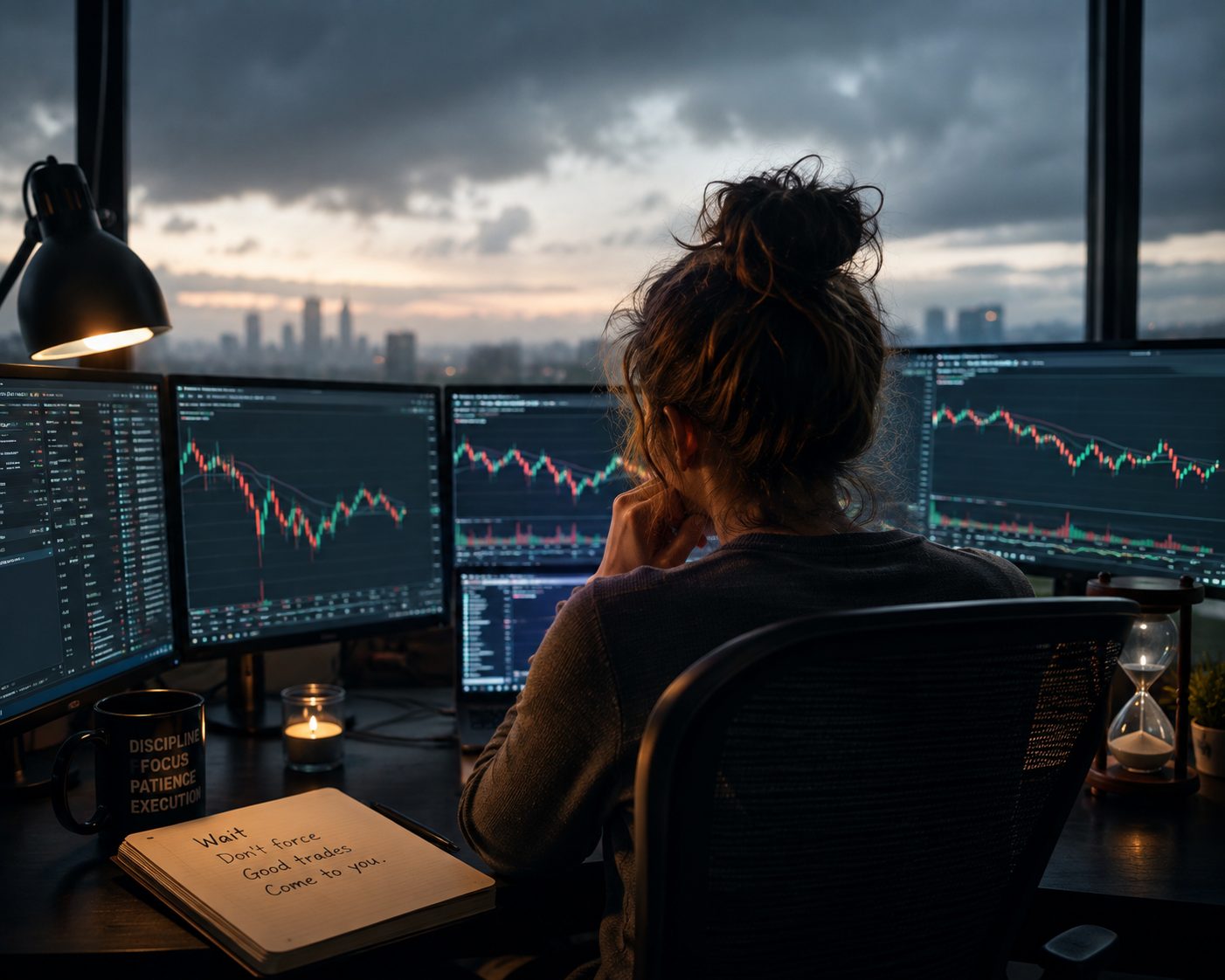
Nobody overtrades on a day they are already up big and the tape is moving. Overtrading has a specific weather pattern, and every trader who has done it more than a hundred times can describe the air pressure exactly: quiet tape, mediocre P&L, low conviction, and the growing hum of your own nervous system asking for input.
The trade you should not have taken did not come from a bad thesis. It came from the twenty seconds before it, when nothing was happening and you couldn't sit inside that nothing.

THE ITCH, NOT THE IDEA
Every overtrade is a setup wearing borrowed clothes
If you go back through your last month of stat sheet and pull the ten trades you most regret, they will not cluster around your worst reads. They will cluster around your worst moods. Flat and restless. Slightly red and wanting even. Slightly green and wanting more. The chart looked like something because you needed it to.
The tell is not the entry. The tell is that you were already looking for one. You opened three tickers, cycled through them, went back to the first, and something on it started to look like a level. It wasn't a level. It was a shape your restlessness could point at.
There is no such thing as a boredom setup. There is only boredom, wearing a setup's clothes.
The uncomfortable version of this is that most overtraders are not undisciplined about analysis. They can name the setup, name the invalidation, name the size. What they can't do is not open the platform when they have nothing to do.
THE CHEMISTRY
It is not a character flaw. It is a nervous system.
The reason overtrading resists every willpower fix you have thrown at it is because you have been treating it like a moral problem. It isn't one. It is a chemistry problem with an interface layer.
The interface — your platform, your hotkeys, your Level 2, your Discord — is engineered exactly like a machine that produces variable rewards on a short interval. That is the same architecture as every gambling product ever built, and it hits the same circuitry. Novelty releases a small chemical hit. Anticipation of novelty releases a bigger one. Loss triggers a compensatory search for the next hit. None of this is metaphor. This is well-mapped neurology.
Which means the trader who "has an overtrading problem" is often a person with a completely functional nervous system responding rationally to an environment designed to keep them clicking. You are not weak. You are wired, and the room you sit in has been decorated to press on that wiring.
- Boredom. Absence of stimulation is physically uncomfortable. A click restores it.
- Recency. The last red trade is louder in your head than the last twenty green ones. The urge to overwrite it is chemical, not logical.
- Proximity to green. Being slightly up creates a specific hunger that being flat does not. Almost-a-good-day is worse than a mediocre day.
- Social tape. Someone in your chat just called a runner. Your chemistry does not distinguish their P&L from a threat to your own status.
Once you can name which of the four you are inside of, the trade you were about to take stops looking like an idea and starts looking like a symptom.
THE MAT
White belts chase submissions. Brown belts wait for mistakes.
Anyone who has trained a grappling art long enough has been through the specific humiliation of a first-round roll where they went hunting. Every opening looked like a submission. Every scramble was an invitation. Two minutes in, arms are lead, lungs are on fire, and a calmer training partner who did almost nothing is now smoothly working a position because the aggressor gave it to him.
The higher belt in that room is not stronger. He is more selective. He is willing to sit inside a position that is not immediately productive, breathing, watching, letting the other person spend energy building the mistake he will eventually punish.
Overtrading is white-belt energy. You are trying to win the round by moving more than the tape.
A day session is not different. The trader with five years on the screen is not seeing more setups than the newer trader — he is seeing the same setups and passing on most of them. He knows the difference between a setup he built and a setup the tape actually offered. The tape offers fewer than you think. On a lot of days it offers one, and it offers it around a moment you were not watching because you were busy managing the trade you took at 12:47 that you did not need to take.
STRUCTURE, NOT WILLPOWER
What actually reduces the trade count
The bad news is that no amount of promising yourself you will trade less has ever, in the history of this profession, caused a person to trade less. Willpower is the wrong tool. Willpower is a muscle that fatigues, and the market session is specifically designed to fatigue it.
The good news is that structure works, and structure does not require you to be a better version of yourself. It only requires you to install a few frictions between the itch and the click.
- Cap the count before the bell. Pick a number. Three. Five. Whatever your honest data says. Write it down before the open, when your nervous system is still yours. Once you are inside the session, you no longer get to negotiate with the number.
- Force a cooling gap between trades. A hard rule: after any close, red or green, you are not allowed to open a new position for a set interval. Ten minutes. Fifteen. The gap is not about analysis. It is about giving your chemistry time to metabolize the last outcome.
- Have a non-trading task ready. The reason boredom triggers trades is because the platform is the most stimulating thing on your desk. Put something else on the desk. Journal the last trade in full sentences. Do the mobility work you keep skipping. Read.
- Name the state, not the setup. Before every click, one line: what state am I in right now — bored, revenge, FOMO, chasing green, clean read. If you cannot name a clean read, you are not entering. This one sentence is the entire discipline.
None of this makes you a better analyst. It makes it harder to act on the trader you become when your nervous system is louder than your plan. That is the only thing that has ever worked.
The system you have been describing to yourself
Everything above is what you already know, arranged in an order you can actually use. But the honest problem is not the list. The honest problem is that in the moment — restless, slightly red, one hand on the hotkey — none of it is in the room with you. Your plan is in a document you wrote at 7am. The person about to click is somebody else.
What closes that gap is not more knowledge. It is a system sitting between you and the click that sees the state you are in, remembers the rules you set, and names them back to you before you act. A cap that is actually enforced. A cooling window that is actually observed. A prompt that asks you to name the read before it lets you take the trade. A record, at the end of the day, of how many of your trades came from a plan and how many came from a mood.
That is what MAKETZO is built to be. Not a signal service. Not a coach who is going to tell you what to buy. An operating layer for the trader you already are — one that catches the overtrade at the twenty-second mark, when it is still an itch, before it becomes a fill you will have to explain to yourself tomorrow.
If you have read this far, you already know what you need. The next step is letting something else hold the line while you sit inside the nothing and wait for the actual trade.