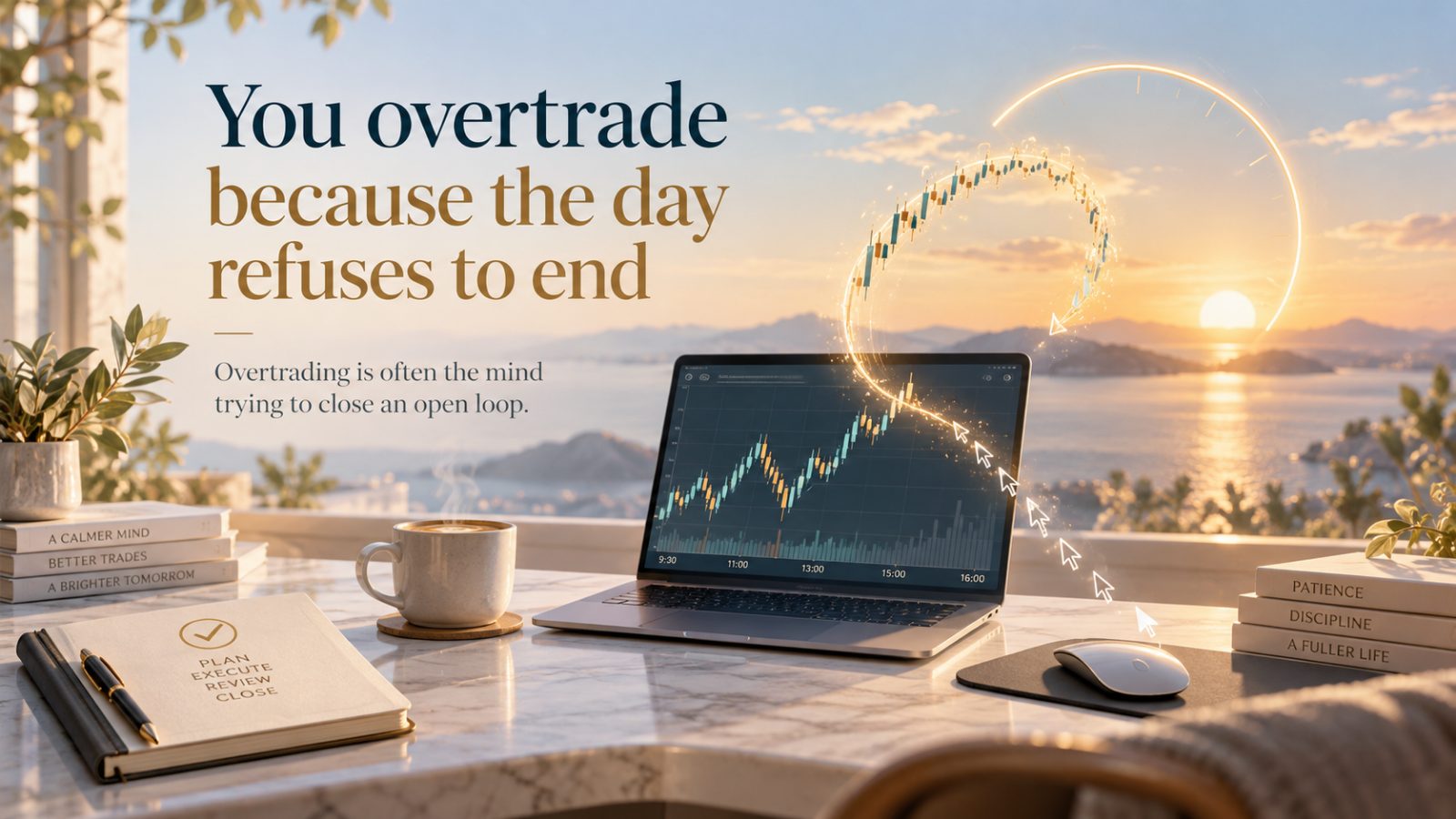
Nobody overtrades on a day that already feels finished.
Think about the sessions where you stepped away clean. One trade, maybe two, filed in your head under done. You weren't tempted. You weren't bored. You weren't tracking the chat. You went and made coffee because there was nothing to resolve. That's not discipline. That's closure.
Now think about the days you couldn't stop. There's a thread you can pull on every one of them. A loss that didn't fit the story you had about yourself. A win you cut too early. A setup you watched run without you. A green number that went red before lunch. Something in the day stayed open, and the rest of the session was you clicking buttons trying to shut it.
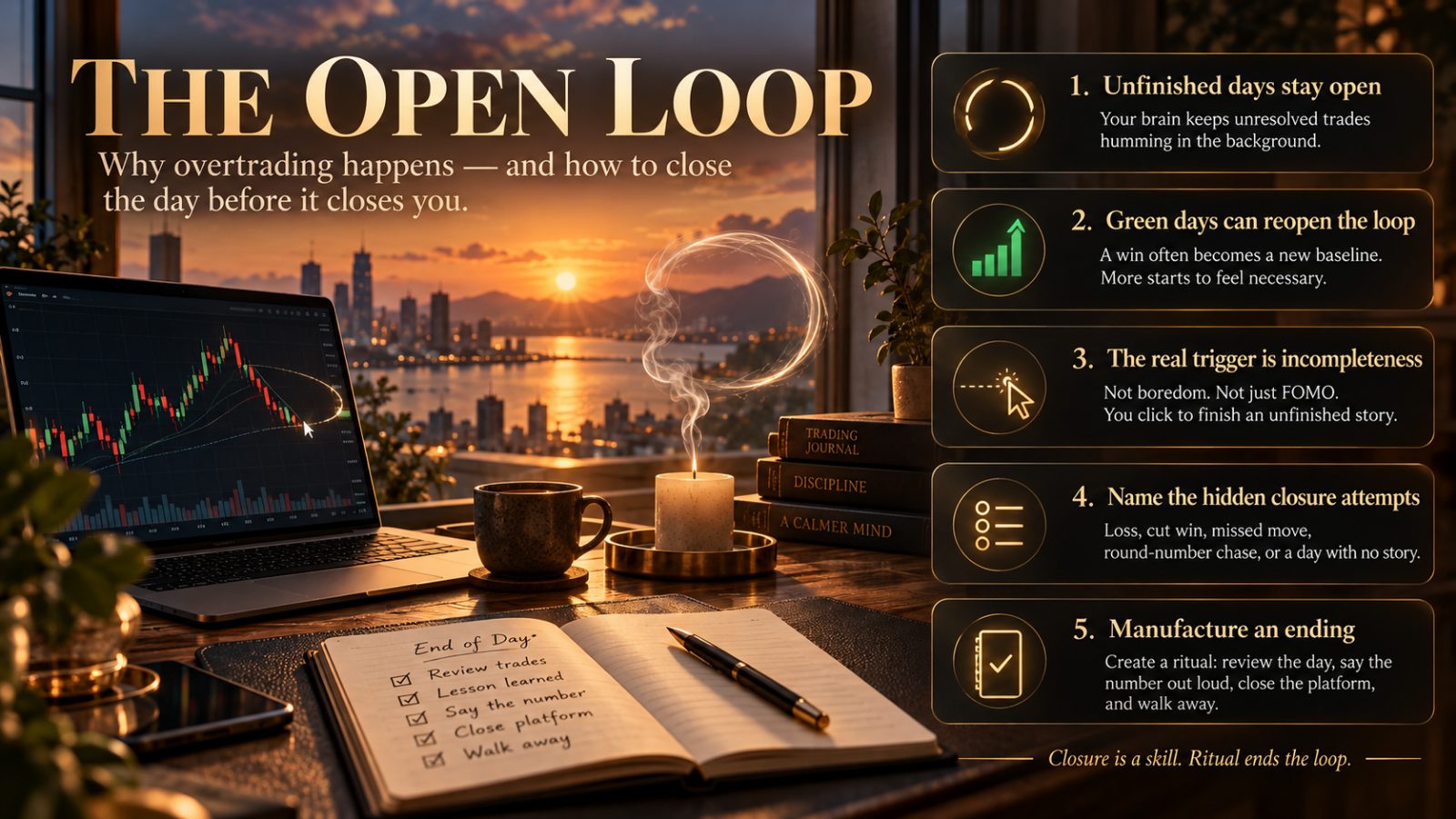
THE OPEN LOOP
What your brain is actually trying to do
Psychologists call it the Zeigarnik effect. Unfinished tasks occupy more mental real estate than completed ones. A waiter can recite every open tab in the restaurant and forgets them the second the bill is paid. Your brain is wired to keep an unresolved thing humming in the background until it gets a sense of resolution.
The market will not give you that resolution. It doesn't owe you an ending. It opens, it chops, it closes, and whatever was unresolved in your head at 9:30 is still unresolved at 4:00 unless you manufactured the ending yourself.
So you try to manufacture it with trades. The red one needs a green one to cancel it. The small green needs a bigger green to feel earned. The missed move needs a chase to prove you weren't asleep. Each new click is your nervous system trying to end a sentence the tape started and refused to finish.
THE SHAPE OF IT
Green days don't close cleanly either
If this were only a red-day problem it would be easier to solve. It isn't. Green days produce their own open loops, and they're more expensive because you don't see them coming.
You take a clean trade at the open. You're up a real number by 10:20. The day has given you what you asked for. And then, instead of filing it under done, your brain reopens the loop. If this is possible, more is possible. The number stops being a result and starts being a floor. The day isn't over because the day hasn't peaked, and the day can't peak because any peak you set becomes the new baseline.
The market doesn't owe you an ending. Whatever was unresolved in your head at 9:30 is still unresolved at 4:00 unless you manufactured the ending yourself.
That's why green-to-red is the signature overtrading pattern. It isn't greed. Greed is too clean a word. It's an open loop dressed up as ambition. The clean morning didn't close the day. It opened a bigger one.
THE REAL TRIGGER
It isn't boredom and it isn't FOMO
The usual diagnoses miss by a step. Boredom is real but boredom alone doesn't move your hand to the mouse. Plenty of boring sessions pass without a stray click. FOMO is real but FOMO is a specific flavor, the ache of exclusion from a move already in progress. Neither explains the trader who sits in front of a quiet tape and keeps opening positions in nothing.
What explains that trader is incompleteness. Watch yourself the next time you take a trade you can't justify out loud. Ask what thread you're trying to tie off. It's almost always one of these:
- A loss that still feels like a verdict on you rather than a cost of doing business.
- A win that got cut and now reads in your head as evidence you're a coward.
- A move you watched happen without you, which your brain is logging as a failure of attention rather than a correct pass.
- A number on the P and L that is close to a round figure and your brain wants the round figure.
- A session that has not yet produced a story, and your brain refuses to let a story-less day end.
None of those are strategy inputs. All of them feel, in the moment, like strategy inputs. That's the trick. The open loop disguises itself as analysis. You believe you're taking the next trade because the setup is there. You're actually taking it because the day isn't.
CLOSURE AS A SKILL
How to end the day before the day ends you
You cannot talk your limbic system out of wanting closure. You can give it closure on terms you choose.
The traders I know who stopped overtrading didn't become more disciplined in the usual sense. They became deliberate about manufacturing an ending. The ending is a ritual, not a rule. A rule says no more trades after two losses. A ritual says this is the gesture that tells my nervous system the day is over. The rule gets argued with. The ritual gets obeyed because it has nothing to argue about.
What a closure ritual looks like varies. Writing one paragraph in a notebook about what the session actually was. Standing up and walking out of the room for ten uninterrupted minutes. Closing the platform entirely, not minimizing it. Saying the number out loud, green or red, so your mouth has to agree with it. One trader I know pours a second coffee and if he drinks it standing at the window, he is done, and the platform does not get reopened.
The point is not the specific gesture. The point is that the day gets a last page. Without one, your brain writes new pages until the bell rings, and most of those pages cost money.
The system you've been describing
If you read this far, you've been building, in your head, a picture of what you actually need. Not more setups. Not a better scanner. Something that notices when the day is still open in your head and names it before your next click does. Something that flags the trade you're about to take as a closure attempt rather than a trade. Something that puts an ending on the session when you can't give it one yourself.
That's the frame MAKETZO is built around. Not more information, but a layer that watches the gap between the trader you planned to be at 9:15 and the trader clicking at 1:30, and intervenes before that gap becomes the day's story. The open loop is the enemy. A system that closes it on your terms is the edge.