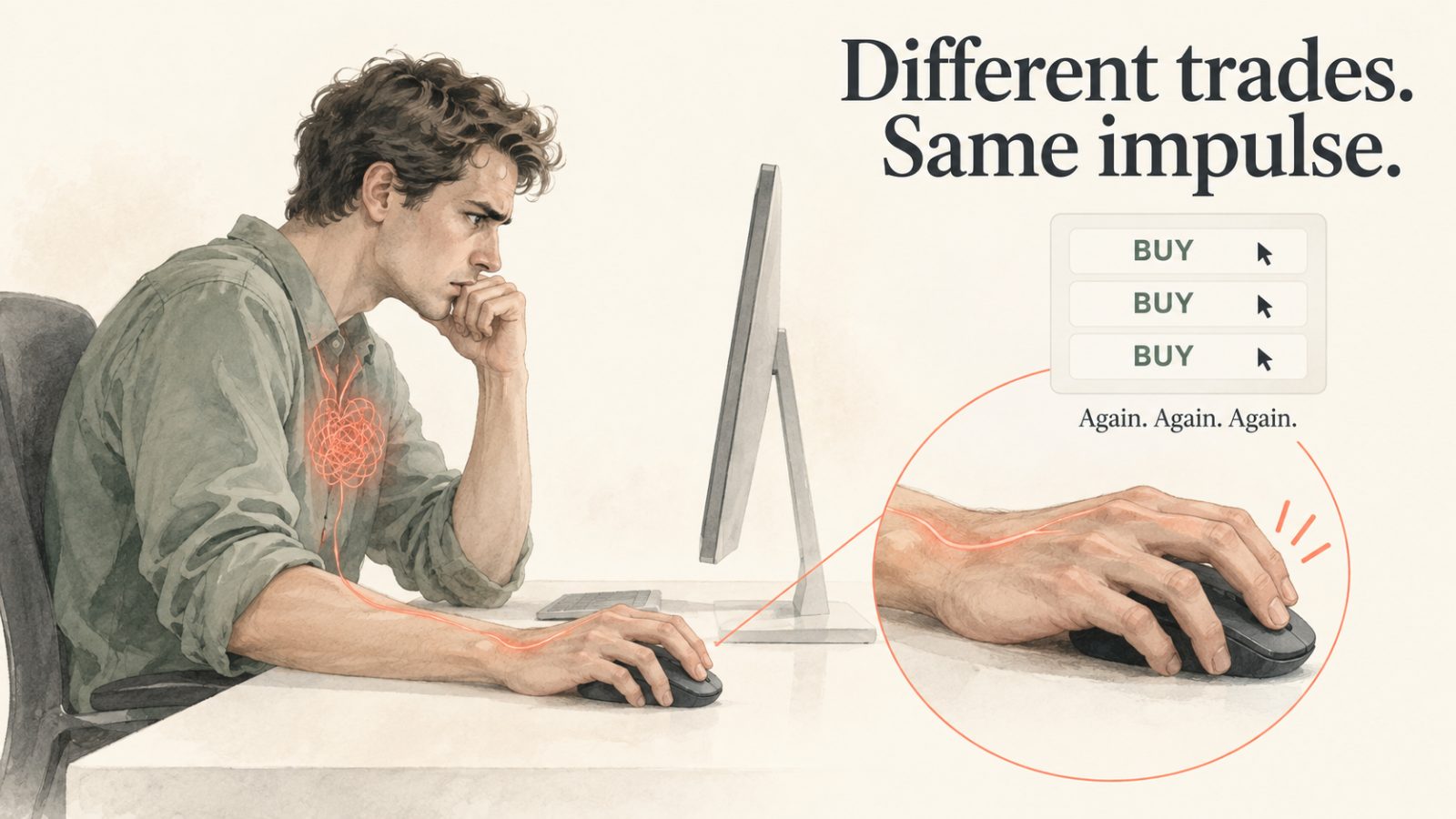
Nobody plans the tenth trade.
You planned the first two. Maybe the third. Somewhere around the fifth your hands started making decisions your prep sheet never signed off on, and by the ninth you weren't reading the tape anymore — you were reading your own P&L and trying to move it. The trade wasn't a thought. It was a twitch.
This is the part of overtrading nobody talks about honestly. It is not, in the moment, a choice you're making badly. It is a state you're inside, and inside that state every click feels reasonable. You don't overtrade because you decided to. You overtrade because your nervous system got there first and your rules showed up late.
WHAT IT ACTUALLY IS
The twelve-trade day was one decision, repeated
Ask a trader after a blown session what happened and you'll get a list. Chased the runner. Sized up on the fade. Averaged the loser. Took the reversal because it "had to" bounce. Twelve trades, twelve stories.
But look at the tape of the session and something else shows up: the same trader, in the same posture, breathing the same shallow way, clicking with the same tempo. The setups changed. The state didn't. What looks like twelve independent decisions is actually one internal condition expressing itself twelve times in a row.
That reframing matters because you cannot fix twelve trades with twelve rules. You can only fix them by interrupting the one condition underneath.
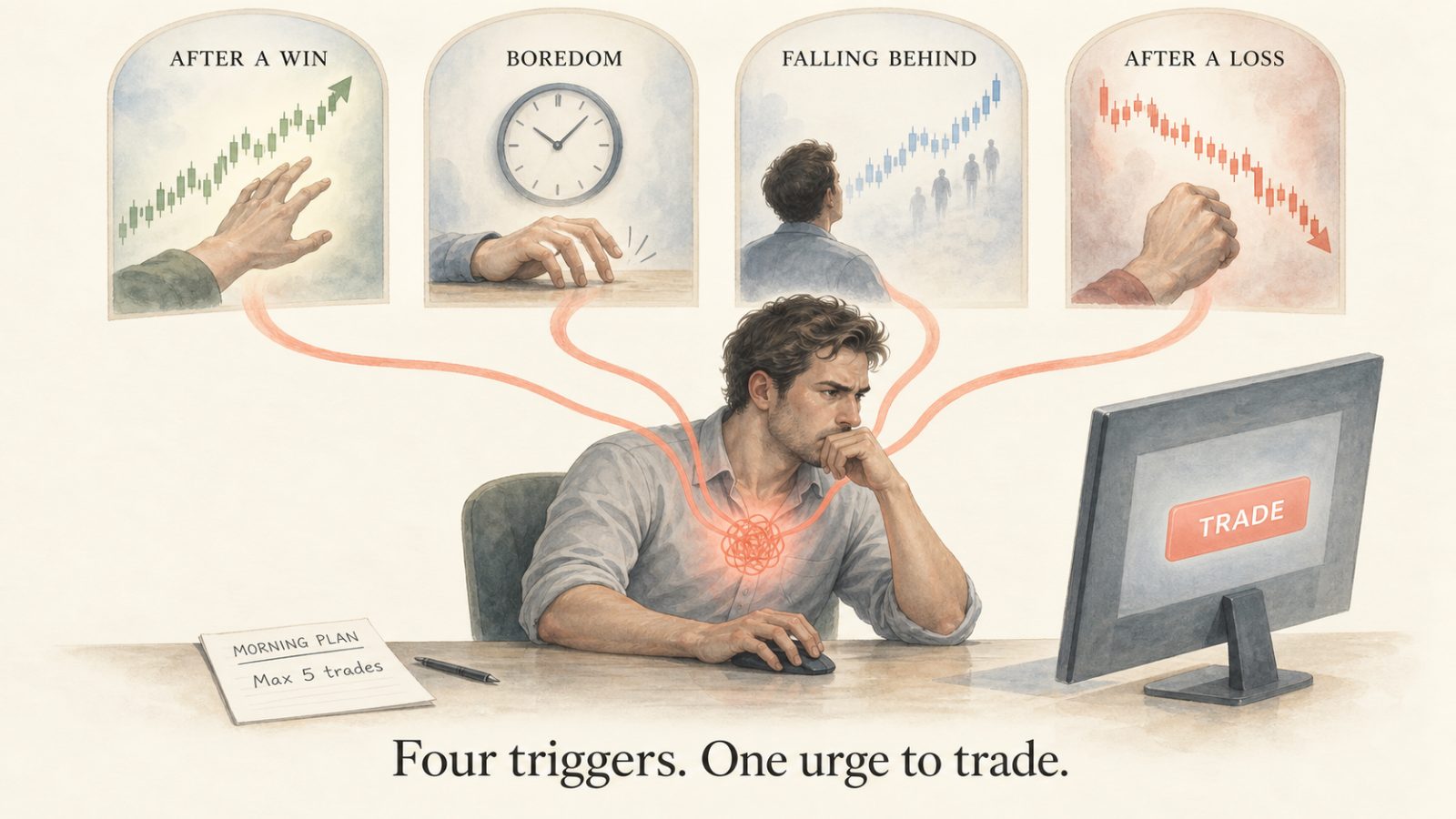
THE FOUR DOORS IN
How the state gets built without your permission
Overtrading has a handful of on-ramps. None of them feel like on-ramps while you're on them. They feel like Tuesday.
- Dopamine debt. A green trade delivers a hit. The brain, being a brain, wants the next one sooner and bigger. Fifteen minutes of stillness after a win now feels like withdrawal. You take the next trade to feel normal, not to make money.
- Boredom in a chair. The market is dead. You've been staring for ninety minutes. Your hands need something to do. A marginal setup on a marginal float suddenly looks like structure because the alternative is admitting there is no trade.
- FOMO in reverse. Not fear of missing the runner — fear of missing your own day. You're flat, the tape is moving somewhere else, and every minute you don't participate feels like a minute you're falling behind an imaginary version of yourself who would've caught it.
- Revenge, dressed up. The last trade was red. You are not going to end on that trade. So the next click isn't a setup, it's a rebuttal. You are arguing with the market, and the market does not know it's in a conversation.
Notice what all four have in common. They are not analytical failures. You did not misread a level. You are not, at that moment, actually looking at the chart. You are managing an internal sensation — restlessness, deficit, itch, insult — and the trade is just the tool you reach for because it's the tool nearest to hand.
You are not trading the setup. You are trading the feeling of needing to trade. Those are two entirely different jobs, and only one of them shows up on the tape.
WHY WILLPOWER LOSES
The rule you wrote at 8 AM cannot hear you at noon
Every overtrader I know has, at some point, written the rule. Max five trades. Hard stop at two reds. Walk away at down 2R. Taped it to the monitor. Meant it.
And then broken it, cleanly, with the same hand that wrote it.
This is not a character defect. This is what happens when a plan made by your calm morning brain has to be enforced, in real time, by your escalated afternoon brain. Those are not the same person. The morning version is patient, has slept, has not yet felt a loss. The afternoon version is caffeinated, down money, and running on a stress response that literally narrows its own field of vision. You cannot out-discipline a nervous system that is no longer accepting input from your prefrontal cortex.
Which is why the intervention has to happen earlier, and it has to happen at the level of state, not at the level of decision. By the time you're deciding whether to take the next trade, the state has already decided for you.
THE ACTUAL FIX
Stop trades by changing your body, not your mind
The traders I've watched climb out of chronic overtrading did not do it with a better rule sheet. They did it with mechanical interrupts that had nothing to do with the market and everything to do with resetting the animal in the chair.
- Name the state before the trade. Before any click after the third trade of the day, say out loud what you're feeling. "Bored." "Tilted." "Down and chasing." You are not trying to fix it. You are trying to force the trade to pass through language before it becomes an order. Most of them don't survive that step.
- Insert a physical gap. Stand up. Walk to the kitchen. Ninety seconds minimum. This sounds absurdly small. It is the single highest-ROI intervention most overtraders will ever install, because it breaks the loop between sensation and click at the only point that loop is actually breakable — the body.
- Pre-commit to a trade budget you'd defend in front of another trader. Not a max. A budget. Five trades to spend. If you'd be embarrassed to justify this trade to a peer as one of your five, it isn't one of your five.
- Track state, not just P&L. A journal that only records entries and exits misses the entire causal chain. A journal that records what you were feeling in your chest before each click starts to show you the pattern your account has been paying tuition for.
- Earn the next trade. The right to take trade six is not automatic because the market is open. It's earned by demonstrating, on trades one through five, that you're still the person who wrote the plan. If you aren't, the day is over regardless of what the clock says.
None of this is glamorous. None of it involves a better indicator. All of it treats the real problem — that you are a body in a chair reacting to sensation — as the problem, instead of pretending you're a spreadsheet that occasionally misfires.
What you're actually asking for
When a trader says "I need to stop overtrading," what they're really asking for is something outside themselves that notices the state before they do. A second set of eyes that sees the tempo pick up, the trade count climb past the plan, the size creep in on a setup that doesn't deserve it — and says something, in the small window before the click, while the prefrontal cortex is still reachable.
That is the entire premise of the platform we're building. Not a chart tool. Not another indicator. A layer that sits next to your session and watches the behavior your P&L is downstream of — pace, plan adherence, state, the specific patterns your account keeps paying for — and interrupts you at the moment interruption is still possible. Because by the twelfth trade, you already know. You needed to know at the fourth.
If that's the missing piece, it's the piece we built.