My jiu jitsu coach used to put two fingers on the side of my neck between rolls. He wasn't checking if I was okay. He was checking how fast my pulse had come down ninety seconds after we broke. If it hadn't dropped, he'd tell me I was still trying to win with panic. He said it wasn't a technique problem. It was a thermostat problem.
I think about that every time I click buy.
The post you are about to read is not another breakdown of trend alignment, volume, structure, and risk. You already know those. You can draw them on a napkin. What you probably haven't been taught is that the most reliable signal of whether an entry was good or bad is not on the chart. It's in your body, two seconds after the fill.
THE BODY
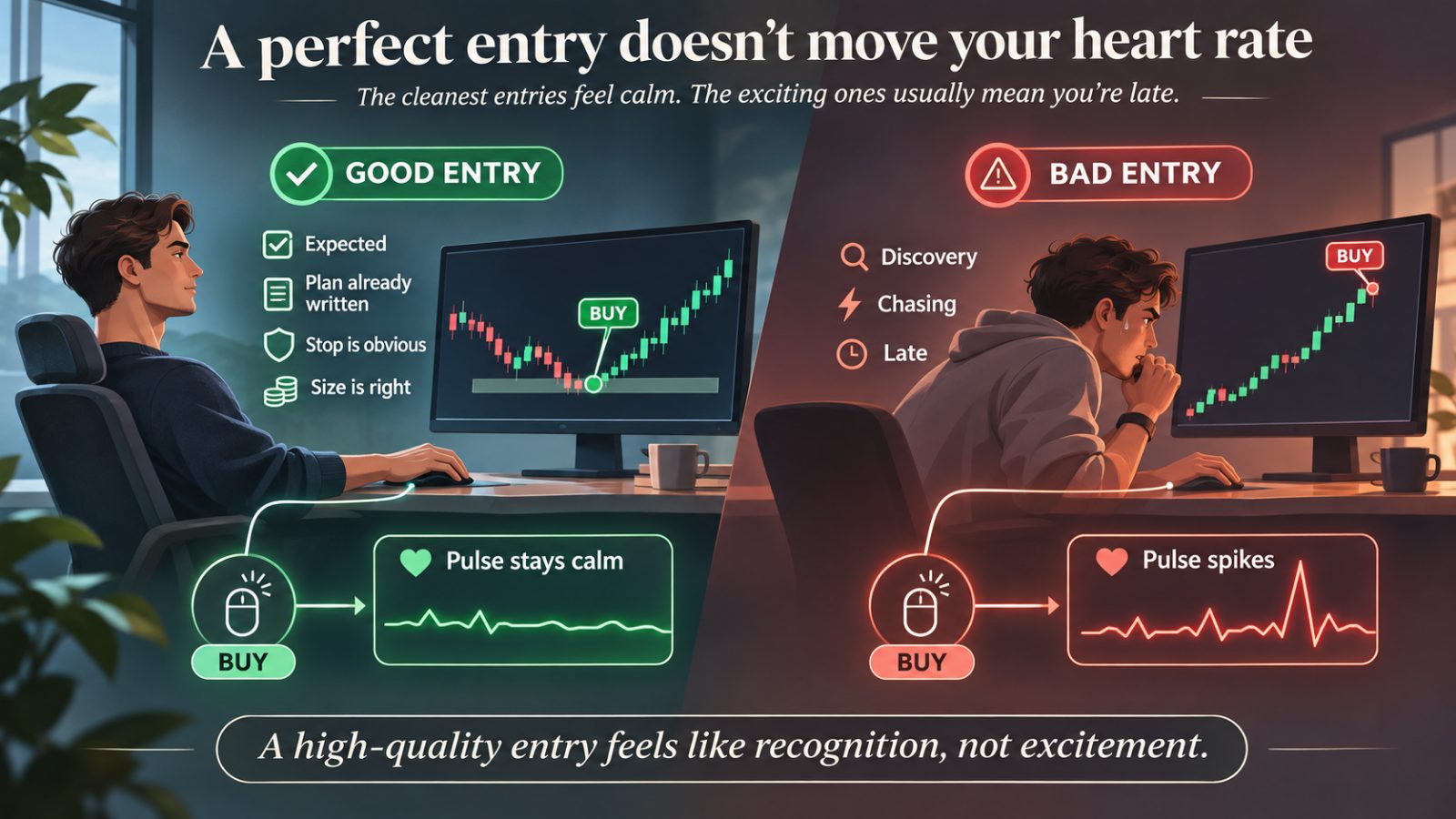
A real entry does not move your pulse
Think about the best trades you took last month. Not the biggest winners. The cleanest ones. The ones where the setup matched the plan, the stop was obvious, the size was right, and you got filled where you wanted to get filled.
Now try to remember what your body did at the moment of the click. You probably can't, because nothing happened. There was no spike. No held breath. No leaning forward. The trade entered itself. You were a spectator to a thing that had already been decided for you by the preparation that led up to it.
That flatness is the signal. A perfect entry is one where the setup arrives so clearly that your nervous system treats it as expected, not as discovery. Expected means the thesis was already written, the invalidation was already drawn, and the size was already sitting in the order ticket. Discovery means you are seeing it for the first time right now, which almost always means you are late.
THE CHASE
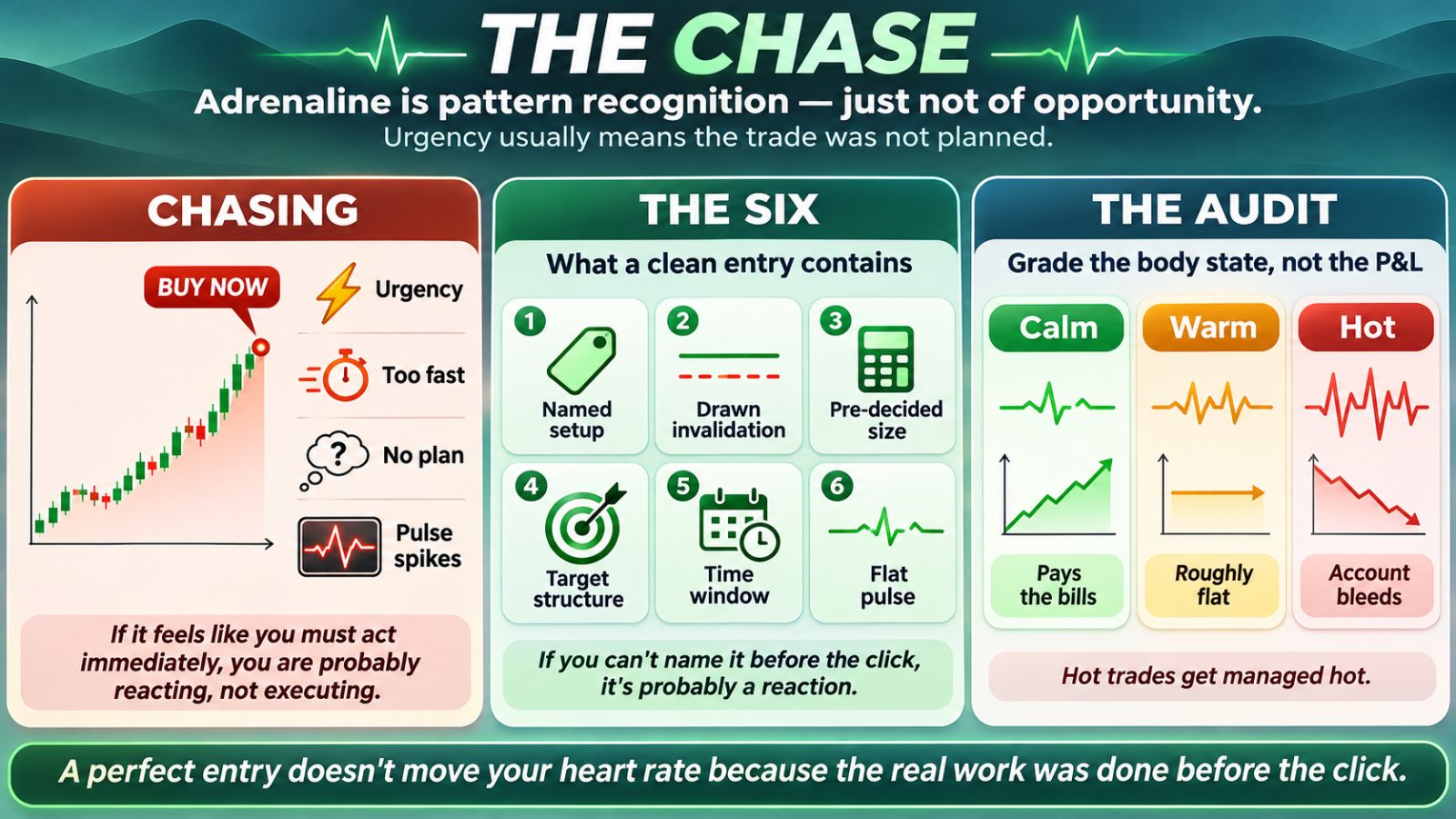
Adrenaline is pattern recognition, just not of opportunity
Here is the trap. Traders think the surge they feel at certain entries is their edge talking. It's not. The surge is your body reading urgency, and urgency is almost always the absence of edge, not the presence of it.
If the trade has to be taken right now, in the next two seconds, before it leaves without you, your body is telling you that you did not see this coming. Which means it was not on your plan. Which means you are now inside a trade whose thesis was constructed in the three seconds between the move starting and your finger landing on the mouse.
Your pulse knows the trade is wrong before your P&L does. You just haven't trained yourself to listen to it yet.
In jiu jitsu, the move I lose most matches to is the one I attack because my opponent gave me a fleeting opening I wasn't set up for. I go for it hot, out of grip, out of base, because the window feels like it will close. I almost always end up in a worse position than I started. The entry that felt urgent cost me the position that had been patiently building.
Trading is the same. The low float runner that gaps on news, that you did not have on your sheet, that you see ripping at 10:22 and jump into at market because it is about to break above the high of day, is the mounted triangle I chased without setting up my grips. The fill will be fine. The exit will be ugly.
THE SIX
What an entry you don't have to defend actually contains
If you stripped a clean entry down to its parts, this is what you'd find. Not on the chart. In the five minutes before the click.
- A named setup. You can say it in one sentence. First pullback on a parabolic after a VWAP reclaim. Backside failure on a low float after an exhaustion wick. If you can't name it before you click, you don't have an entry, you have a reaction.
- A drawn invalidation. A level, not a feeling. The price where the thesis is wrong and you are out. Not where you'll "reassess." Where you are out.
- A pre-decided size. Risk in dollars from entry to stop, divided by stop distance, equals shares. You did this math when your pulse was 62, not 94.
- A target structure. Where you take off the first piece, where you trail, where you're flat. Not for execution, for commitment. If you don't know where you're taking it off, you will take it off the moment it moves against you by a penny.
- A time window. This setup works in the first hour, or in the mid-day fade, or in the last thirty minutes. If the window is "anytime between now and the close," it isn't a window.
- A flat pulse. The one none of the books list. You feel ordinary. The fill feels ordinary. You are not leaning toward the screen.
If five of those are there and your pulse is spiking, it is not a perfect entry. It's a good setup you are taking in the wrong state, which historically for you is a losing trade even when the chart cooperates.
THE AUDIT
Grade your entries by what your body did, not what the P&L did
Here is a review exercise that costs nothing and will change what you see. For every trade you took last week, write one word next to it. Calm, warm, or hot. Nothing else. Don't look at the outcome. Mark the body state at the click.
Then total the calm trades as a group, the warm trades as a group, the hot trades as a group. Look at expectancy by group. Almost every trader I know who has run this honestly finds the same thing. The calm group pays the bills. The warm group is roughly flat. The hot group is where the account bleeds, and it bleeds even on the days the chart technically agreed with you, because hot trades get managed hot. They get sized wrong, cut late on losers, cut early on winners.
You don't need a better setup. You need to stop taking the setups you already have while hot.
The answer to the headline, in one line
A perfect entry doesn't move your heart rate because the real work was done before the setup ever appeared. The named setup, the drawn invalidation, the pre-decided size, the target structure, the time window. All of that gets written while you are calm. When you build the trade with a flat pulse, the click has nothing left to decide, and your body knows it.
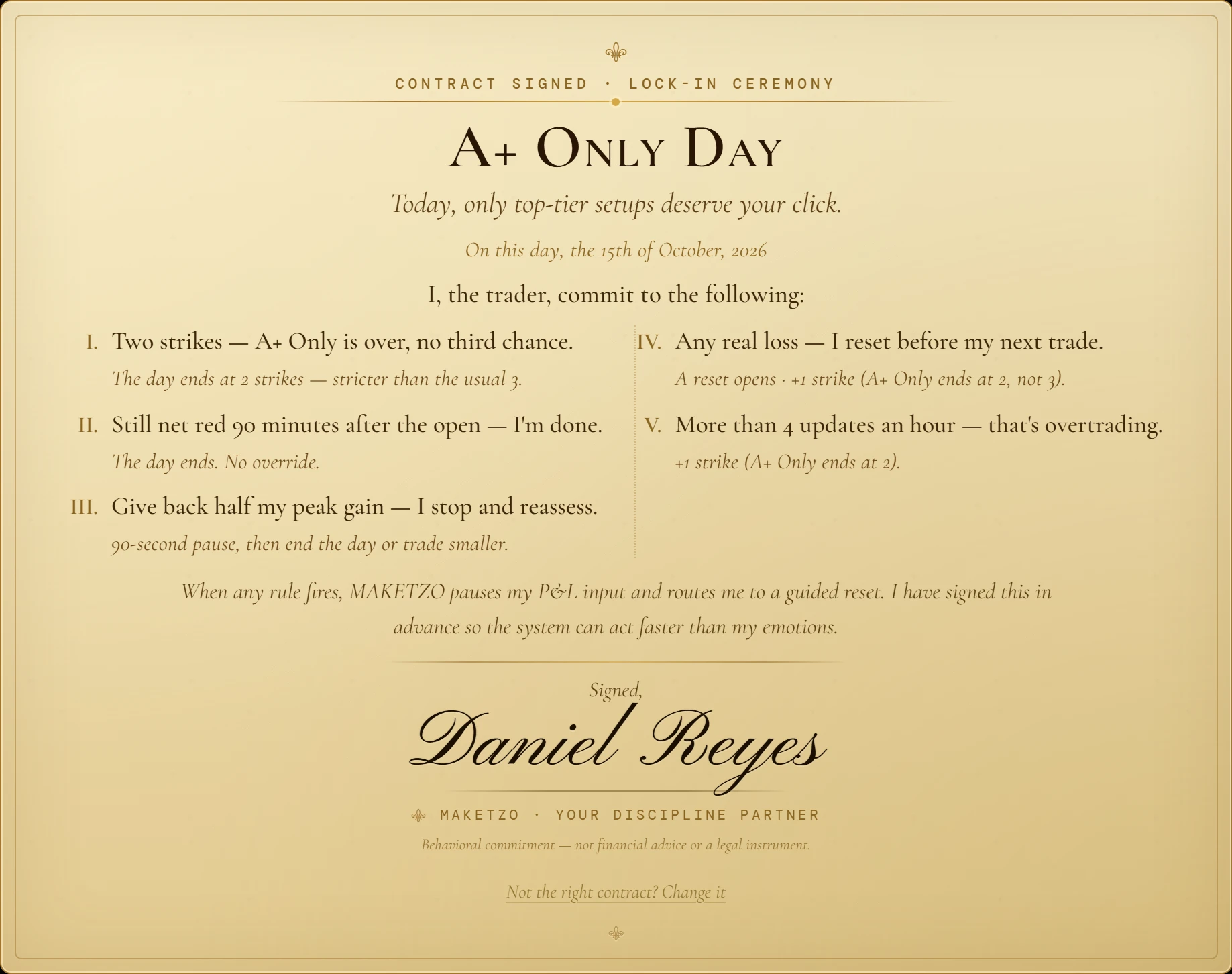
The trader who runs this way is the one who writes the trade down before the bell, not during the move. If you want a place to do that, our Morning Lock-In is the rules you sign while you are still calm, before the first order of the day. It will not stop you from chasing. Nothing stops that but you. What it will do is make sure that when the setup you planned for finally shows up, your body treats it as expected, not as news.