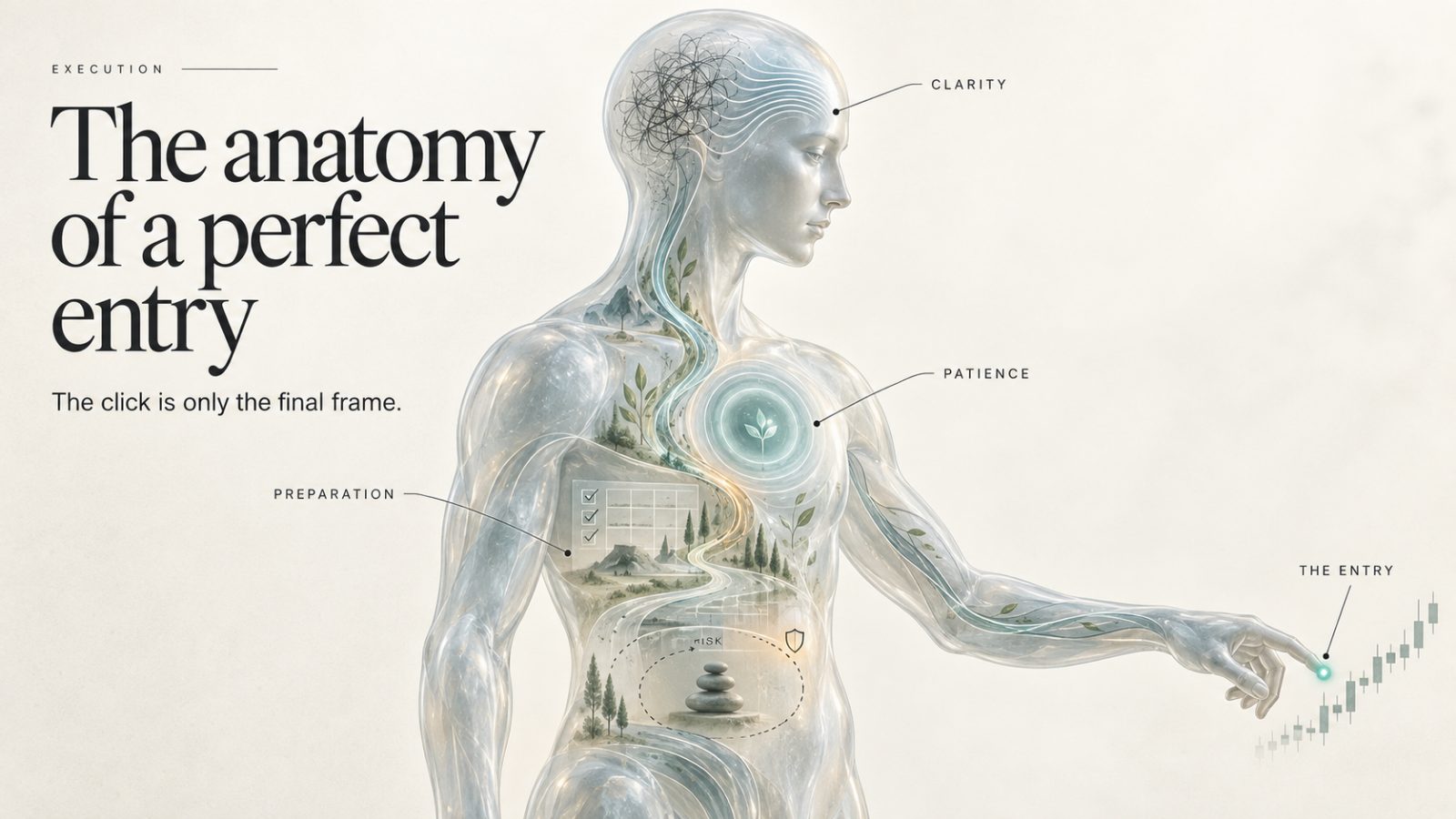
Ask ten small-cap traders what a perfect entry looks like and you'll get ten annotated screenshots. Volume shelf, level reclaim, first pullback holding, tape thinning out, the whole liturgy. Ask them what they were doing in the five minutes before that entry — not looking at, doing — and most of them go quiet.
That silence is the actual answer. A perfect entry is the last frame of a much longer film, and traders keep trying to study the last frame. They screenshot the candle they clicked on. They circle the wick. They save it to a folder called "A+ setups" and then they cannot reproduce it, ever, and they don't know why.
The reason they can't reproduce it is that the entry wasn't the cause of anything. It was a symptom. Something upstream had already gotten quiet enough, and clean enough, and prepared enough, that when the setup finally printed, the click was almost boring. That upstream is what nobody screenshots.
THE FRAME NOBODY SAVES
What was actually true before the click
Think about the last entry you took that felt right — not the P&L, the feel. The one where you didn't hesitate, didn't oversize, didn't tack on a second bad add, didn't tell yourself a story after. Rewind it. Not the chart. Yourself.
You were probably not scrolling Twitter. You were probably not on your third coffee refill mid-move. You were probably not adding it to a watchlist for the first time as it broke — you'd been on it for an hour, maybe since premarket, and you already knew what you were going to do if it did the specific thing it then did.
Now rewind a bad entry. Almost every variable flips. The chart pattern might be identical. The instrument might be a near-clone of the winner. The difference lives entirely in the trader, in the ten minutes before the click, in a place no screenshot captures.
The entry didn't make the trade good. The trade was already good. The entry was just where it became visible.

THE UPSTREAM CHECKLIST
Six things that were already true
When I go back through the entries that actually paid — the ones I'd take again in the same shape tomorrow — the same conditions keep showing up. Not on the chart. Around it.
- The name was already on a short list, not a scroll. I'd narrowed to two or three tickers before 9:30 and I stopped looking at anything else. A perfect entry almost never comes from a symbol I discovered after the bell.
- I already knew what invalidation looked like. Not in the abstract — literally, a price. If it did X, I was out, no argument. That single number is what let me size honestly instead of scared.
- My last trade was fully closed in my head. Not just the position — the emotion. If I was still chewing on the previous stop-out, the next entry was going to be a revenge dressed up as a setup, and I'd have called it "conviction" in my journal later.
- The move had to come to me. I wasn't reaching. I had a level, the tape had to prove something at that level, and if it didn't, I passed. Perfect entries have almost no chase built into them.
- The size was pre-decided. Not "I'll feel it out." A number, matched to the invalidation, matched to my daily heat. Deciding size in the moment is the tell that the entry is already going to go sideways.
- I was physically settled. Not hungry, not needing the bathroom, not on a call with the school. This sounds trivial. It is not trivial. A body in low-grade discomfort will click for relief and dress it up as a signal.
None of those six live on the candle. All six of them decide the candle.
WHY THE STUDY LOOPS
Studying the wrong frame is why the pattern won't stick
Here's the loop that breaks traders who are otherwise smart. Green day, they screenshot the entry. Red day, they screenshot the entry. They stack these into a folder and stare at them on the weekend looking for the difference. There isn't one. The candle that made them $2,300 and the candle that gave back $1,800 look like siblings, sometimes twins.
So they conclude the market is random, or that they need a better indicator, or that they need to trade smaller, or bigger, or a different float band. What they actually need is to start journaling the upstream. What was on the watchlist and when did it get there. What the last trade did to their nervous system. Whether they'd eaten. Whether they'd pre-decided the stop or improvised it.
When you journal the upstream, the pattern shows up fast, and it's uncomfortable. The A+ entries share a state. The give-backs share a different state. The chart is almost incidental. This is not a spiritual claim. It is the most repeatable thing in this job.
THE QUIET MECHANIC
A perfect entry is a receipt
The entry is not the cause of the good trade. The entry is a receipt for the preparation. If the preparation isn't there — the short list, the invalidation, the closed emotional loop, the honest size, the settled body — no amount of chart study will conjure the entry. And if the preparation is there, the entry starts to feel almost mechanical. Not exciting. Not a hunt. Just the moment the plan you already had becomes payable.
You cannot copy someone else's entry. You can copy the ten minutes that preceded it.
The best traders I know are boring at the point of click. All the interesting work happened before the bell, or during the first flat hour they refused to trade through. By the time they entered, there was nothing left to decide. That's the tell. If your entry still feels like a decision, it wasn't a perfect entry — it was an improvisation you got away with.
What the platform is actually for
The reason "study your entries" doesn't work is that entries aren't the unit. State is the unit. Preparation is the unit. The gap between what you said you'd do and what you actually did is the unit. Those are things a screenshot can't hold, which is why a folder of A+ candles never taught anyone anything permanent.
MAKETZO was built around that exact gap. It watches the upstream — the state you're in, the rules you set for yourself, the shape of the day so far — and it flags you before the click, not after the P&L. So the next time you take an entry that feels perfect, you'll actually know why. And the next time you're about to take one that isn't, something will have already said so out loud.
If you want to stop studying the last frame and start seeing the whole film, this is the tool built for it.