
Nobody has ever entered the zone by wanting to. You can't will your way there at 9:29. You can't caffeine your way there either, though most of us keep trying. The zone is not a mood the market grants you if you show up with the right attitude. It is a state you either walked into the seat already carrying or you didn't.
Which means the trade before the trade is the hour before the bell. And most retail traders treat that hour like a green room — scrolling, sipping, half-watching gappers, waiting for something to feel exciting enough to react to. The open then hits like weather. You take the first thing that moves because you never decided what you were actually here for.
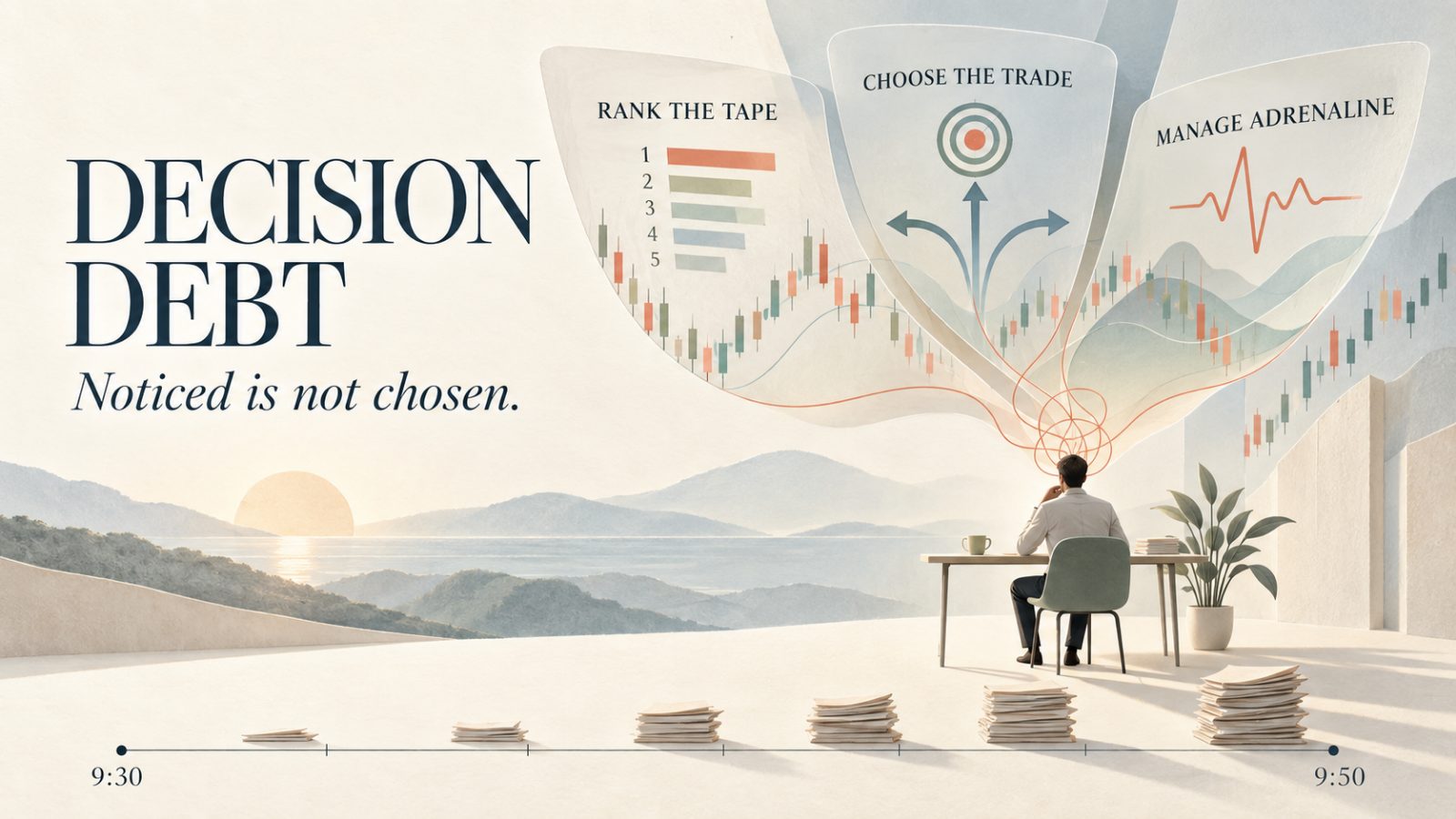
WHAT ACTUALLY BREAKS
An unroutined open is a decision debt you pay in the first twenty minutes
When you sit down cold and the bell rings, your brain has to do three things simultaneously that it is very bad at doing simultaneously: rank the tape, decide what qualifies as your trade, and regulate the adrenaline of watching money move in real time. Any one of those in isolation is fine. All three at once, under time pressure, without pre-loaded answers — that's how you end up long a name you had never heard of ninety seconds earlier.
The trades that hurt in the first half hour almost never fail because the setup was bad. They fail because the setup was never chosen. It was noticed. There's a difference, and the difference is the entire pre-bell hour.
THE SEQUENCE
Four things, in order, every day
Getting in the zone is not a vibe. It is a sequence, and the order matters more than any single step. Reverse the order and you get a trader who has opinions but no plan, or a plan but no state to execute it.
- Scan. A finite pass through the names that could actually pay you today. Gappers with a reason. Yesterday's high-volume runners. The float, the catalyst, the level. You are not looking for the trade yet. You are drawing the map.
- Decisions made. For each name that survived the scan, one sentence: what has to happen for me to be in this, and what has to happen for me to be out. If you can't write it in a sentence, you don't have a trade — you have a name on a list.
- Plan written. Not held in your head. Written. Which two, maybe three names are the A-tier. What size. What invalidates. What you will not do today no matter how good it looks. The plan's job is not to predict the day. Its job is to make the you-of-10:07 accountable to the you-of-8:45.
- State primed. The last fifteen minutes are not for one more scan. They are for closing tabs, quieting Discords, breathing, and reading your own plan back to yourself until it is boring. Boring is the goal. Boring is what a primed state feels like from the inside.
The plan's job is not to predict the day. Its job is to make the you-of-10:07 accountable to the you-of-8:45.
THE WAITING ROOM
The last fifteen minutes are the whole routine
Most traders who build a pre-market routine build steps one through three and skip step four. They finish the plan at 9:15 and then they fill the remaining fourteen minutes with more input — one more scan, one more Twitter check, one more glance at the pre-market movers to see if anything changed. That fourteen minutes of extra input is where the whole routine gets undone.
You are not adding information in those last fourteen minutes. You are adding noise, and noise is the enemy of a primed state. A trader who reads three new hot takes between 9:16 and 9:29 will take a trade at 9:31 that is not on their plan. Guaranteed. The tape didn't change their mind. The input did.
The last stretch before the bell is a waiting room, and the discipline of a waiting room is that you do less, not more. You sit with the plan you already made. You let the version of you that made calm decisions be the version of you that shows up to execute them. That handoff — from the analyst you were at 8:45 to the operator you need to be at 9:30 — is the whole point of the hour.
WHY IT KEEPS FAILING
Willpower is not a routine
Everyone reading this has, at some point, decided that tomorrow will be different. Tomorrow they'll wake up earlier, do the scan properly, write the plan, sit quietly until the bell. And most of those tomorrows lasted about four days.
Not because the trader is weak. Because the routine was held together by willpower, and willpower is a battery — it runs down, and it runs down fastest on the mornings you needed it most. The morning after a red day. The morning you slept badly. The morning your kid was up at 5. Those are the mornings the routine has to run itself, and willpower-based routines never do.
What runs itself is infrastructure. A sequence with a checklist. A screen that shows you the same four steps in the same order every day. A waiting room that closes your tabs for you because you asked it to yesterday, when you were calm, and it doesn't care what mood you're in now. The routine only survives when it stops depending on you to enforce it.
The pre-bell hour, installed
This is exactly what MAKETZO's Focus Room and Waiting Room are built to do — turn the hour before the open into deliberate infrastructure instead of a willpower project. The Get-In-The-Zone track walks you through the sequence in order: scan, decisions, plan, state. The Waiting Room holds the last stretch for you so you're not filling it with fresh noise. By the time the bell rings, the trade before the trade is done, and the version of you that shows up to the open is the version you actually wanted at the seat.
The zone was never a mood. It was always a sequence somebody either ran or didn't. If you want the sequence to run every morning without depending on how you feel that morning, this is what it's for.