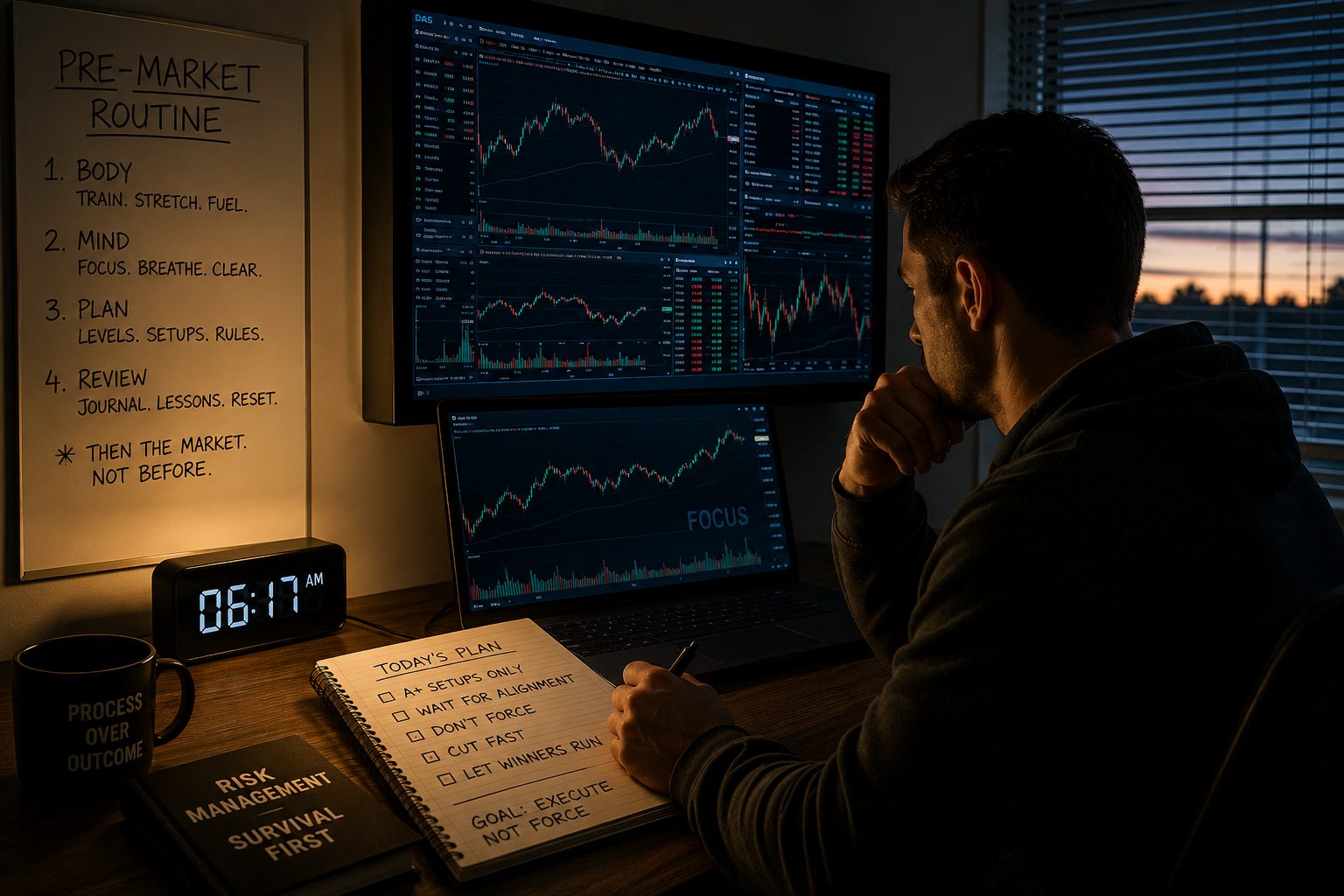
Nobody who trades well opens the platform first.
That's the tell. Watch a trader who's about to have a bad morning and you'll see it — laptop up, chart up, scanner already screaming, coffee still too hot to drink. They're inside the market before they're inside themselves. By 9:30 they're not trading a plan, they're trading a feeling that got dressed up as a plan somewhere around 9:26.
The traders who look calm at the open aren't calmer people. They ran a sequence. And the sequence is boring on purpose, because a boring sequence is the only kind that survives a red Monday when you'd rather skip it.
THE MISUNDERSTANDING
"In the zone" is not a mood
The phrase gets thrown around like it describes a state you catch, the way you catch a wave. It doesn't. In the zone is a byproduct. It shows up after four specific things have happened, and it refuses to show up before.
Try to shortcut it and you get the imitation version — the caffeinated, slightly-too-online, slightly-too-loud version that feels like readiness but is actually just arousal. You'll know it's the fake one because it can't sit still. Real focus can sit on its hands for 20 minutes waiting for the setup it drew at 8:50. Fake focus takes the first thing that moves.
Getting in the zone isn't something you feel your way into. It's something you assemble, in order, before the bell has any say in your morning.
So the question isn't how do I get in the zone. The question is what is the sequence, and which step am I skipping. Because you're skipping one. Everybody is.
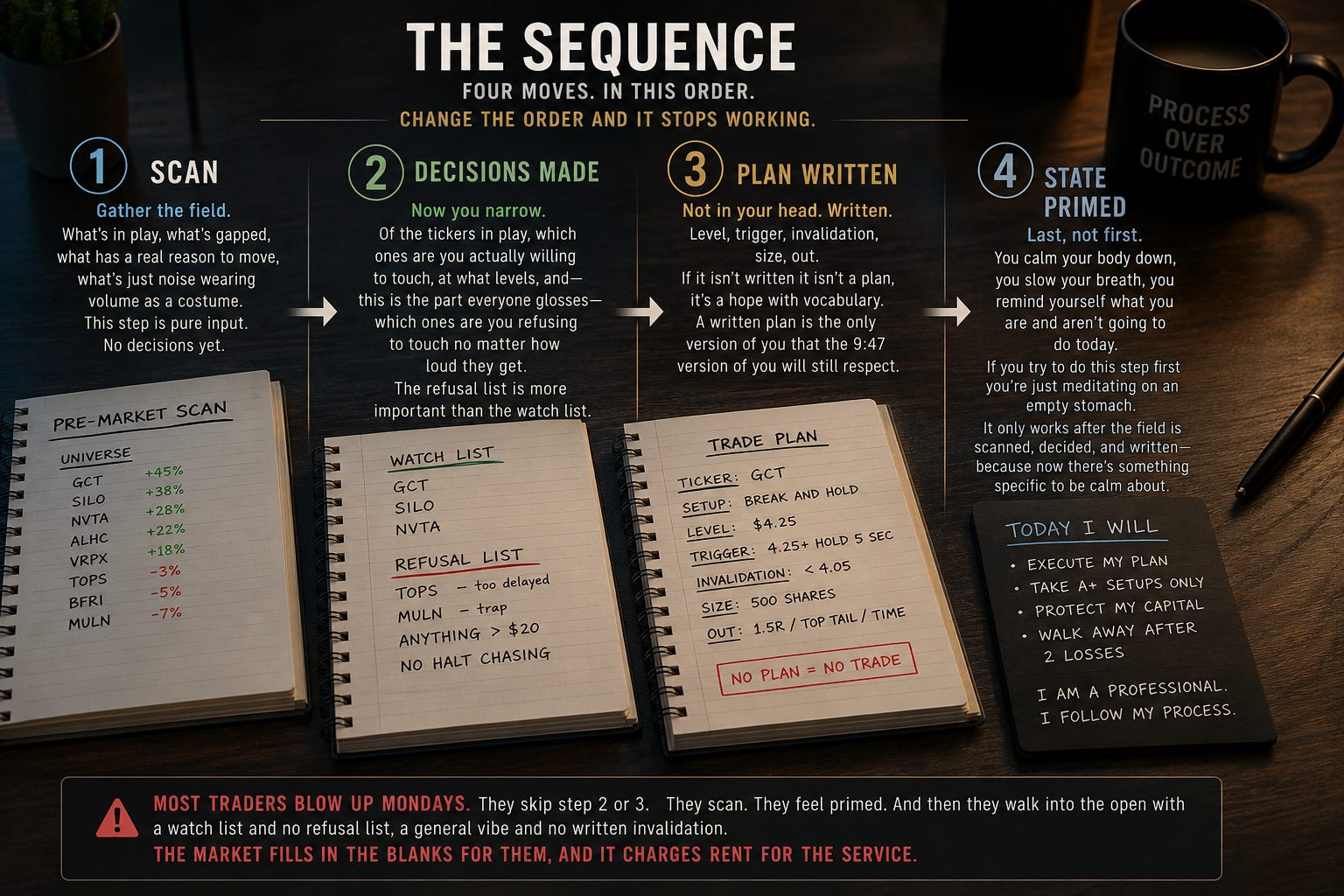
THE SEQUENCE
Four moves, in this order
Change the order and it stops working. That's not a stylistic claim, it's mechanical. Each step exists to make the next one honest.
- Scan. Not with the platform open. Not with a live P&L in your peripheral vision. You are gathering the field — what's in play, what's gapped, what has a real reason to move, what's just noise wearing volume as a costume. This step is pure input. No decisions yet.
- Decisions made. Now you narrow. Of the tickers in play, which ones are you actually willing to touch, at what levels, and — this is the part everyone glosses — which ones are you refusing to touch no matter how loud they get. The refusal list is more important than the watch list.
- Plan written. Not in your head. Written. Level, trigger, invalidation, size, out. If it isn't written it isn't a plan, it's a hope with vocabulary. A written plan is the only version of you that the 9:47 version of you will still respect.
- State primed. Last, not first. You calm your body down, you slow your breath, you remind yourself what you are and aren't going to do today. If you try to do this step first you're just meditating on an empty stomach. It only works after the field is scanned, decided, and written — because now there's something specific to be calm about.
Every trader I know who blows up a Monday skipped step two or step three. They scan. They feel primed. And then they walk into the open with a watch list and no refusal list, a general vibe and no written invalidation. The market fills in the blanks for them, and it charges rent for the service.
THE PART NOBODY WANTS TO HEAR
The pre-market window is the trade
Most of the P&L outcome of your session is decided before 9:30. Not the direction of the market — the direction of you. Whether you'll chase, whether you'll size correctly, whether you'll respect the level you drew, whether you'll take the A+ setup when it prints or fumble it because you're already down $180 on a B− you didn't plan.
The pre-market window is where all of that gets pre-decided. You just don't experience it as a trade because no order is placed. But the trade is happening. You're either building the infrastructure that will hold you at 10:03, or you're skipping it and outsourcing the job to your amygdala.
The version of you that trades the open is a hostage of the version of you that prepped for it. Feed that earlier version well or don't be surprised what walks out of the room at 9:31.
You can't decide well and prime well at the same time. That's why the sequence has an order. Deciding is cognitive — it wants friction, it wants slowness, it wants you looking at levels and asking hard questions. Priming is physiological — it wants your shoulders down, your breath long, your jaw unclenched. Try to do both simultaneously and both come out half-done. That's the morning where you sit down feeling ready and blow up in the first ten minutes and can't explain why.
WHAT KEEPS BREAKING IT
Why your routine keeps collapsing
You've tried the routine thing before. It lasted a week. Then a bad session bled into a late night, and the next morning you slept through your scan window, and by Thursday you were back to opening the platform first and calling it prep.
Three things collapse a routine every time:
- No container for the pre-market window. If the routine lives in your head, it drifts. Some mornings it's 45 minutes, some mornings it's 6. Some mornings scan and decide happen at the same time, poorly. You need a place the routine lives — the same place, every morning, that treats pre-market as a room you enter and leave, not a mood you drift through.
- No handoff between prep and open. The moment the bell rings, whatever you did in prep starts evaporating unless something carries it forward. Your written plan needs to sit somewhere you'll actually look at when the tape is moving — not buried in a notes app you'll never open at 9:34.
- No enforced pause between decide and act. A waiting room, on purpose. A gap between "I've decided" and "I'm live" so the priming step can actually land. Traders who skip this step trade their adrenaline. Traders who honor it trade their plan.
None of this is willpower. Willpower is what you run out of by Wednesday. This is infrastructure — a container, a handoff, a pause — that makes the routine survive the mornings when you don't feel like doing it. Which, for the record, are the mornings it matters most.
The room the routine needs to live in
What you're describing, if you say it out loud, is a system. A dedicated pre-market track that walks you through scan, decide, write, prime — in that order, every morning, without asking you to remember. A waiting room between prep and the open that gives the priming step somewhere to land. A written plan that carries forward into the session so 9:47-you can still see what 9:12-you decided.
That's the exact shape of MAKETZO's Get-In-The-Zone Focus Room and the Waiting Room that follows it. Not a checklist you'll abandon by Thursday. A room you walk into, that runs the sequence for you, so the version of you that shows up at the open is the one you actually prepped.
If your pre-market routine has been collapsing on you — or if you don't have one and you've been calling that "staying flexible" — the free trial is where you find out what a real one feels like.