
Nobody tells you the hardest account to trade is the small one.
They tell you the opposite. They say when you're small you can be nimble, you can take asymmetric shots, you don't move the tape, you're free. All of that is technically true and completely beside the point. The problem with a small account isn't mechanical. It's psychological. A small account punishes every lapse in discipline at a magnitude the account cannot absorb, and it does it before you've built the reps to notice the lapse is happening.
The funded trader who gives back half a day's P&L on a tilted re-entry still has a career tomorrow. The small-account trader who does the same thing is rebuilding from a hole that compounds against them for the next three months. Same mistake. Different gravity.
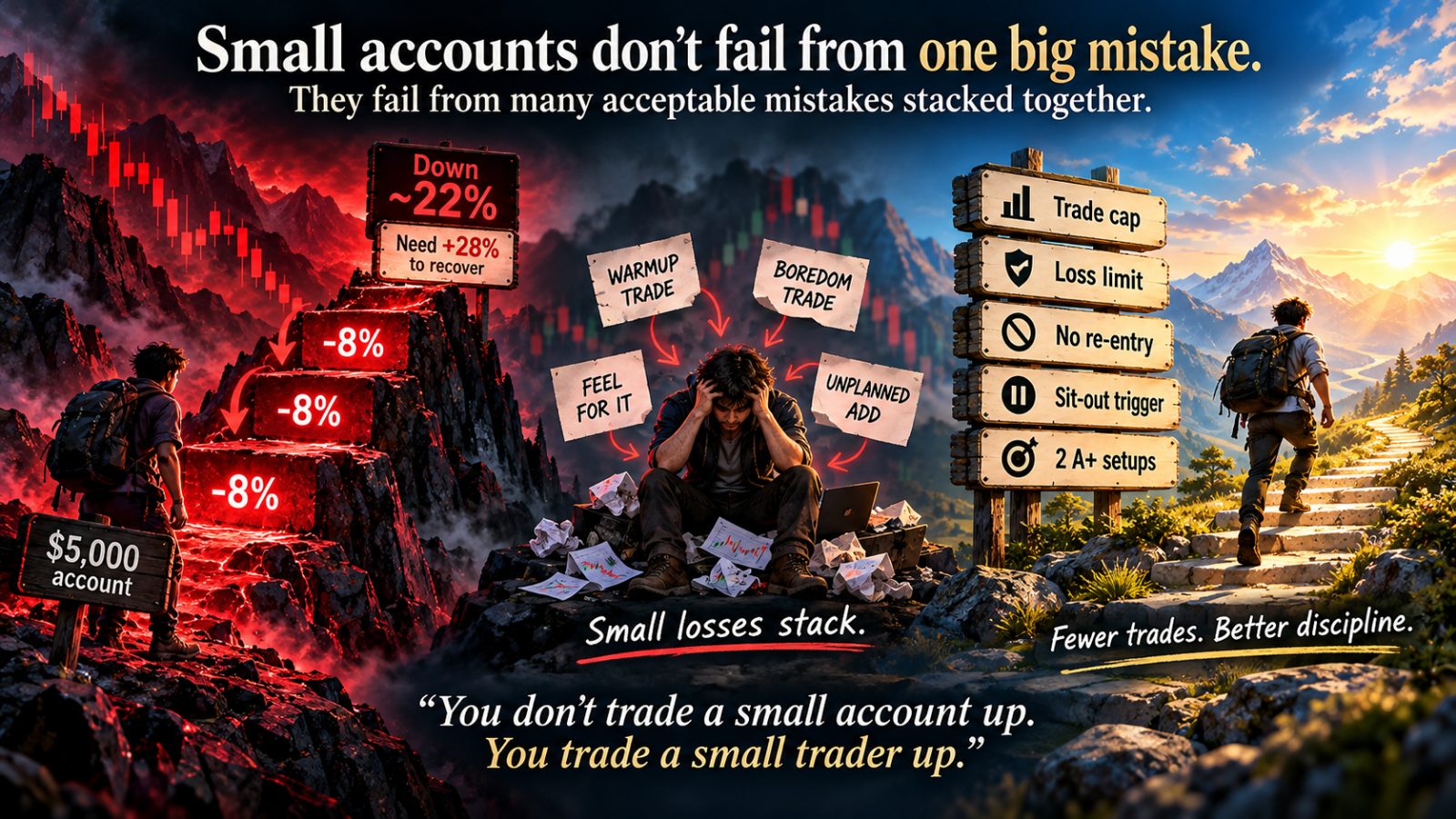
THE MATH NOBODY WANTS TO DO
Compounding runs both ways and the small side is steeper
Take a $5,000 account. One red day of negative 8% is $400. That's a dinner. Mentally it feels survivable, which is exactly the trap. To get back to flat from down 8% you need a green day of roughly 8.7%. Not a huge gap. Now stack three of those in a month, which is a very normal month for someone still learning. You're down about 22%. To climb back you need north of 28%.
Do that twice in a quarter and the hill in front of you is no longer a trading problem. It's a math problem that trading can't solve at the size you're now forced to run.
Meanwhile the funded trader next to you, running size on someone else's balance sheet, took the same three red days. Their drawdown rule kicked in, they sat out, they came back Monday. The structure around them did the discipline work their brain didn't have to.
The small account doesn't fail from one blown trade. It fails from a hundred acceptable ones, each small enough to justify, each stacked on the last.
THE SILENT KILLER
Overtrading is the only mistake small accounts can't survive
Ask a struggling small-account trader what killed their last run and they'll say a stock. A squeeze they shorted. A halt they got caught on. A gap down that ran them over. That's never what killed it. What killed it was the eleven trades on either side of that one — the warmup trade, the boredom trade, the "let me get a feel for it" trade, the fade of the bounce of the fade, the add that wasn't planned, the hedge that wasn't a hedge.
Each of those trades, in isolation, was fine. Each one cost somewhere between twelve and forty bucks in commissions, slippage, and bad fills. That's the kill shot. Not the big loss. The slow bleed from a trader who, in their head, is "being active" and "staying sharp," when what they're actually doing is paying rent to the broker to learn a lesson a journal would've taught them for free.
On a small account, every unnecessary trade is a tax that scales inversely to your size. A trader running $500k can eat forty dollars of friction and never feel it. A trader running $5k eats it four times a day and wonders why the account won't grow even on green weeks.
THE DISCIPLINE ASYMMETRY
You need more rules, not fewer, and the opposite is what you'll want
Here's the cruel part. The smaller the account, the more disciplined you have to be, and the smaller the account, the harder discipline feels. The pressure to "make something happen" compounds the smaller the base. Every green day looks like it should've been bigger. Every red day looks like it set you back a week. Both feelings push you toward more trades, bigger size, sloppier entries.
What the small-account trader actually needs looks like the opposite of what the small-account trader wants:
- Fewer setups, not more. Two A-plus patterns you can describe in a sentence, not nine you can almost recognize.
- A hard daily loss limit that's smaller than feels manly. If 2% stings, 2% is the number. The sting is the point.
- A hard trade count cap. Four trades. Five. Whatever the number is, it exists before the open, not after the third loser.
- A rule against re-entry on a stock that already stopped you out that session. One shot, one look, next ticker.
- A sit-out trigger — a specific count of red trades or a specific drawdown — that ends your day whether you "feel" done or not.
None of these rules are new. You've read them in every book. The question isn't whether you know them. The question is whether anything in your setup actually enforces them when the moment arrives, because the moment is always louder than the rule.
THE BELT YOU HAVEN'T EARNED YET
Small-account trading is the white belt phase, and you can't skip it
In jiu-jitsu there's a phase where you lose constantly, you tap constantly, and the only way through it is to show up and get submitted by someone slightly better than you until your body figures out what your brain already learned from watching. There is no shortcut. The guys who try to skip that phase, who tap less by rolling softer, who avoid the hard rounds, stay bad for years.
Small-account trading is the same phase. You're going to lose. You're going to feel small. The temptation to size up to "feel like a real trader" is the equivalent of avoiding the hard rolls. It feels like progress. It is the opposite of progress. It is you buying your way out of the exact rep you need to put in.
The traders who make it out of the small-account phase alive aren't the ones who got lucky on a runner. They're the ones who treated the small account like a dojo. Show up. Take the four trades. Honor the stop. Log the session. Leave. Do it again tomorrow. The account doesn't grow because of a single trade. It grows because the trader stopped being the problem.
You don't trade a small account up. You trade a small trader up, and the account follows.
What small accounts actually need
What the small-account trader is describing, usually without the words for it, is a structure that behaves like the risk desk a funded trader has sitting behind them. Something that counts the trades. Something that notices when today's third entry on the same ticker is a tilt entry, not a planned one. Something that sees the drawdown climbing and ends the session before the trader does something they can't math their way back from. Something that logs the behavior so next week isn't a rerun of this one.
Most small-account traders try to be that structure themselves, in real time, with the same brain that's trying to trade the open. That's the whole reason it doesn't work. The brain that needs to be disciplined cannot also be the thing enforcing the discipline — not under live pressure, not on a red day, not when the account is already small and the math is already tight.
MAKETZO is built to be the structure around the trader so the trader can be the trader. Trade count caps, loss limits, re-entry rules, behavioral flags on the setups that keep bleeding you — all enforced in the moment, not reviewed on Sunday after the account is already down. If you're running small and you're tired of being the only thing standing between your account and your worst habit, let something else carry that weight for a while.