
Nobody who's still trading after five years takes big losses anymore. They just don't. Ask them.
They take small ones constantly. Death by a thousand paper cuts is the shape of a long career. What ends careers is the one loss the trader wouldn't cut when it was still cheap — the one where the stop got "reassessed," where the thesis got "refined," where the size got averaged because surely it can't go lower from here.
The second time I blew up an account, it wasn't from a huge trade. It was from twelve small losses I refused to take when they were small. Every one of them was a decision to let a loser breathe. Every one of them was a decision the previous version of me would have made in reverse.
THE LIE
Small isn't small when you're inside it
The problem with a small loss is that it never feels small in the moment. It feels wrong. It feels like a mistake being made twice — once when you got in, once when you're stamping it official by getting out. So the mind reaches for the alternative that lets you stay a person who was right: hold it, work it, average it, wait for the bounce that only needs to be big enough to make the loss feel voluntary.
None of those are trades. They're all the same trade — a refusal to accept the position size you actually took.
What separates the small-cap trader who's still here from the one who isn't isn't pattern recognition. It's a boring, almost embarrassing willingness to press a button that says I was wrong for eighty bucks. Not two hundred. Not eight hundred. Eighty.
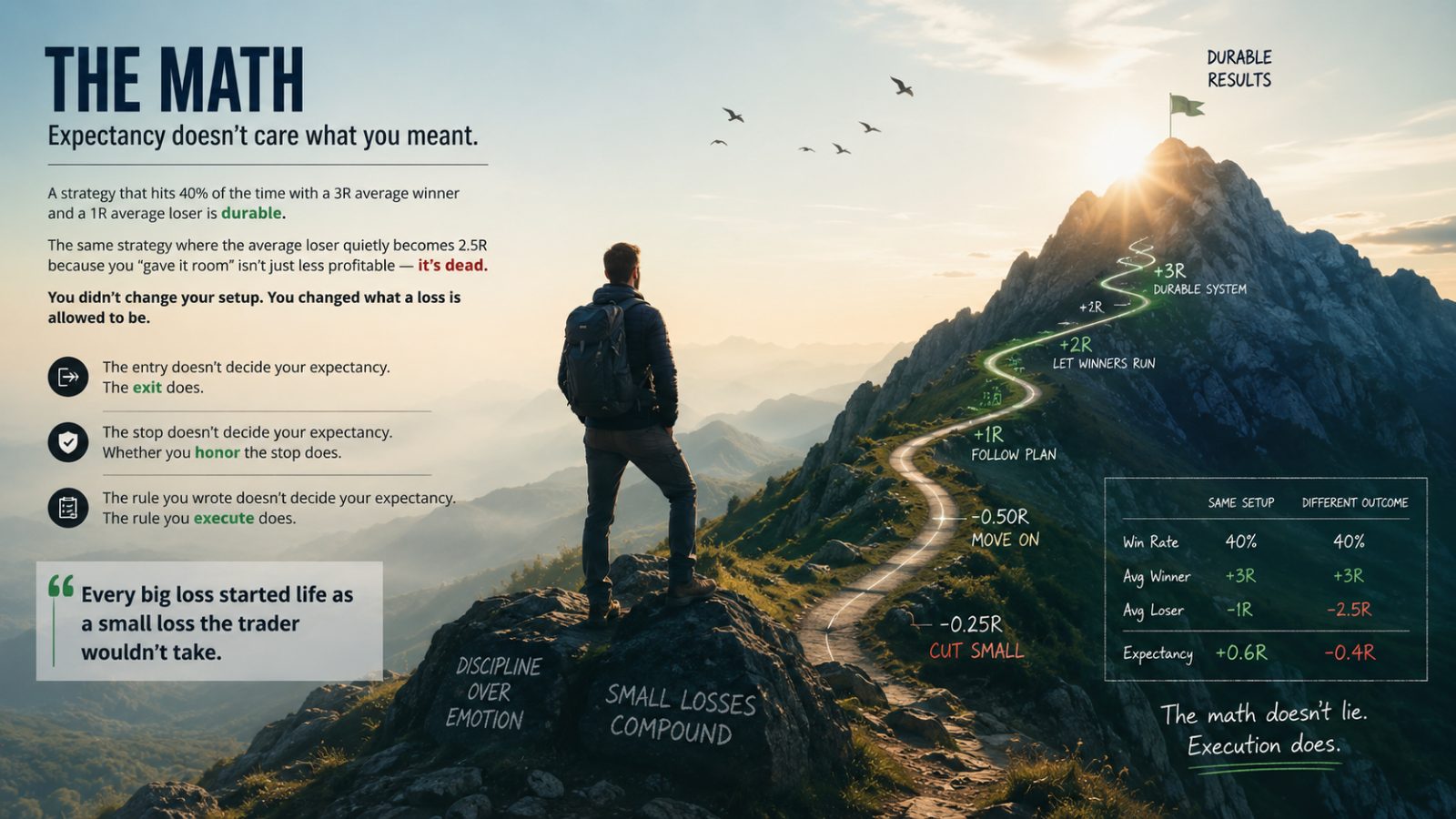
THE MATH
Expectancy doesn't care what you meant
The reason small losses build big winners isn't spiritual. It's arithmetic that most traders can quote and almost none actually run.
A strategy that hits 40% of the time with a 3R average winner and a 1R average loser is durable. The same strategy where the average loser quietly becomes 2.5R because you "gave it room" isn't just less profitable — it's dead. You've inverted the whole system without changing your entries. You didn't change your setup. You changed what a loss is allowed to be.
- The entry doesn't decide your expectancy. The exit does.
- The stop doesn't decide your expectancy. Whether you honor the stop does.
- The rule you wrote doesn't decide your expectancy. The rule you execute does.
Everybody has the same charts. What separates accounts is what happens between the moment a trade goes against you and the moment you're flat. That interval is the entire business.
Every big loss started life as a small loss the trader wouldn't take.
THE LESSON
What the second blow-up actually taught
The first blow-up teaches you the concept. You read the books afterward, nodding at the sections you skimmed the first time. You promise yourself you'll respect risk. You believe it. You mean it in the way you can only mean something after you've paid for the lesson in cash you didn't have.
Then you come back. You size smaller. You take the small losses for six weeks. You feel virtuous.
The second blow-up teaches you something different. It teaches you that the discipline decays. Not dramatically — nothing dramatic ever happens on the way to a blown account. It decays through the small permissions. One trade where the stop was "basically" honored. One trade where you added at the level you'd promised yourself was the invalidation. One trade where the loss felt too small to bother locking in, so you left it running "for a scalp back."
The first blow-up teaches you that risk matters. The second teaches you that you're the person who forgets.
Nobody stays disciplined by remembering to be disciplined. That's the whole trick, and it took me two accounts to see it. Discipline is a system that catches you before your worst version gets a chance to sign the paperwork.
THE PURCHASE
What you're actually buying with a small loss
Traders think a small loss is the cost of being wrong. It isn't. Being wrong is free — the market prints wrong entries all day and charges nothing extra for them.
What you're buying with a small loss is four specific things, and they're worth every penny:
- The right to see the next setup clearly. A trader carrying an unresolved loser cannot read the next chart. They're reading the P&L.
- The right to size the next trade correctly. A trader who let the last loss double can't size the next entry — they're either revenge-sizing or gun-shy.
- The right to still be here in October. Capital preservation isn't a mindset. It's the literal condition of having an account to trade.
- The right to stay the trader you were an hour ago. Every unresolved loss is a slow mutation. You don't notice it changing you until you're placing trades a stranger would recognize as desperate.
The small loss is expensive-feeling and cheap-actually. The refused small loss is cheap-feeling and career-ending.
You're not paying to be wrong. You're paying to still be the trader who can be right tomorrow.
THE SHAPE
Winners look like a long ledger of small L's
Pull up any equity curve from a trader who's compounded for years. The wins are lumpy — a few outsize green days carry most of the year. But the losing days? They're a flat line of small red bars, none of them memorable, none of them fatal. That flatness is the entire achievement. The green comes from setups. The flatness comes from character.
The trader who cuts small isn't more talented. They're more architected. Their exit is not a decision they're making in real time under duress. It's a decision they made once, in advance, and installed as a reflex. The market only gets to test the reflex, not the resolve.
That's the difference between a trader who blows up twice and a trader who blows up zero times. Not resolve. Architecture.
If you've read this far, you already know the small loss isn't your problem. Taking it is. The gap between the rule you wrote in your journal Sunday night and the finger that won't press the button Wednesday at 10:04 — that's the whole game, and willpower has never once closed it for anyone.
What closes it is a system that sees the loss going past its number before you do, that names the size drift before it becomes an average-down, that flags the sequence of small permissions before they compound into the trade that ends the month. Something that behaves like the version of you who wrote the rules, standing next to the version of you who's about to break them. That's what MAKETZO was built to be. If you're tired of learning the same lesson a third time, take the trial and let a system hold the line your discipline keeps handing back.