
Nobody respects the trader who never loses. They respect the one who's still here.
The two are not the same person. The first one is a story you tell at the bar. The second one is the account that quietly compounds for a decade because it never had to climb back from a 40% hole. Every trader eventually finds out which one they are, and most find out the hard way.
The small loss is not a failure of your trade. It's the thing that lets you take the next one. That's the whole frame. Not courage, not conviction, not reading the tape better than the next person. Just: did you lose in a way you can come back from before lunch, or in a way that took the week.
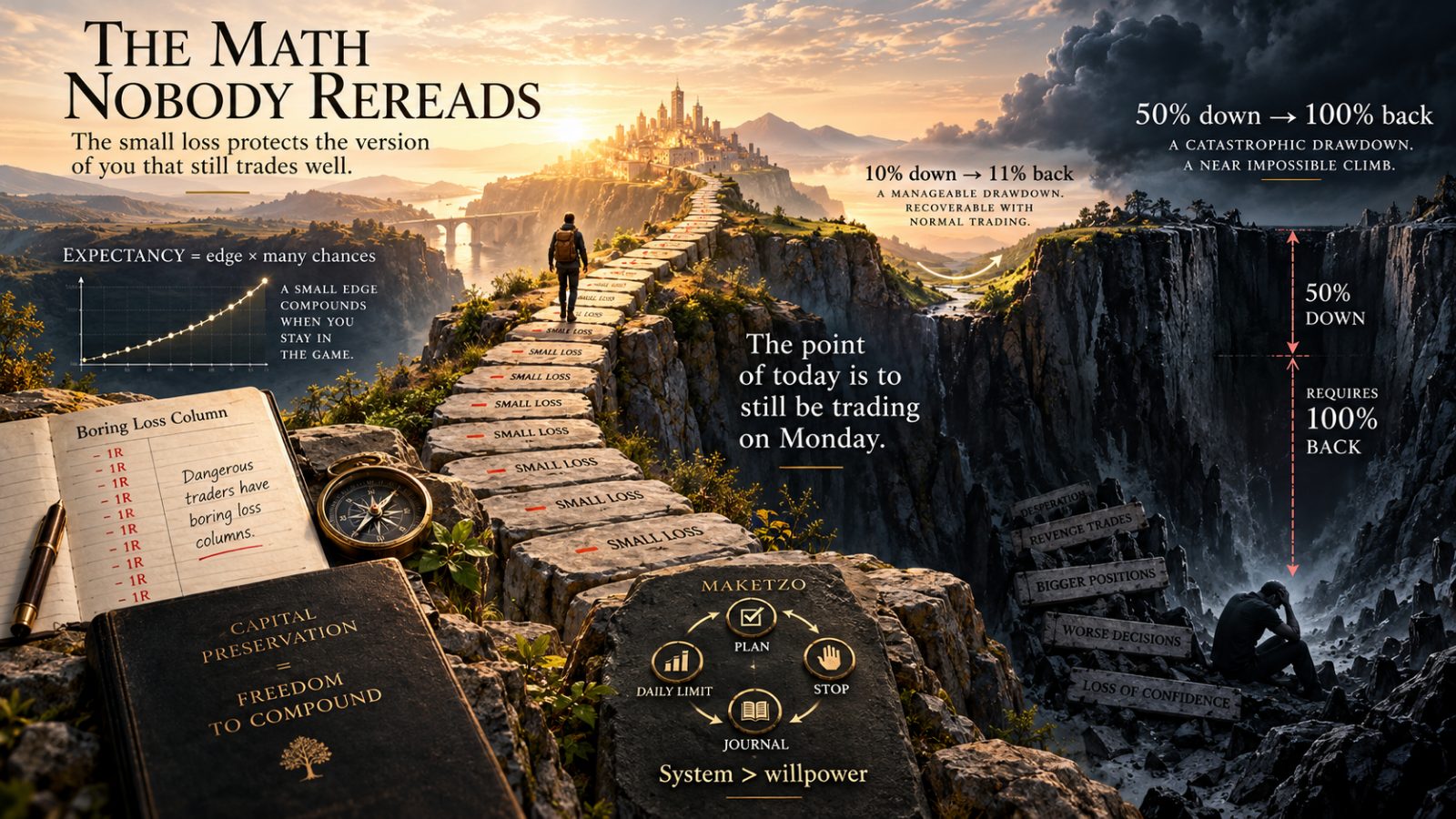
THE MATH NOBODY REREADS
A 10% drawdown asks for 11% back. A 50% drawdown asks for 100%.
You've seen this table. Every risk book prints it. And every trader who has ever ignored a stop has felt it in their chest at 2pm on a Tuesday, staring at a position that is now a problem instead of a trade.
Here is the part the table doesn't show. The 10% hole is a problem you solve with normal trading. You keep sizing, you keep taking A+ setups, you grind it back inside two weeks and nothing about your process has to change. The 50% hole is a problem you can only solve by becoming a different, worse trader — one who sizes up to "get it back," who takes B- setups because A+ setups don't move the needle anymore, who holds losers because closing them makes the hole real.
The small loss protects the version of you that still trades well. The big loss replaces that trader with someone desperate wearing their clothes.
The small loss protects the version of you that still trades well. The big loss replaces that trader with someone desperate wearing their clothes.
EXPECTANCY
Your edge is a tiny number multiplied by a lot of chances
Pick any honest edge in small-caps. A clean morning gap reclaim. A failed breakdown off the premarket low. Whatever your setup is, if you've journaled it long enough you know the real number. Something like 42% win rate, average winner twice the average loser, net positive expectancy per trade of maybe a few tenths of R.
That edge is real. It also only works if you get to run it a thousand times.
Three things kill the "thousand times" part:
- One loss that's four times the size of your normal loss. You now need six good trades just to be flat on the week.
- A string of normal losses you refuse to accept at the stop, each one quietly becoming an abnormal loss.
- A win you give back because you couldn't close red, so you held the winner too long waiting for the loser to also come back.
None of those are strategy problems. They're all the same problem, which is that at the moment the stop hit, you decided your judgment about this one trade was better than the hundred-trade sample that proved your edge in the first place. The small loss is you siding with the sample. The refused loss is you siding with the story.
PSYCHOLOGY
Taking the stop is not weakness. It's the only part of this that's optional.
Most of a trade isn't yours. The entry is a guess dressed up as a plan. The exit on the winning side is mostly the stock's decision. The only piece of the trade that is 100% in your control, every single time, is whether you honor the stop you wrote down before the position had feelings attached to it.
Which is why the stop is where traders fight themselves hardest. It's the one place the market can't overrule you. Taking it means admitting that you were wrong in public, on your own screen, with real money. Not honoring it means you get to stay in the fantasy for another ten minutes.
The small loss is cheap because you paid it with money. The big loss is expensive because you paid it with the belief that you can trust yourself. That second currency is the one you can't earn back by Friday.
CAPITAL PRESERVATION
The point of today is to still be trading on Monday
There is a specific feeling that comes after a clean red day where every loss was a planned loss. Not a good feeling. Not a bad one. Flat. You journal it, you close the platform, you make dinner. Nothing broke.
That flat feeling is the entire asset. It means you'll size the same tomorrow, take the same setups tomorrow, trust the same stops tomorrow. The account is down a controlled amount and the trader on top of the account is unchanged. That's capital preservation in the sense that actually matters — not just the dollar line, but the operator.
Compare that to the night after a loss that doubled on you because you widened the stop at 10:40 and widened it again at 10:52. The dollars are recoverable. The operator isn't the same. Tomorrow that operator will either revenge-size or paper-trade for a week to avoid feeling it. Neither of those is your edge.
THE QUIET COMPOUND
Dangerous traders have boring loss columns
If you look at the loss column of a trader who's been doing this profitably for five years, it's shocking how uninteresting it is. Every red trade is roughly the same size. Not identical, but close. There's no row that's three times the others. No week where one bad decision shows up as a crater.
That uniformity is not luck. It's the single habit the entire career is built on. Everything else — the setups, the tickers, the entries — can evolve. The loss size cannot. It is the invariant.
And it's what makes that trader dangerous. Not the winners, which anyone can have for a week. The fact that nothing on their worst day took them out of the game on their best day. They are always one setup away from a good month because they are never one trade away from a blown account.
WHAT ACTUALLY HELPS
You don't need more conviction. You need a system that makes small losses the default.
Everything written above sounds like a mindset problem. It isn't. It's an architecture problem. The trader who takes the stop every time is not more disciplined than you in some mystical way. They've built a loop around themselves where not taking the stop is harder than taking it.
That loop looks like: a pre-market plan that names the stop before the position exists. A platform state that flags when size, stop, or time in trade are drifting from the plan. A journal that doesn't just log the trade but surfaces the specific decision that turned a small loss into a bigger one, so the pattern can't hide. A line at the daily loss limit that closes the day for you instead of asking politely.
That's the thing a tool like MAKETZO is actually for. Not picking your trades. Making it uncomfortable to break your own rules — flagging the drift, naming the pattern, holding the line at the daily stop so the version of you at 11:18 doesn't get to overrule the version of you at 8:30. The small loss stops being a willpower event and starts being the default output of the system you're running.
You already know the edge. You already know the stop. You already know which trades last week should have been small losses and became something else. What you need is the loop that makes next week different.