
A trader I know keeps a spreadsheet of every setup he's taken for the last eighteen months. Win rate by pattern, by time of day, by float, by catalyst. He can tell you which setup prints money and which one bleeds him dry.
He still takes the bleeding one. Not every day. Just the days he's bored, or down, or convinced this one is different. That's enough. You don't need to break your rules often to erase your edge — you just need to break them on the trades that matter.
This is what people mean when they say they're trading randomly. They don't mean they have no plan. They mean the plan is a suggestion that competes, in real time, with their mood.
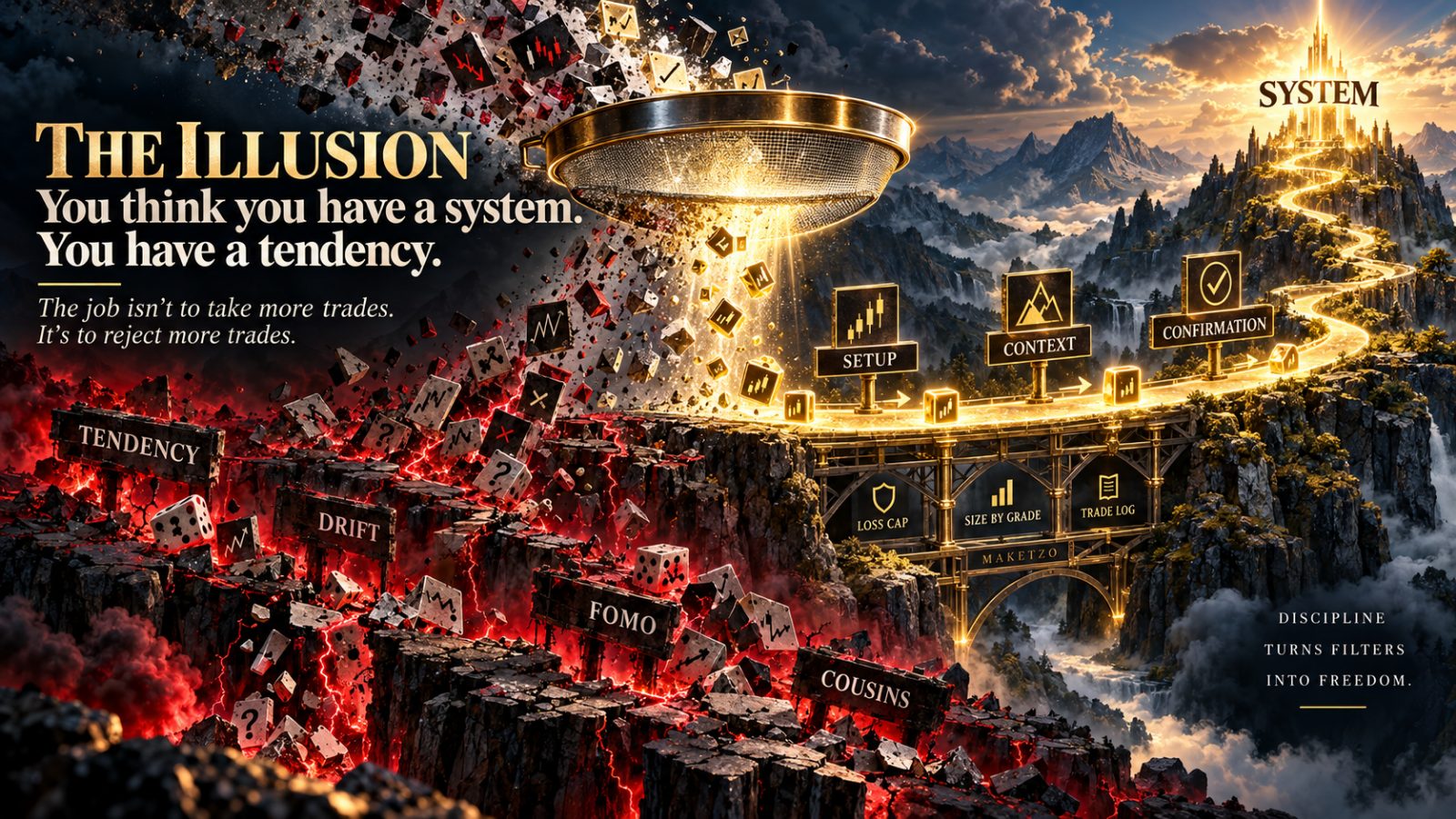
THE ILLUSION
You think you have a system. You have a tendency.
Ask any struggling trader what their setup is and they'll give you a clean answer. Breakout over the premarket high with volume. Failed follow-through on an overextended runner. First red candle after a parabolic move. Textbook. Articulated. Backtested in their head a thousand times.
Now pull their last fifty trades. Count how many actually matched the description they just gave you. If you're honest, the number is somewhere between a third and a half. The rest are cousins of the setup. Second cousins. Strangers wearing the setup's jacket.
A tendency is a setup you take when the conditions remind you of the setup. A system is a setup you take only when the conditions are the setup, and you pass on everything else without negotiation. Most retail traders have the first and believe they have the second. The gap between those two things is where the account goes.
THE MATH
Randomness doesn't lose slowly. It compounds.
Here's what nobody wants to look at. If your A-setup is a 55% winner at 2R and your impulsive trades are a 40% winner at 1R, you don't have a 55% strategy with some noise around it. You have whatever weighted average emerges from the ratio of discipline to drift that particular week. And that ratio moves.
Green week, discipline is easy, the ratio is 80/20, your numbers look like a professional's. Red week, discipline cracks, the ratio flips to 40/60, and now the exact same trader with the exact same screen is running a losing strategy. Same brain. Same software. Different inputs on the human side.
A system you only follow on good days isn't a system. It's a mood with a backtest attached.
This is the thing that drives traders insane and keeps them stuck for years. They look at their results and conclude the edge doesn't work. The edge works fine. The execution of the edge is what's random, and random execution of a positive-expectancy setup produces results that look exactly like a negative-expectancy setup. You can't tell them apart from the equity curve alone.
THE FILTER
The job isn't to take more trades. It's to reject more trades.
Rule-based execution sounds like it's about rules. It isn't. It's about what you do with everything that isn't a rule. The real work is the no.
Every chart that moves is a candidate. Candidates aren't trades. A candidate becomes a trade only when it passes a specific sequence of filters, in order, without you adjusting the filters mid-check to let it through. The sequence matters more than the content of any single filter. Three filters, applied every time, will outperform ten filters applied selectively.
- Does this match the setup I defined before the open — not a cousin, the thing itself?
- Is the context the one the setup needs, or am I about to argue that today's context is close enough?
- Is my entry trigger actually here, or am I front-running it because I'm afraid of missing?
If any of those is a no, the candidate dies. Not postponed. Not reduced in size. Dies. The trader who can kill a candidate at the second filter without flinching is the trader who gets to keep the P&L of the ones that make it through all three.
THE CONFIRMATION
Waiting isn't passivity. It's the trade.
Impulse trades almost always share a tell: they happen a beat before confirmation. The entry is a prediction, not a response. You see the move setting up, you feel the certainty, and you click before the market has actually done the thing you need it to do. When it does the thing, you feel vindicated. When it doesn't, you tell yourself you were early.
Early is a word that lets random trades hide inside your system. There's no such thing as early. There's confirmed and there's not confirmed. If you entered before the confirmation, you weren't early — you took a different trade than the one you planned. A worse one, with a worse edge, under a worse frame of mind.
The traders who stop trading randomly aren't more patient as a personality trait. They've just stopped letting themselves rename impulsive entries as prescient ones. They let the setup prove itself before they fund it. That one shift collapses most of the randomness out of a book without changing a single setup, a single indicator, a single ticker on the list.
THE INFRASTRUCTURE
Discipline is a workflow problem, not a willpower problem.
You can't out-willpower a brain that's been staring at tickers for four hours, down on the day, watching other traders post green screenshots. Nobody can. The traders who look disciplined aren't fighting harder in those moments — they've built an environment that makes the undisciplined trade physically harder to execute than the disciplined one.
That means a defined setup list written before the open and visible during the session. A size that's determined by the setup's grade, not by how confident you feel. A loss cap that stops you before your judgment degrades, not after. A log that gets filled in trade-by-trade so you can't lie to yourself at the end of the week about what you actually did versus what you meant to do.
This is what people are reaching for when they say they want to stop trading randomly. They don't need a new strategy. They need a scaffolding around the strategy they already have — one that filters candidates, enforces confirmation, flags the drift from A-setups toward cousins, and tells them, out loud, when their execution is starting to look nothing like the plan they laid out two hours ago.
That scaffolding is what MAKETZO is. Not a signal service, not a magic indicator — a trade intelligence layer that watches the gap between your defined edge and your real-time behavior, and closes it in the moments your willpower won't. If you've been running a decent strategy and getting random results, this is the layer that's been missing. Try it for a week and see what your edge looks like when the randomness is squeezed out of it.