
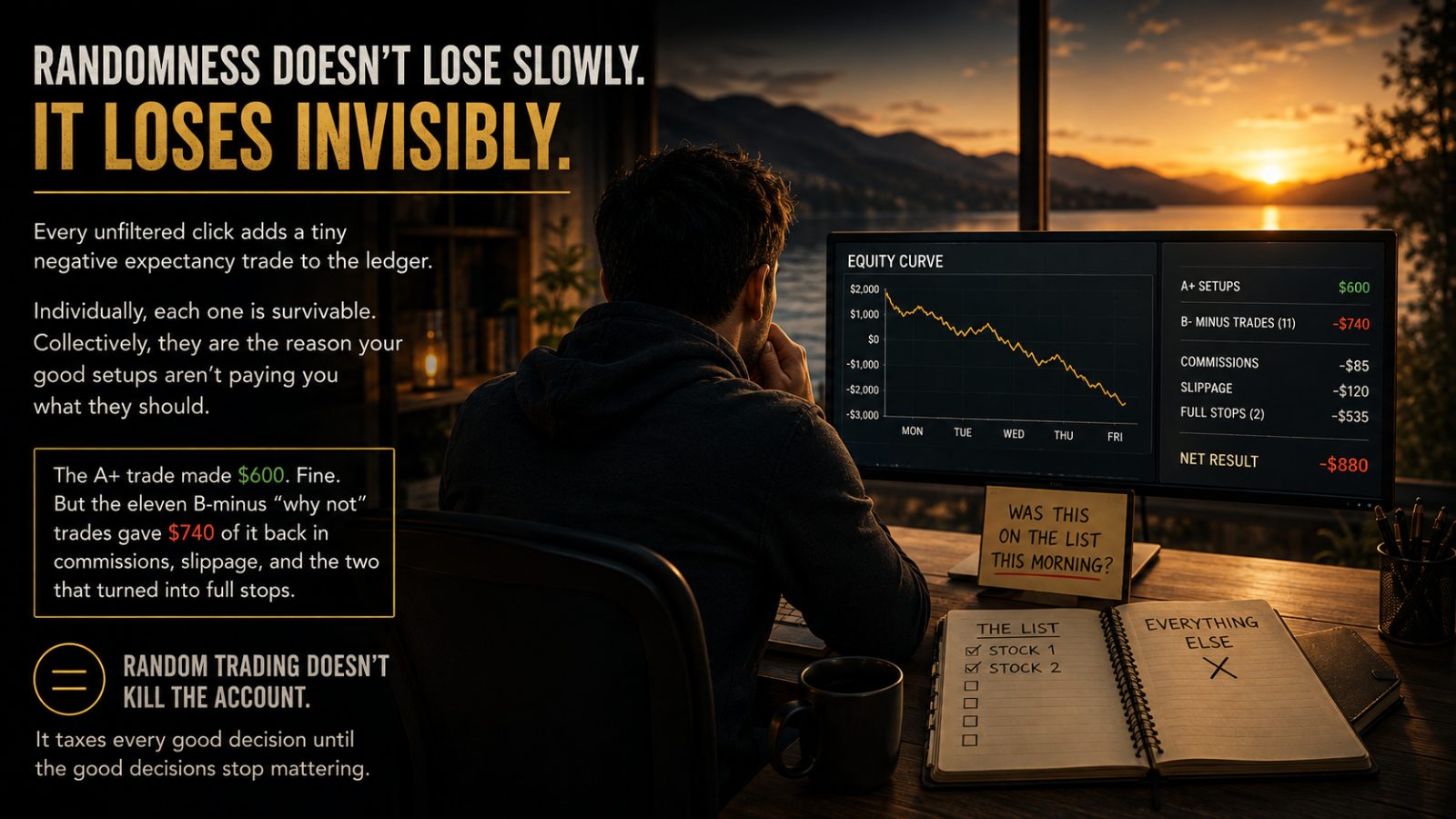
A trader I know keeps a note taped to the bezel of his second monitor. It reads: Was this on the list this morning? He put it there after a Tuesday where he lost more on stocks he'd never heard of at 8am than on the two he'd actually prepared for. He didn't blow up. He just did what most of us do — he traded whatever moved.
That's the quiet definition of random trading. Not reckless. Not emotional, necessarily. Just unfiltered. Something on the scanner lit up, the shape was familiar enough, the finger was already hovering, and the trade got taken. If you asked him later why that ticker, he'd give you a reason. He'd mean it. But the reason was reverse-engineered from the entry, not the other way around.
THE ILLUSION
A pattern you noticed is not a pattern you tested
Small-cap traders live inside a specific hallucination: because the setups repeat, we assume we're pattern-matching. And sometimes we are. But most of the day, the eye is doing something dumber than pattern recognition — it's doing shape recognition. A red-to-green reclaim looks a lot like a bull trap looks a lot like a stuffed halt candle looks a lot like the exact move that just paid you yesterday. Your brain files them together because they rhyme visually. Your P&L files them very, very differently.
The tell that you're shape-trading instead of setup-trading is simple: you can't write down, before the trade, what would make it invalid. If the only exit plan is "if it doesn't work," the entry wasn't a plan. It was a vibe with a position size attached.
A reason you found after clicking buy is not a reason. It's an alibi.
THE MATH
Randomness doesn't lose slowly. It loses invisibly.
Here's the part that gets underrated. Random trading rarely produces a spectacular red day. It produces a fog. You end the week down a little. Down a little more. Green Wednesday, so it feels fine. The equity curve isn't falling off a cliff; it's slowly leaking through a seam you can't locate because there isn't one seam — there are forty.
Every unfiltered click adds a tiny negative expectancy trade to the ledger. Individually, each one is survivable. Collectively, they are the reason your good setups aren't paying you what they should. The A+ trade made $600. Fine. But the eleven B-minus "why not" trades between 9:45 and 11:15 gave $740 of it back in commissions, slippage, and the two that turned into full stops because you were already sized in on nothing when the real one showed up.
Random trading doesn't kill the account. It taxes every good decision until the good decisions stop mattering.
THE FILTER
A rule you'll actually follow beats a rule that's actually optimal
The correct response to random trading is not a more sophisticated strategy. It's a shorter list. Traders love to solve chaos by adding — another indicator, another scanner, another timeframe. Chaos is not solved by adding. It's solved by subtracting until only the thing you can defend remains.
The practical version looks like this:
- A written setup, in a sentence. If it takes a paragraph, it's actually three setups pretending to be one.
- A pre-market list. Not a watchlist of forty. Three names, maybe five. If a ticker isn't on it, you need a real reason to override — not a scanner alert, a reason.
- A confirmation you have to wait for. One specific event that has to happen after you notice the shape. This is the checkpoint that kills 80% of shape-trades, because most shapes never produce the confirmation. That's the whole point.
- An invalidation written before the entry. Not a stop-loss level. A thesis-invalidation. What would tell you the setup you thought you saw isn't the setup you're actually in.
None of that is exotic. All of it is boring. Boring is the feature. A rule you'll follow at 10:37 on the third red day of the week is worth ten rules you'll follow at 9:31 on Monday when you're fresh.
THE HARDER PART
The trades you don't take are the ones that prove the system works
Here's the thing nobody tells you about switching from random to rule-based. It feels worse before it feels better. For the first two weeks, you will watch things run without you. You will watch shape-trades — the exact junk that was leaking your account — do the move they occasionally do. You will feel stupid. You will feel slow. You will feel like the rules are the problem, because the rules kept you out of the one runner you would have caught.
What you won't feel, in that same two weeks, is the forty small red trades you didn't take. You can't feel absence. You can only feel the runner you missed. This is why almost nobody makes it through the transition on their own — because the reward for filtering is invisible, and the punishment for filtering is loud.
You can't feel the trades that didn't happen. That's the whole problem, and it's also the whole edge.
The way through is to make the invisible visible. Log the trades you didn't take. Log the setups that didn't confirm. Log the moments you overrode the list and what it cost. Not because logging is virtuous, but because the ledger is the only thing standing between you and the version of yourself who, at 11:24 on Thursday, sees a shape and clicks.
THE HANDOFF
A system that filters before you can flinch
Everything above is doable alone. Traders have done it alone for decades. But doing it alone requires you to be the setup, the confirmation, the invalidation, the logger of skipped trades, and the person who has to feel the pain of the missed runner without a witness. That is a lot of jobs for one nervous system running on three hours of sleep and a cold coffee.
This is where a discipline platform earns its place. Not by picking your trades — nobody wants that, and it doesn't work anyway — but by putting the filter in front of the click. A pre-market list that has to exist. A setup that has to be named. A confirmation that has to be checked. A skipped-trade log that fills itself. A record, at the end of the day, of how many times the random shape came up and how many times you didn't take it.
MAKETZO is built for the trader who already knows the difference between a setup and a shape and cannot, alone, stop themselves from trading the shape anyway. If that is the fight you're actually in, the tool is here.