
Ask a losing trader to describe their setup and watch them freestyle.
They'll start with something that sounds like a rule — "I look for a stock with news and volume" — and by sentence three they're describing feel. The tape looked heavy. It seemed like it wanted to go. The float was tight so they gave it more room. Somewhere between the words "setup" and "exit" the criteria stopped being criteria and became weather.
This is the quiet crisis at the center of most retail P&L: the trader thinks they have a strategy, but what they actually have is a mood with tickers attached.
SECTION ONE
Randomness wearing a rulebook
The word "setup" does a lot of dishonest work in this business. It implies a repeatable, definable, countable pattern. But if you asked a random-execution trader to write down — in advance, before the bell — the exact conditions under which they would take a trade, most couldn't do it in under a paragraph. And a paragraph is not a rule. A paragraph is a story you'll edit in real time to justify what you were going to do anyway.
Rule-based execution has one property that mood-based execution can't fake: it produces the same decision twice given the same input. Run the tape back on your last twenty trades. If you can't find twenty near-identical entries, you weren't running a setup. You were narrating.
SECTION TWO
Why randomness feels smart in the moment
Random trades don't feel random. That's the whole problem. They feel like instinct — a fast, confident, almost bodily recognition that this one is different. The setup wasn't quite there, but the tape was talking. You could feel it.
What you were actually feeling was pattern-matching noise against a database of every prior chart you've ever stared at, weighted heavily by the last two hours. It's not intuition. It's availability bias with a heartbeat.
You don't have a strategy. You have a mood with tickers attached — and moods don't have a hit rate you can measure.
The tell is simple. Ask yourself, honestly: could I have written down the exact conditions for this trade before the day started? Not the story you'd tell after — the input, in advance, in one sentence a stranger could execute. If the answer is no, the trade was random. It may still work. Random trades work often enough to keep you doing them. That's the trap.
SECTION THREE
The filter that isn't actually filtering
Most traders believe they filter trades. They don't. They filter the language they use to describe trades. There is a difference.
Real filtering looks like this:
- A written pre-market list of names that qualify. Everything not on the list is invisible.
- A specific entry trigger — one that either fires or doesn't, with no intermediate "kind of."
- A confirmation the market has to give you, not one you construct in your head after the fact.
- A disqualifier that will kick you out of a stalking position without you having to argue with yourself.
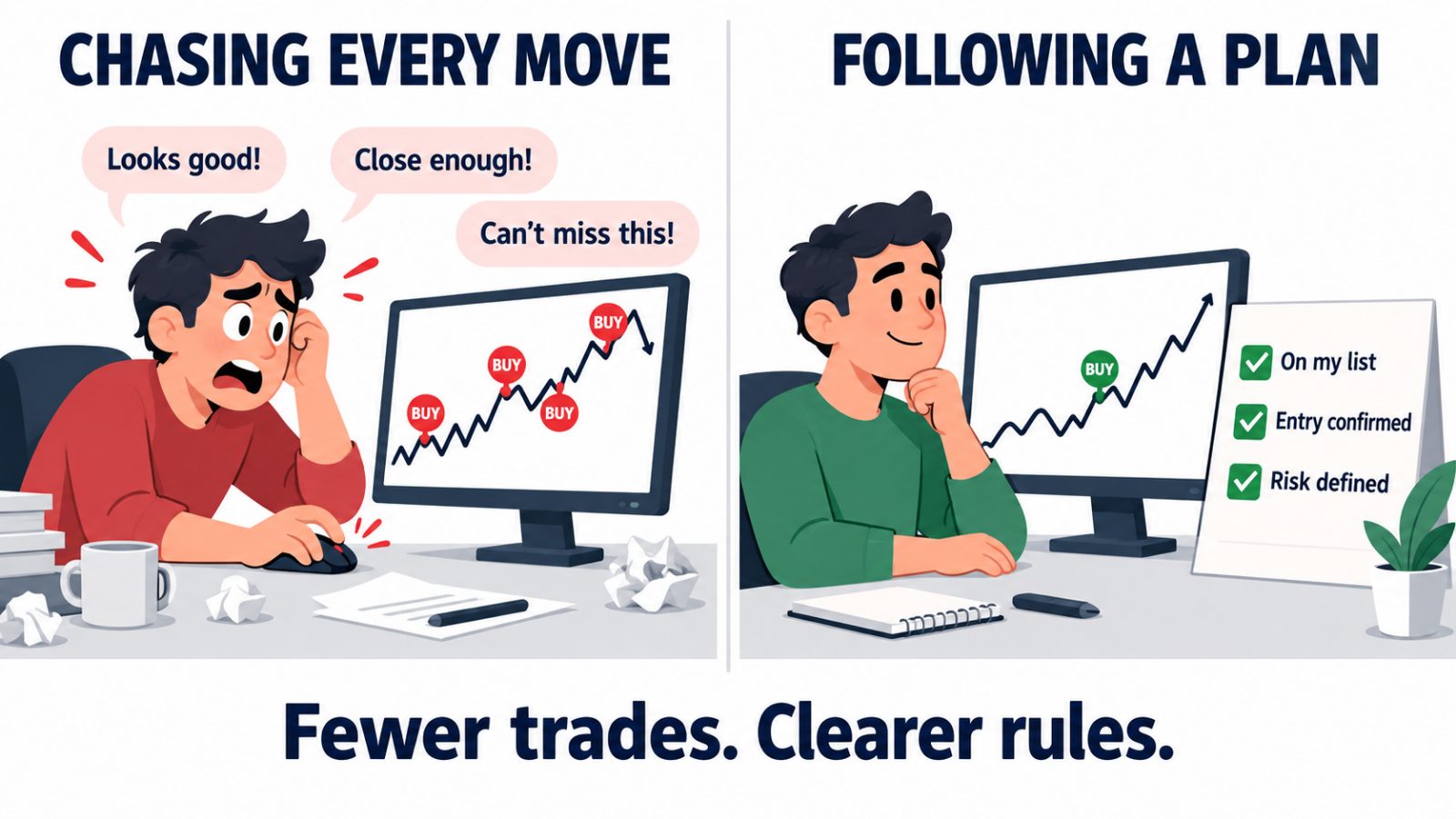
What most traders do instead is vibe-filter. The name isn't on the list, but it's ripping. The trigger didn't quite fire, but it's close enough. Confirmation is what you saw thirty seconds after entry. The disqualifier gets renegotiated the moment it's triggered because the story changed.
Vibe-filtering is randomness with a vocabulary. It is the single most expensive thing a retail trader does, and the reason it survives is that the trader can always point to the words and say — see, I had a process.
SECTION FOUR
What rule-based execution actually costs
Nobody talks about this part, so here it is: real filtering feels bad. It feels like watching runners go without you. It feels like sitting through an entire session and taking two trades when the guy in your Discord took eleven. It feels like missing the move that would have made your week — over and over — because it didn't fit the one thing you said you'd wait for.
This is the actual price of not being random. Most traders will not pay it. They'd rather take eight impulsive trades that average out to a small loss than take two clean ones and spend six hours doing nothing. The math of the first path is worse. The feeling of the first path is better. That's why the first path wins the day and loses the year.
Real filtering feels like watching runners go without you. That feeling is the tuition on the discipline.
The trader who runs rules is bored more often, wrong less often, and — this is the part that matters — can actually improve. A random trader can't improve, because there's nothing to improve on. You can't debug a mood. You can debug a rule.
THE TURN
Build the system that won't let you freestyle
The uncomfortable truth is that willpower does not solve randomness. You already know your rules. You already know the trade wasn't on the list. The problem isn't the knowing. The problem is the moment between the impulse and the click, when the story writes itself faster than the rule can defend itself.
What closes that gap is not more knowledge. It is a system that sits between you and the button — one that flags the trade that wasn't on the list, that counts your out-of-plan entries in real time, that shows you the pattern of your impulsive fills before the day ends instead of six months later when the account is smaller. A system that makes it harder to freestyle than to follow the plan you already wrote.
That is the entire point of MAKETZO. We built the accountability layer for the trader who has the rules and can't consistently execute them — the trader who's tired of finding out at the end of the month that half their trades weren't setups at all. If that's the gap you're trying to close, this is what closing it looks like.