
Nobody blows up on their small losses.
They blow up on the loss they refused to take small.
Say that sentence out loud and watch what happens in your chest. If you've been trading longer than six months you already know it's true. You've already lived it. You just haven't organized your whole method around it yet.
THE PAPER CUT
Small losses don't kill accounts. They're what accounts are made of.
Think about what actually happened the two or three times you seriously damaged an account. Not "had a bad day." Damaged. The month you had to explain to yourself in the shower.
It wasn't a series of well-taken stops that added up to a bad number. It was one trade, sometimes two, where you decided the small loss wasn't the loss you were going to take today. You were going to give it room. You were going to be patient. You were going to let it work.
Every big loss you've ever taken started as a small loss you were qualified to take and chose not to. That's not motivation. That's forensic accounting on your own account.
The small loss isn't a loss. It's a receipt for still being in the seat tomorrow.
Nothing has actually failed when you take a small loss cleanly. The system worked. The premise didn't. Those are different things, and only one of them costs you anything real.
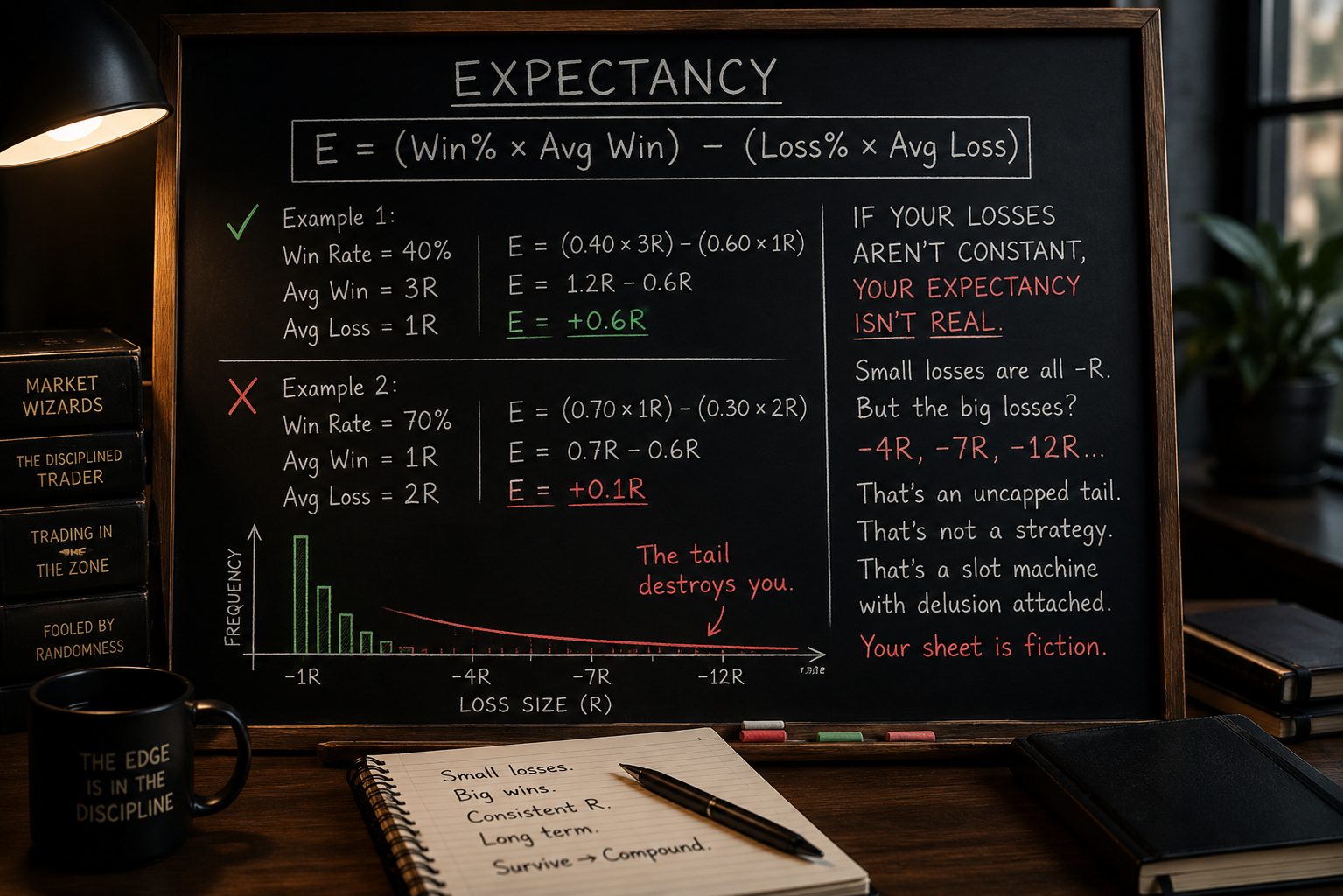
EXPECTANCY
The math is boring. That's why nobody runs it.
You already know the expectancy formula. Win rate times average win, minus loss rate times average loss. You know a 40% win rate at a 3-to-1 payoff crushes a 70% win rate at 1-to-2. You could draw it on a napkin.
None of that matters if your average loss is a variable instead of a constant.
The trader whose small losses are all −R and whose big losses are −4R, −7R, −12R doesn't have a strategy. They have a slot machine with delusion attached. Their expectancy sheet is a work of fiction because the tail on the loss side is uncapped and they know it.
Your account doesn't die from bullets. It dies from the one you decided to hold.
Small, uniform losses are the only thing that makes the winning side of your ledger arithmetically meaningful. A +5R winner does not offset a −8R "I know this thing turns around here." It offsets nothing. It funds the next one.
THE NERVOUS SYSTEM
You can't out-think a body that thinks it's dying.
Capital preservation isn't only math. It's the reason your prefrontal cortex is still online three hours into the session.
When you take a small planned loss, your body registers it as a survivable event. Nothing to reorganize. The next setup gets the same attention as the last one. You are still a trader.
When you take a loss five times bigger than you planned to take, something else happens. Your sympathetic nervous system logs it as a threat. Now every decision for the rest of the day — the size, the entry, the exit, the "one more" — is being made by a person your morning self would not have hired.
The reason small losses create big winners is that they leave the trader intact enough to still recognize a big winner when it prints. A trader in a fight-or-flight loop doesn't hold a runner. Doesn't press a good idea. Doesn't sit through the pullback that separates a +1R from a +6R. They scratch it because their body is trying to make the bad feeling stop.
Small losses protect the account. They also protect the operator.
THE SECOND TIME
The lesson the first blow-up doesn't teach.
The first time you seriously damage an account, you tell yourself it was position sizing. Or a bad stock. Or the tape was weird. You reduce size, you promise to be more careful, and you get back in.
The second time you damage an account is when the lesson finally lands, because you can no longer blame the tape or the ticker or the size. The variable that stayed constant between blow-up one and blow-up two was you — specifically the version of you that will not take a small loss when a small loss is what's on offer.
That version of you doesn't need more information. Doesn't need a new setup. Doesn't need a better watchlist. That version of you needs a structure that makes taking the small loss the path of least resistance instead of the path of maximum ego pain.
You have to make the honorable exit cheaper than the dishonorable hold.
That's what a real trading operation does. Not through willpower. Through architecture.
THE TURN
Small losses need a scaffolding, not a sermon.
Every trader who compounds has some version of the same infrastructure. Rules that fire before emotion does. A record of every time they took the small loss and every time they didn't, so the pattern becomes undeniable instead of deniable. Something outside their own head reminding them what today's version of "small" actually is, before today's account is on the table.
MAKETZO is that scaffolding. It's built for the trader who already knows all of this and still, at the moment of truth, negotiates. It flags the position that has drifted past the stop you wrote down when you were calm. It counts the small losses you took cleanly today and the ones you talked yourself out of. It notices when the day's arithmetic is starting to tilt into blow-up geometry, and it says so, in language you set for yourself before the session started.
None of that trades for you. All of it makes the small loss — the one you already know you should take — the easiest thing in the room instead of the hardest.
Which is what a big winner is actually built out of.