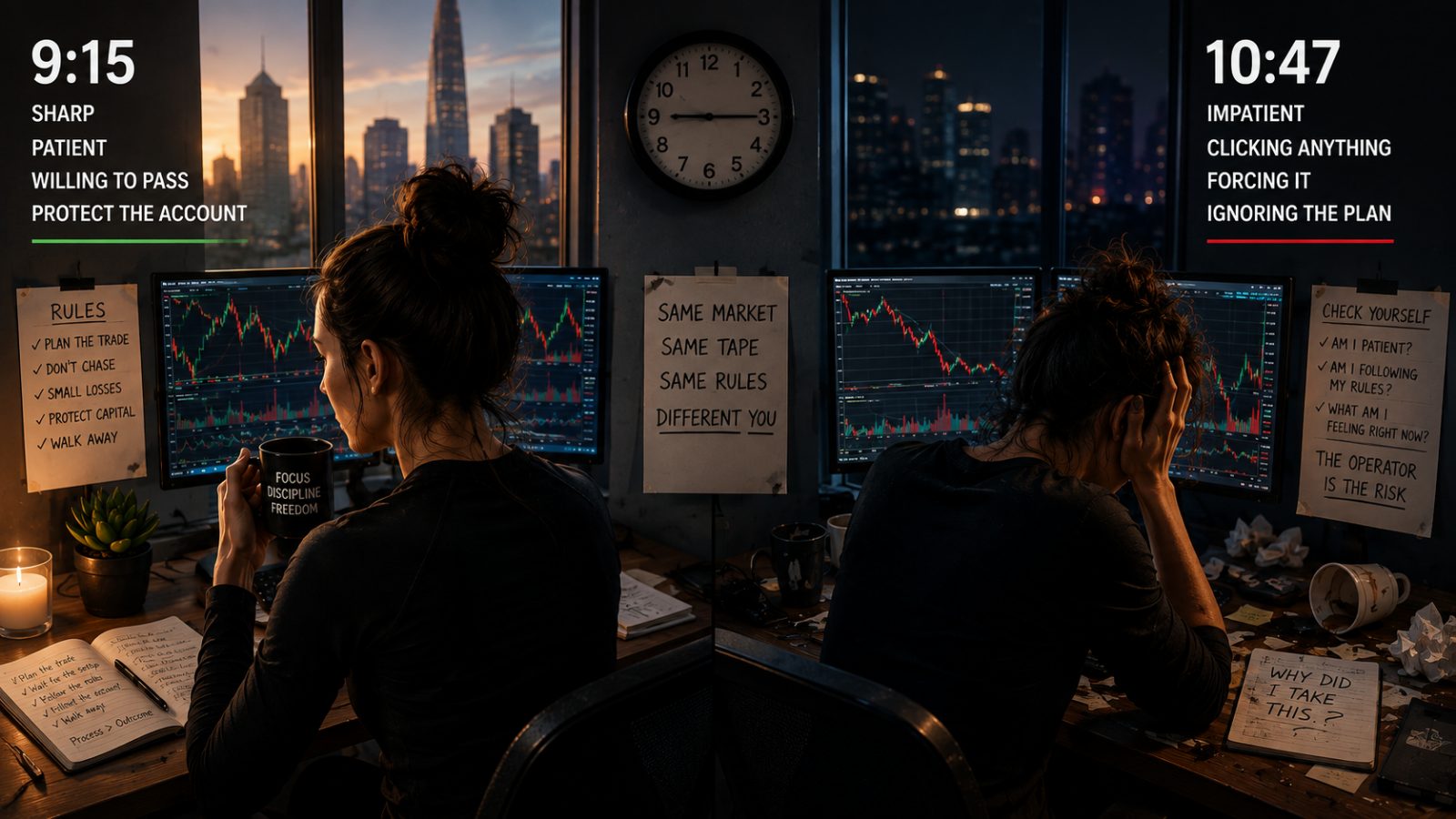
At 9:15 you were sharp, patient, willing to pass on marginal setups. By 10:47 you were clicking into a chart you would have laughed at ninety minutes earlier. Same market. Same tape. Same rules taped to your monitor. The only variable that moved was you — and you never checked the instrument that was actually drifting.
Most traders spend their weekends studying charts. Almost none of them spend any time studying the operator behind the mouse. That's the asymmetry that kills accounts.
You can have a flawless playbook and still bleed for months, because the playbook assumes a version of you that shows up rested, focused, and emotionally neutral. That version doesn't always arrive at the desk. And when a different version sits down — tired, tilted, bored, frustrated, euphoric — the playbook stops being a playbook and starts being a suggestion.
The state is the setup
Professional traders talk about setups as if they're purely technical: the flag, the failed breakdown, the opening range reclaim. But every setup is executed by a nervous system. If the nervous system is compromised, the setup is compromised — no matter how clean the chart looks.
There are a handful of internal states that reliably precede rule violations. If you can name them in real time, you can defuse most of them.
- Tilted: a recent loss is still loud in your head. You're not sizing the next trade — you're sizing the last one, in reverse.
- Bored: nothing has moved for forty minutes and your hands want a job. You will invent one.
- Euphoric: you're up, and up feels like proof. Proof feels like permission. Permission is how green days become red days.
- Fatigued: you slept poorly, or you've been staring at Level 2 for five hours. Your prefrontal cortex is done. Your amygdala is not.
- Fear-of-missing: a name is running without you and your identity as a trader feels threatened by the absence.
None of these are moral failings. They're weather. The problem isn't that the weather exists — it's that most traders don't check the forecast before they leave the house.
You do not have a strategy problem. You have a state problem wearing a strategy problem's clothes.
Why willpower keeps losing
The instinct, when you notice you're tilted or tired, is to try harder. Grip the mouse tighter. Promise yourself you'll be disciplined. Read your rules one more time.
This almost never works, because willpower is a finite resource that gets drained by exactly the kind of stress that put you in a bad state to begin with. By the time you're consciously deploying discipline, you've already lost most of the reserve you needed to execute cleanly.
The fix isn't more willpower at the point of decision. The fix is fewer decisions when you're in a state that can't afford them. You engineer the environment upstream so the compromised version of you has fewer buttons to push.
A pre-trade state check
Before the open, and again after any meaningful P&L swing, run a thirty-second audit. Not journaling. Not analysis. Just a diagnostic.
- Rate your focus 1–10.Below a 6, you trade half size or you sit out. Non-negotiable.
- Name the loudest emotion.One word. Frustrated. Excited. Anxious. Numb. If you can't name it, that itself is a signal.
- Ask what version of you is at the desk.The trader who wrote the rules, or the one who wants to break them? Be honest — you already know.
- Set the exit condition. "If I hit X down, I close the platform. If I take a rule-violation trade, I close the platform." Decide it now, when the decision is cheap.
None of this is glamorous. It is not the part of trading that shows up on the highlight reel. It is the part that quietly separates the traders who compound from the ones who spend a decade running back to break-even.
The trader you were at 9:15
The goal of state awareness isn't to eliminate emotion — you can't, and you wouldn't want to. The goal is to make sure the person clicking buy at 10:47 is still recognizably the same person who set the rules at 9:15.
Most of your worst trades are not decisions. They are drifts. Small unnoticed changes in state that accumulate until you're doing something the morning version of you would never sign off on. Catch the drift, and you save the account.
The chart will do what the chart will do. Your edge is not in predicting it. Your edge is in showing up as the same operator, day after day, regardless of what the last trade did to your mood.
If you want a system that tracks your state alongside your P&L — that flags the drift, logs the pattern, and helps you connect specific mental states to specific behaviors — that's what MAKETZO was built for. Track the operator, not just the trades.
Further reading: Trading in the Zone by Mark Douglas.