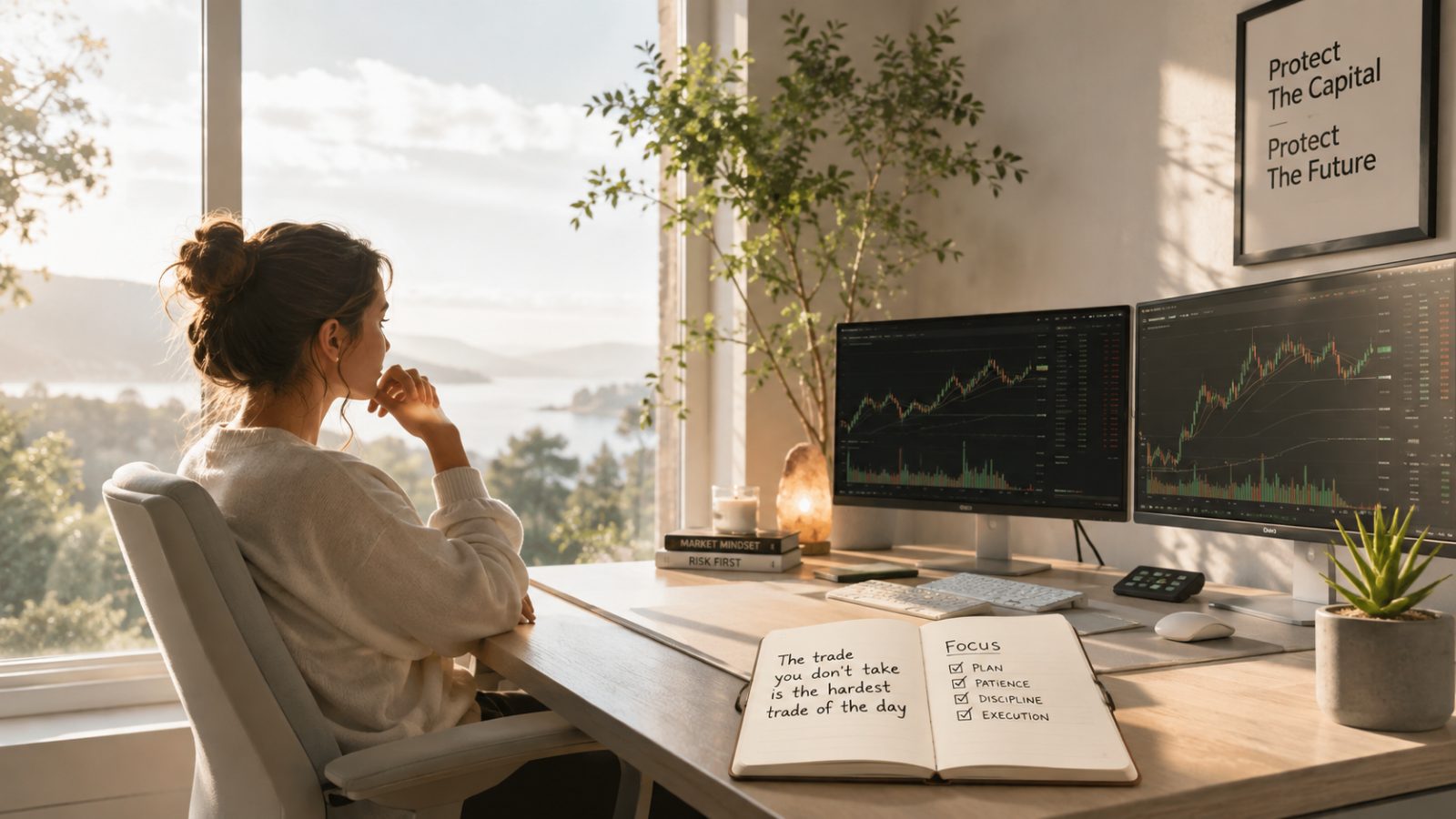
Nobody claps for the trade you skipped. There's no confirmation on the ticket, no green candle to point at later, no story to tell in the Discord. Just you, still sitting there, hands off the keys, watching a runner go without you. And somehow that — doing nothing while something is happening — is the hardest thing a small-cap trader does all day.
Ask any trader with more than two years of scars what changed. They won't say they found a better setup. They'll say they stopped taking the bad ones. Which sounds like the same sentence but is a completely different skill.

THE INVISIBLE MUSCLE
Sitting still is an active decision, and you were never taught to make it
Every book, every mentor, every screen recording you've ever watched is about the trade. Entry criteria. Exit rules. Position sizing. Stop placement. Nobody hands you a curriculum on the other 90% of the session — the part where the right answer is to keep your hands in your lap while a low float chops sideways and your brain screams that you're missing something.
So you improvise. And improvising, under pressure, with a mouse in your hand, is how you end up in a trade you can't defend. You didn't decide to take it. You just ran out of the ability not to.
The trade you don't take is not passive. It's a small, repeated act of restraint that has to be performed dozens of times in a session, most of them against your own nervous system. That's a muscle. Nobody trained it. Which is why it fails right when you need it.
THE MATH NOBODY RUNS
Skipped trades don't show up in your P&L, but they're what's paying for it
Pull your last thirty sessions. Sort by outcome. Look at your reds. Now ask the honest question: how many of those were trades you kind of knew, at the moment of the click, weren't your setup? Not obviously bad. Just close enough. B+ tape. Right ticker, wrong time. Right time, wrong ticker. Something felt off but you clicked anyway because you'd been sitting for forty minutes and needed to do something.
Those are the trades that fund everything downstream. The revenge trade you take at 2:07 to make it back. The size-up on the next A+ because now you're behind. The give-back at the close because you're tilted and don't know it yet. The B-minus setup you accepted at 10:11 is the parent of every bad decision you made after it.
The trades that break your account are almost never the ones you planned. They're the ones you took because you couldn't stand not being in one.
None of that is in the trade journal as a lesson, because the journal is organized around trades you took. The trade you didn't take doesn't get a row. Which is exactly why it never gets studied.
WHY IT'S HARDER ON SMALL CAPS
The tape rewards impatience, then punishes it, on a five-minute delay
Small caps are cruel to patient traders for the first ten minutes and generous to them for the rest of the day. A runner will absolutely go without you. That happens. What also happens, and what nobody counts, is that three of them will fake, fade, and trap the trader who couldn't wait. You only remember the one that went.
The stock that ran without you is a story. The three that trapped the guy who chased them are statistics. Your brain does not weight them equally. It weights the story ten times heavier, which is why sitting out feels like losing even when the data says sitting out is winning.
This is the specific reason small-cap discipline is a different animal. On liquid names, a bad entry is a scratch. On a low float at 10:47, a bad entry is a gap through your stop. The cost of the trade you shouldn't have taken is asymmetric — and so, correspondingly, is the value of the trade you didn't.
WHAT WAITING ACTUALLY LOOKS LIKE
Inactivity has to have a shape, or your hands will find one for you
Here's the thing nobody tells you: you can't just "be patient." That's not a plan. That's a mood. And moods do not survive contact with a Level 2 that's flashing green.
Waiting has to be structured or it becomes waiting-to-click. A few things that separate the two:
- A named condition you're waiting for. Not "a good setup." A specific one, written down, with the tickers that could deliver it that morning.
- A visible cost of breaking the wait. If a B-minus entry costs you the ability to take the A+ that comes twenty minutes later, that constraint has to be in front of your face, not in the back of your head.
- A place for the energy to go. Watching the tape without the ability to click is not rest. It's tension building up. The hands need somewhere to be that isn't the buy button.
- Something that notices when you're drifting. Because you won't. Nobody catches themselves in the moment of impatience. That's what impatience is.
Every trader who has learned to sit on their hands has, whether they call it that or not, built some version of this system. Most of them built it after blowing an account, which is the expensive way.
THE TURN
Waiting stops being boredom the moment it becomes edge
The reframe that changes everything is boring to say and hard to internalize: the not-trade is a position. When you sit through a chop hour and don't give back the morning's gain, you have made money in the only sense that matters — you kept it. When you skip the B-minus at 10:11 and take the A+ at 11:43, the A+ is bigger because you have the size, the composure, and the account to size into it properly.
The reason inactivity feels like losing is that you have no scoreboard for it. Trades taken have a P&L. Trades skipped have nothing — no ticker in the journal, no line item, no evidence they happened. Give them a scoreboard and the whole psychology inverts. The waiting itself becomes something you can be good at, track, and improve.
This is exactly the gap MAKETZO's Waiting Room was built for. It gives the no-trade decision a place to live — a structured space where the setups you're waiting for are named, where the cost of breaking the wait is visible in real time, and where the discipline of sitting still gets counted as the work it actually is. So the trade you don't take stops being invisible, and starts being the trade that funded the day. If sitting on your hands has always felt like the hardest part, that's because it is — and it's the part nobody has ever helped you actually practice.