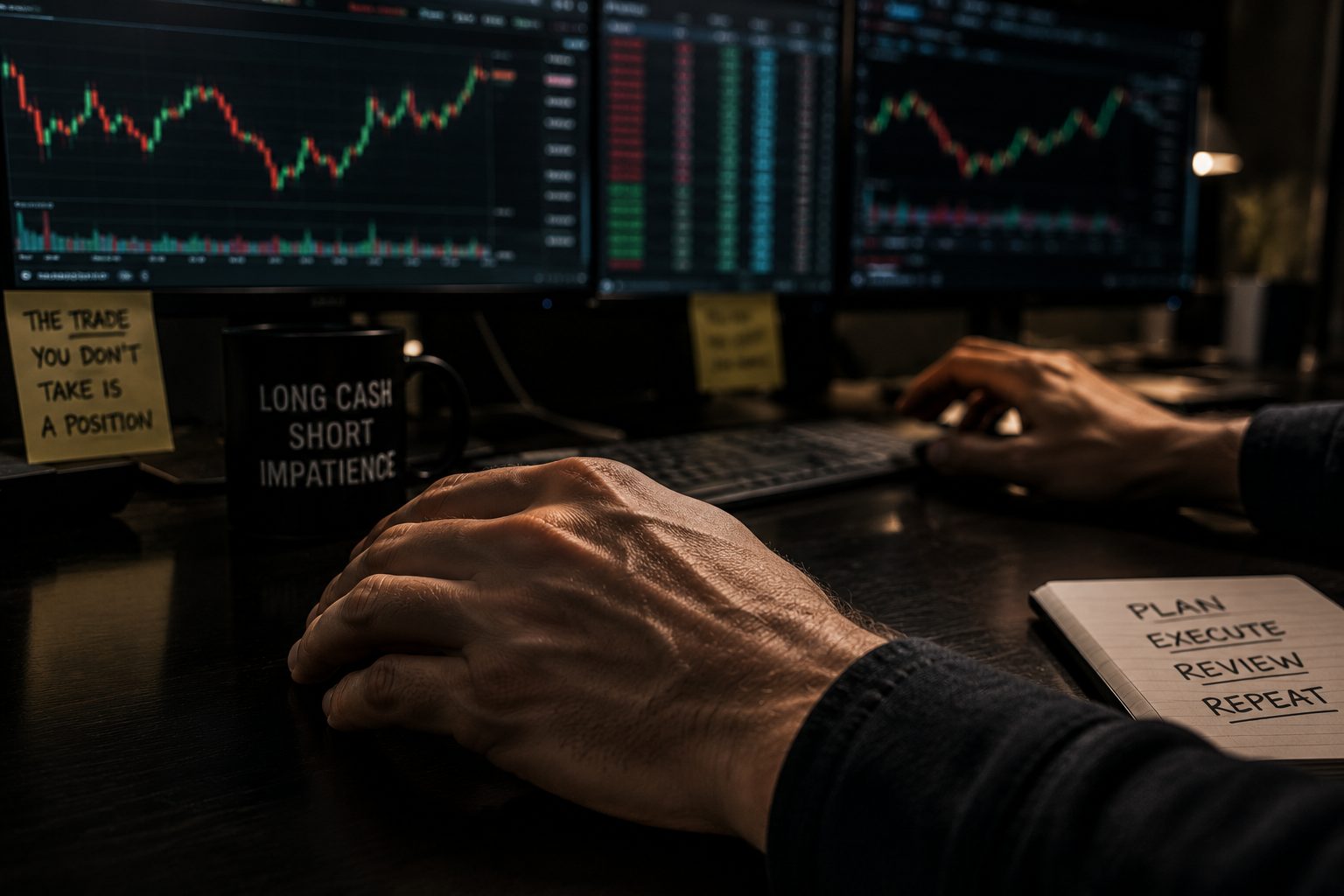
Your hands know before you do.
Somewhere around the second cup of coffee, after the open has faded and the A+ setup you promised yourself hasn't shown, your right hand drifts back toward the mouse. Not because anything has changed on the tape. Because the hand needs something to do, and the market is the nearest object.
The trade you don't take is not the absence of a trade. It is a position — long cash, short impatience — and it is the hardest one to hold all day.
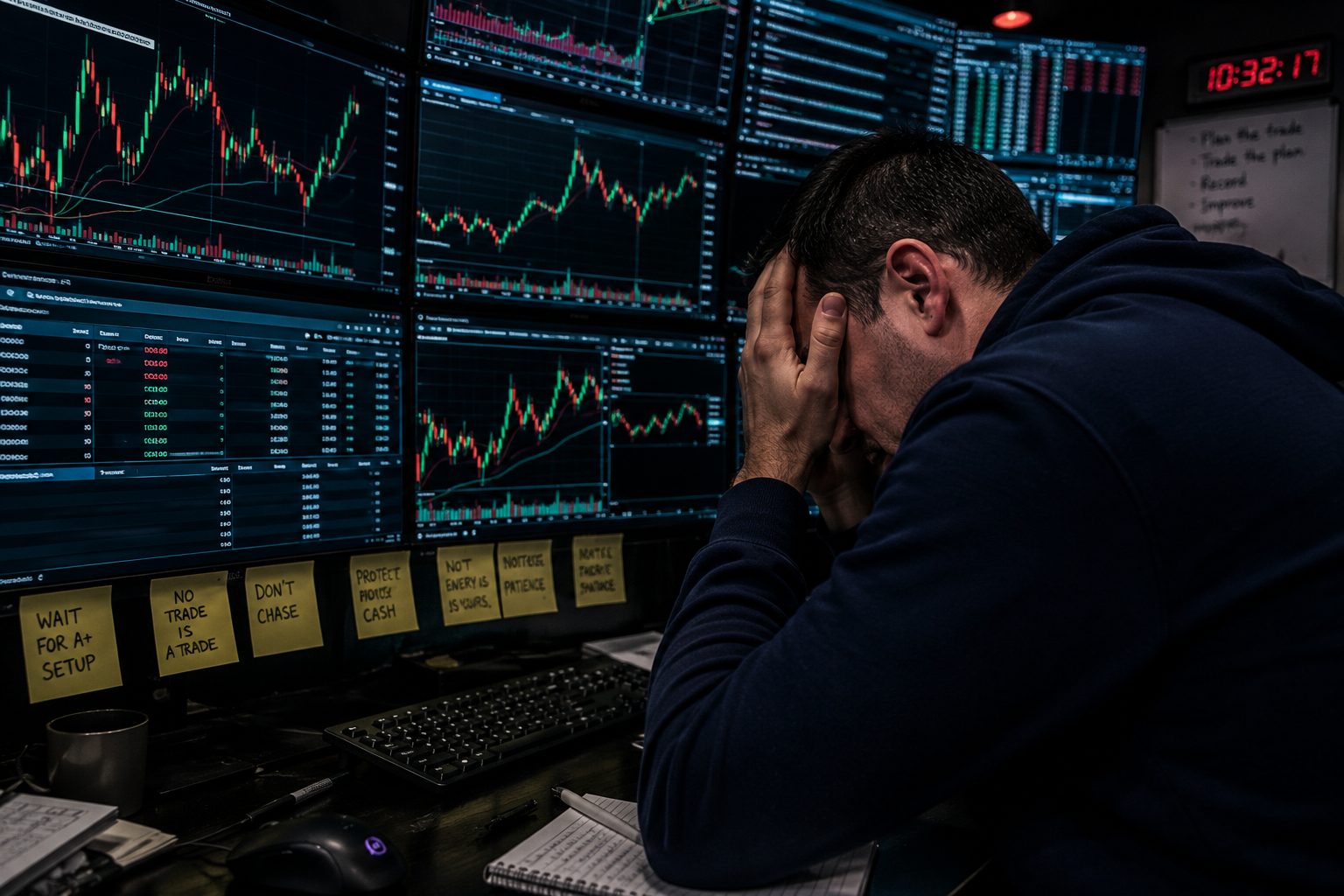
THE ASYMMETRY NOBODY WARNS YOU ABOUT
Taking a trade is one decision. Not taking one is a thousand.
When you click buy, the decision is over. The market takes it from there. Stop, target, time-stop, the noise of a live position — all of it does the psychological work of eating up the next fifteen minutes for you. You have outsourced the discomfort.
When you don't click, the fifteen minutes are still there. Every tick is another invitation. Every green candle that prints without you is a small accusation. The ticker you were watching runs three percent while you were deciding not to chase, and now you have to keep deciding not to chase, again, and again, on every retrace that could pretend to be your setup.
Nobody talks about this. The books frame patience as a virtue, like it's a mood you settle into. It isn't. Patience in a small-cap seat is a repeated micro-decision under fluorescent pressure, and the pressure compounds.
THE BODY'S ARGUMENT
Boredom isn't the problem. Boredom is the signal you've mislabeled.
The feeling you call boredom, sitting there at 11:40 with nothing on, is not boredom. Boredom is what you feel in a waiting room at the dentist. What you feel in front of the tape is closer to withdrawal — a low-grade autonomic hum that says do something, anything, to make this feeling stop.
You are not bored. You are being asked, by your own nervous system, to pay a bill it isn't your job to pay.
The retail trader's whole edge lives inside their ability to sit with that hum and not confuse it with information. Most can't. They take a trade to relieve the sensation, and then, because the trade was a chemistry decision instead of a chart decision, they mismanage it. The give-back that follows didn't start with the entry. It started with the mislabel.
Rename the feeling and you get a piece of your account back. It's not boredom. It's not a slow tape. It's your body billing you for stillness. Pay it and keep sitting.
WHAT NO-TRADE ACTUALLY DOES
The flat hour is where the edge is built, not lost.
Ask a four-year small-cap trader what changed between year two and year four and they will not tell you they found a better setup. They will tell you they stopped taking three trades a day that used to feel mandatory. That's it. That's the whole delta.
The math of a small account is brutal on this exact point:
- One clean A+ entry a day, sized appropriately, is a career.
- Three B-minus entries a day, sized the same, is a slow bleed dressed up as activity.
- The difference between those two traders is not skill. It's what they did with the sixty minutes between the good setups.
The flat hour is not dead time. It is the container the good trade lives in. Without it, you don't have a setup — you have a random walk through your own P&L, and randomness, over enough reps, always finds the drawdown.
You are not paid for the trades you take. You are paid for the ones you refused so the good one still had size behind it.
THE REFRAME
Stop calling it sitting out. Start calling it stalking.
Language does more work here than most traders admit. Sitting out sounds passive, like you got benched. Stalking is what a small-cap trader actually does when they're flat and watching — narrowing the list, watching a Level 2 book breathe, waiting for the one ticker to declare itself.
The stalker is not idle. The stalker is doing the most important work of the day, which is deciding, in advance, exactly what would have to happen for them to click. When that thing happens, the trade is already 80% made. When it doesn't happen, the day is still a win, because the account is intact and the reps of restraint just got one deeper.
A trader who can stalk for two hours without clicking has an edge that no indicator can give them and no course can teach them. It is built one refused entry at a time.
WHERE MAKETZO FITS
A room built for the trade you don't take.
Most platforms are built for the moment you click. They optimize the entry, the exit, the ladder, the hotkey. They assume the decision to trade has already been made and now needs execution support. This is why most traders overtrade on most platforms — the tool is a slot machine dressed up as a cockpit, and the whole environment is asking you, quietly, to click.
MAKETZO is built differently. The Waiting Room is a real room inside the product — a place designed for the flat hour, where the interface's job is to help you not trade until your criteria walk through the door. It reframes stillness as work. It counts your refused entries the way most platforms count your taken ones. It puts the reps you've been doing invisibly onto a page so you can see them, and see yourself building the exact muscle nobody else is training.
If the trade you don't take is a position, you deserve a seat built for holding it. That's the room we made.