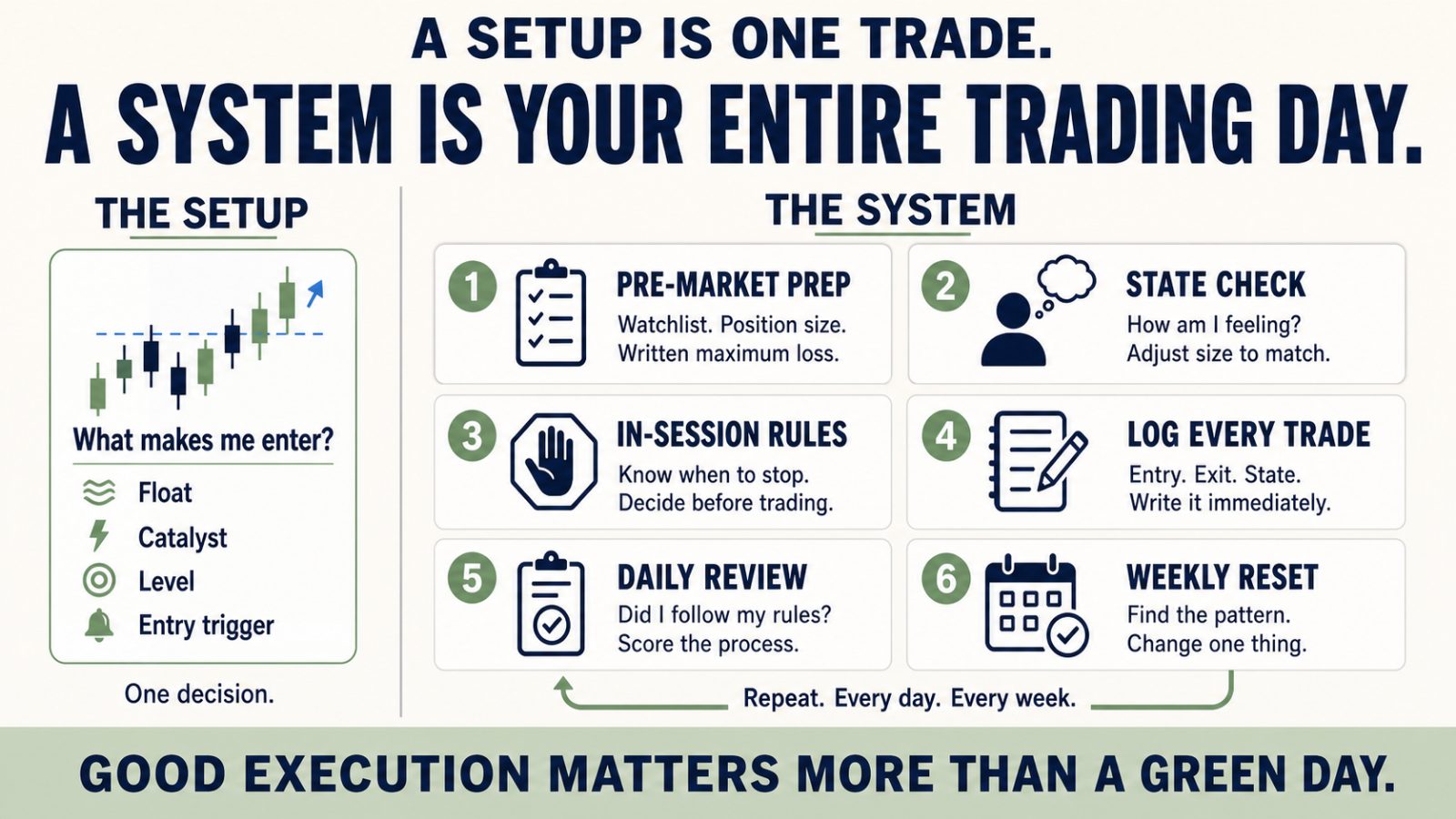
A trader told me last month he had a great system. When I asked him to describe it, he described a setup. Float, catalyst, level, entry trigger. All clean. All correct.
Then I asked him what he does at 9:15 every morning. He paused. Then he asked what I meant.
That pause is where most retail careers quietly end. Not on a bad trade. Not on a bad week. On the slow accumulation of decisions made from memory instead of from a machine you built when you were calm.
SETUP VS SYSTEM
A setup is one card. A system is the whole deck.
A setup tells you what to enter. A system tells you whether you should be at the desk at all, what your size is today, what your maximum loss is before you're done, which trades you're allowed to take in which conditions, what you do after a red trade, what you do after a green trade, what you write down before you close the platform, and what you review on Sunday.
Setups are the fun part. Everyone collects setups. Traders trade setups the way collectors trade cards — always looking for a rarer one, a cleaner one, the one that finally works.
The system is the boring part. It's why the guy across the discord who takes the exact same three setups you take somehow keeps his money and you don't.
LOOPS
An operating system is six loops that run every day whether you feel like it or not.
Strip away the vocabulary and every functional trader I've ever met runs some version of the same six loops. You don't have to run mine. You have to run something.
- Pre-market prep. A fixed, timed routine that outputs three things: a watchlist, a size for the day, and a written maximum loss. Not "a rough idea." A written number. If you can't produce those three artifacts before the bell, you don't trade.
- State check. One honest paragraph about where your head is. Slept badly. Fought with your partner. Green for four days and feeling like a genius. Whatever it is, name it. Your state is an input to your size.
- In-session rules. A short, memorized list of what triggers a stop-trading decision. Max loss hit. Three losses in a row. Broke a rule once. You don't decide these in the moment. You decided them Sunday.
- Trade log — during, not after. Written the moment the trade closes. Entry reason, exit reason, and one word on your state. Fifteen seconds. Not a journal entry. A receipt.
- End-of-day review. Twenty minutes. Not to relive the trades — to score whether you followed the system. Green day with broken rules is a loss. Red day with clean execution is a win.
- Weekly recalibration. Sunday. What patterns show up in the receipts. Which rule got broken most. What one thing changes next week. One thing. Not five.
That's it. Six loops. None of them are hard. All of them are boring. Almost nobody runs all six for more than a week.
A green day with broken rules is a loss. A red day with clean execution is a win. If you can't say that out loud and mean it, you don't have a system — you have a scoreboard.
THE FAILURE MODE
The problem isn't that you don't know this. It's that you run it from memory.
Every trader I've watched fail could describe a version of those six loops. They knew. They just ran the loops from memory, in their head, in the middle of a session, while their heart rate was 110.
Memory is not a system. Memory is what a system is designed to replace.
In jiu-jitsu the brown belts don't remember more techniques than the blue belts. They remember fewer, but the ones they remember are wired into their body. When the position happens, the response happens. There is no decision in the middle. The decision was made in a thousand quiet reps on a Tuesday night when nothing was on the line.
An operating system is your Tuesday-night reps. It's the pre-made decision, sitting there in writing, so that when the P&L is red and your hands are shaking you don't have to be a hero. You just have to read.
WHAT IT FEELS LIKE
Running a real OS is quieter than you'd think.
The trader running an operating system doesn't look impressive from the outside. They take fewer trades. They walk away earlier. They don't post screenshots. Their days are almost boring.
Internally, though, something has changed. The frantic layer is gone. The layer that used to run in the background — am I doing this right, should I be sized bigger, should I take this one, is this the day I make it back — has been replaced by a checklist and a receipt.
You stop asking whether you're a good trader. That question was never answerable in the moment anyway. You start asking a smaller, better question: did I run my system today. Yes or no. The scoreboard for whether you're a good trader is somewhere much further out, on a much longer timeline, and it's not your job in-session.
You stop asking whether you're a good trader. You start asking whether you ran your system today. That's the entire shift.
THE HANDOFF
The reason you haven't built one yet
You haven't built an operating system because building one alone is a full second job. You'd need a pre-market checklist tool, a state-tracking log, live in-session guardrails that actually stop you, a receipt system that captures trades the moment they close, a review dashboard that surfaces which rules you break most, and a weekly loop that ties it all together.
You'd need it to run whether you feel like running it or not. You'd need it to be louder than your worst impulse at the worst moment of the worst day. And you'd need it to remember what you did last Thursday, because you won't.
That's the platform we built. MAKETZO is an operating system for a retail day trader — the pre-market prep, the state check, the in-session guardrails, the receipt-grade trade log, the review dashboard, and the weekly recalibration, all wired together so the six loops actually run. Not because you're disciplined enough to run them from memory. Because they're built.
If you already know what your system should look like and you're tired of running it from your head, this is what you've been describing.