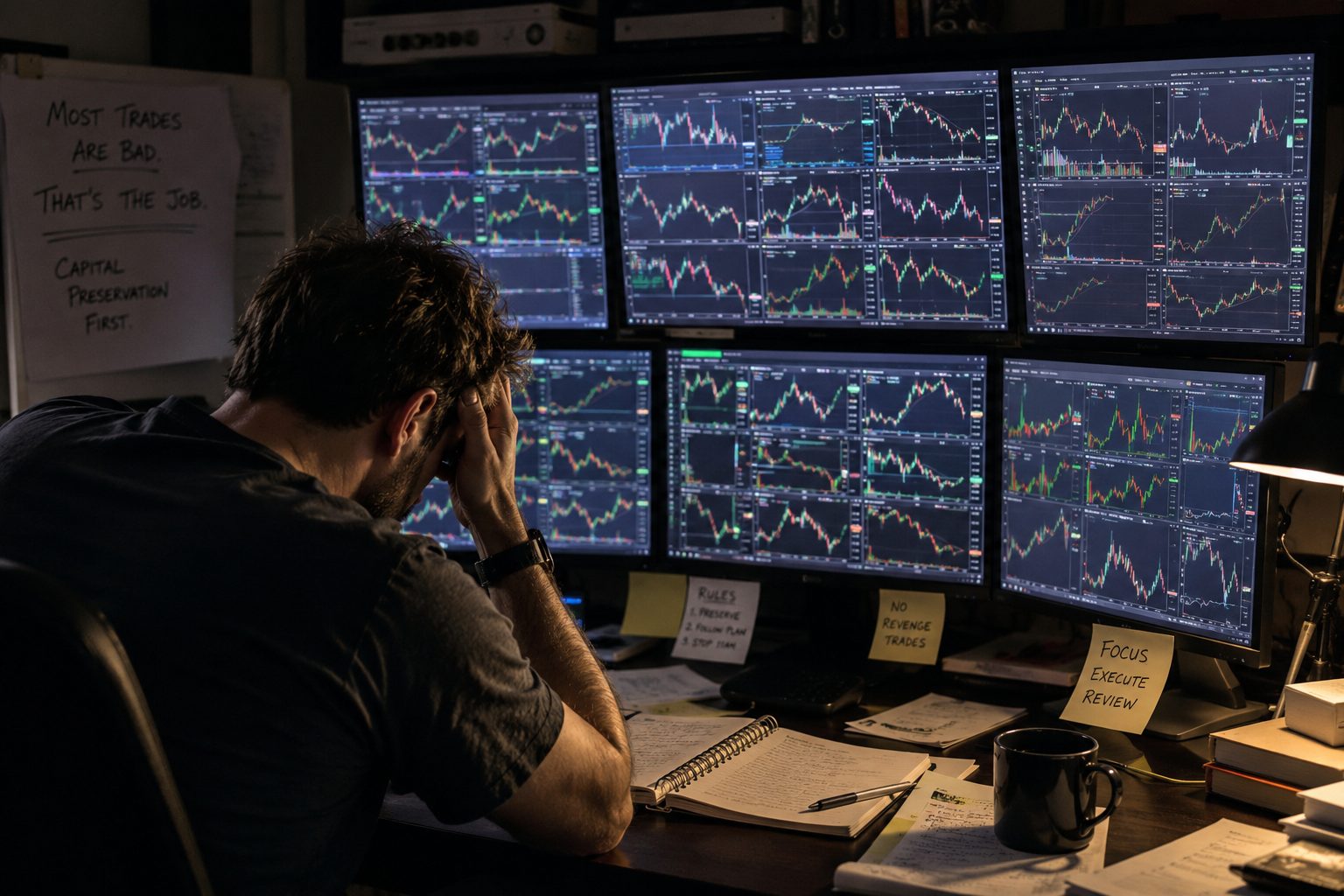
Pull up your last twenty trades. Not the P&L — the trades themselves. The setup. The catalyst. The time of day. The float. The reason you clicked.
Now find what they have in common.
For most traders reading this, the honest answer is: almost nothing. Some were breakouts. Some were fades of breakouts. A few were it looked heavy. One was because a Discord went quiet and quiet felt like accumulation. Two were revenge. Three were boredom. The rest were… available.
That's not a strategy. That's a mood with a P&L attached.
THE SHAPE OF NOISE
What randomness actually looks like on the account
The word random sounds harsh, because you can point to a thesis behind each trade. Each one, in the moment, had a reason. You saw something. You clicked. Fine.
But randomness in trading isn't the absence of reasons. It's the absence of the same reason, repeated. If Monday's trade and Wednesday's trade have no criteria in common, they are two independent bets on two different games. You are not running a strategy — you are running twenty strategies, one trade deep each, and no strategy survives being run once.
Sample size is a myth if every sample is a different experiment. The account doesn't lose to the market. It loses to your inconsistency.

THE COPE
Why the brain sells you flexibility
Traders don't randomize because they don't know better. They randomize because the brain gives it a flattering name.
It's called reading the tape. It's called being adaptive. It's called not being married to one setup. It's called trading what's in front of you.
Each of those phrases is true in the mouth of a trader with three thousand reps in a defined system, choosing between known variants of that system. In the mouth of a trader who hasn't yet built the system, those phrases are cope. They describe the freedom to click on anything as if it were a skill.
Under the hood, the reward isn't performance. It's stimulation. Randomness feels alive. A filter feels like sitting on your hands. Given the choice between running an edge and feeling awake, most traders choose awake and blame the market later.
You didn't have a bad week. You had five different traders sharing one account.
THE CONTAINER
What rule-based execution actually is
Rule-based execution is not a personality trait. It's not something disciplined people have and impulsive people don't. It's a container the trader builds so that the animal in them — the part that wants to click something, anything, right now — can't reach the button unless the container agrees.
At minimum, the container names four things before the trade exists:
- The setup. Not “it looked good” — the specific structure and catalyst.
- The filter. What must be true about the day, the float, the session.
- The trigger. The exact price and behavior that turns the setup into a trade.
- The invalidation. Where the setup is wrong, priced in dollars, before you click.
Every trade that survives all four is a trade the system took. Every trade that doesn't is a trade you took, and those are the ones that quietly redistribute your equity to more patient people.
You'll notice this is not sexy. It cuts your trade count in half. It leaves you sitting through moves you “would have caught.” That's the price. The trader you're competing against is already paying it.
THE PART NOBODY ADMITS
You already know most of this
That's what makes it painful.
You know your green weeks share a shape and your red weeks share a shape and the two shapes are different. You know which setup you're actually good at. You know which trades you take when you're bored, and you know they lose over a hundred-sample window. You've journaled it. You've said it out loud to another trader. You've promised yourself Monday.
Then a name moves on Tuesday and none of that knowledge reaches your hand.
The gap is not information. The gap is enforcement. The rules exist in your head; the animal exists at the mouse. Between them there is nothing — no friction, no pause, no witness. The trade goes on.
What actually closes the gap
Something has to sit between the impulse and the click and ask, out loud, whether this trade is one of yours — or one of the twenty other traders quietly using your account this month.
Not a mantra on a sticky note. Not a screenshot of your rules that you stopped seeing three weeks ago. Something that watches the actual behavior — the setups you take, the times you take them, the state you're in when you click — and shows you, in real time, whether the trade you're about to make belongs to the trader you claim to be or the one who's been bleeding you.
That's what MAKETZO is built to be. A layer over your execution that learns the shape of the trader you are on your green days and flags every trade that doesn't match it. It won't stop your hand — nothing will. It will make sure the click is seen, by you, before the loss teaches it to you at the end of the day.
You don't need another strategy. You need the one you already have to be the only one you run.