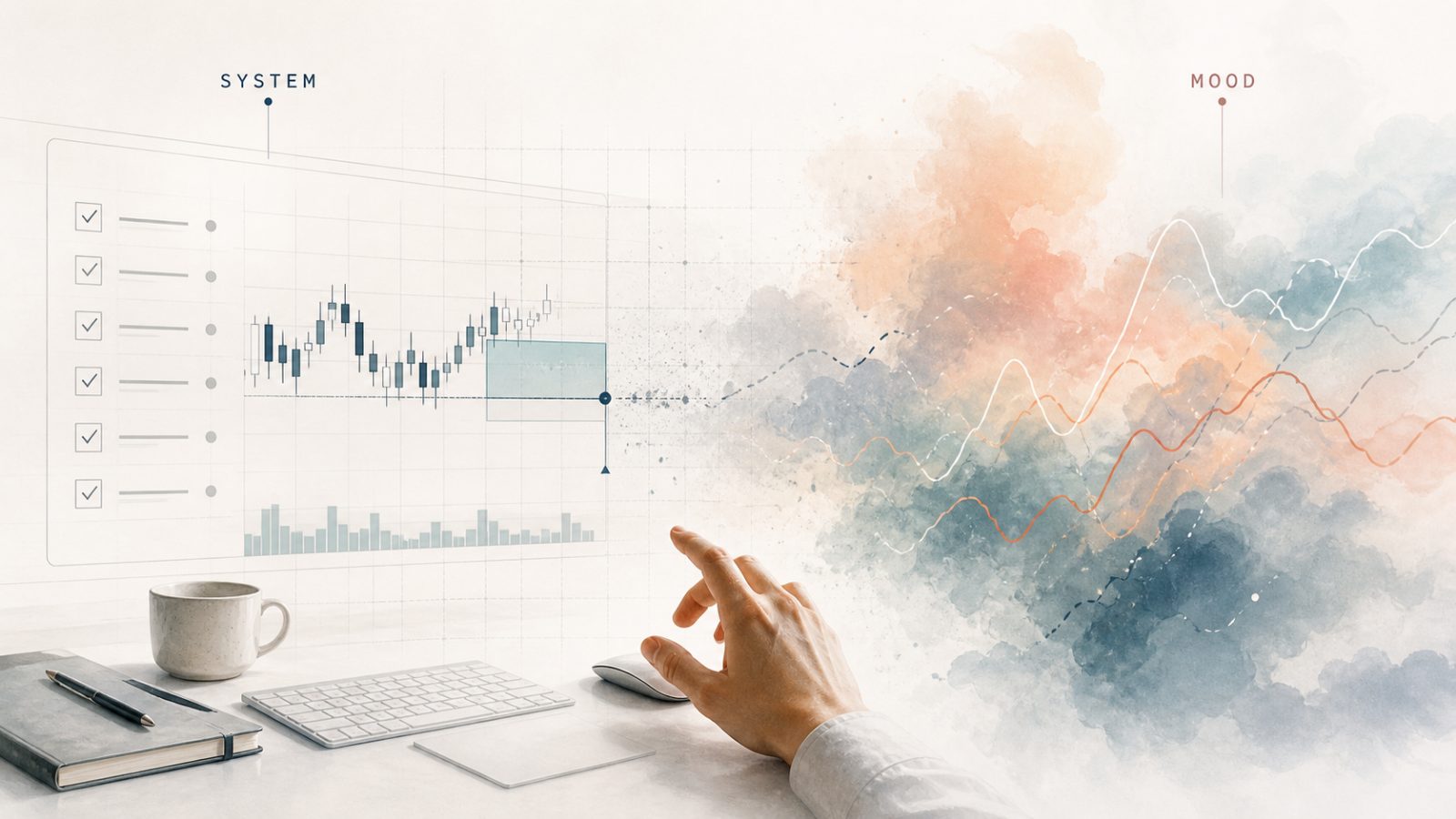
Ask a trader why they took the trade. If the answer starts with "it was setting up" or "I liked the tape" or "it felt right", you're not hearing a system. You're hearing weather.
The trader isn't lying. That's the part that makes this hard. They genuinely believe there was a reason. There was a feeling, and the feeling was real, and the feeling gets promoted in memory to a criterion. By the time the position is on, the mood has been rebranded as a plan. The tell isn't the loss. The tell is that the explanation only exists after the click.
THE SHAPE OF RANDOMNESS
Random doesn't look random from the inside
Randomness in trading is not chaos. It doesn't feel like flailing. It feels like being present. Alert. In flow. The trader who takes eleven trades in a session and can articulate a real thesis for four of them is not undisciplined — they're inconsistent, which is worse, because inconsistency is invisible from the driver's seat.
Look at a week of your own tickets. Sort them by outcome, then sort them by whether you can, right now, in one sentence, name the exact condition that had to be true for you to press. Not the ticker's story. Not the general vibe. The condition. The trades where the condition is fuzzy are the trades where you were trading a mood. They will, over time, cluster on the wrong side of the ledger. Not always. Just enough to be the whole gap between your good months and your bad ones.
This is the ugly math nobody wants to run: your edge is not the average of your trades. Your edge is the average of your rule-based trades minus the drag from your mood-based trades. Cut the second bucket and your P&L reorganizes.
THE MOOD ENGINE
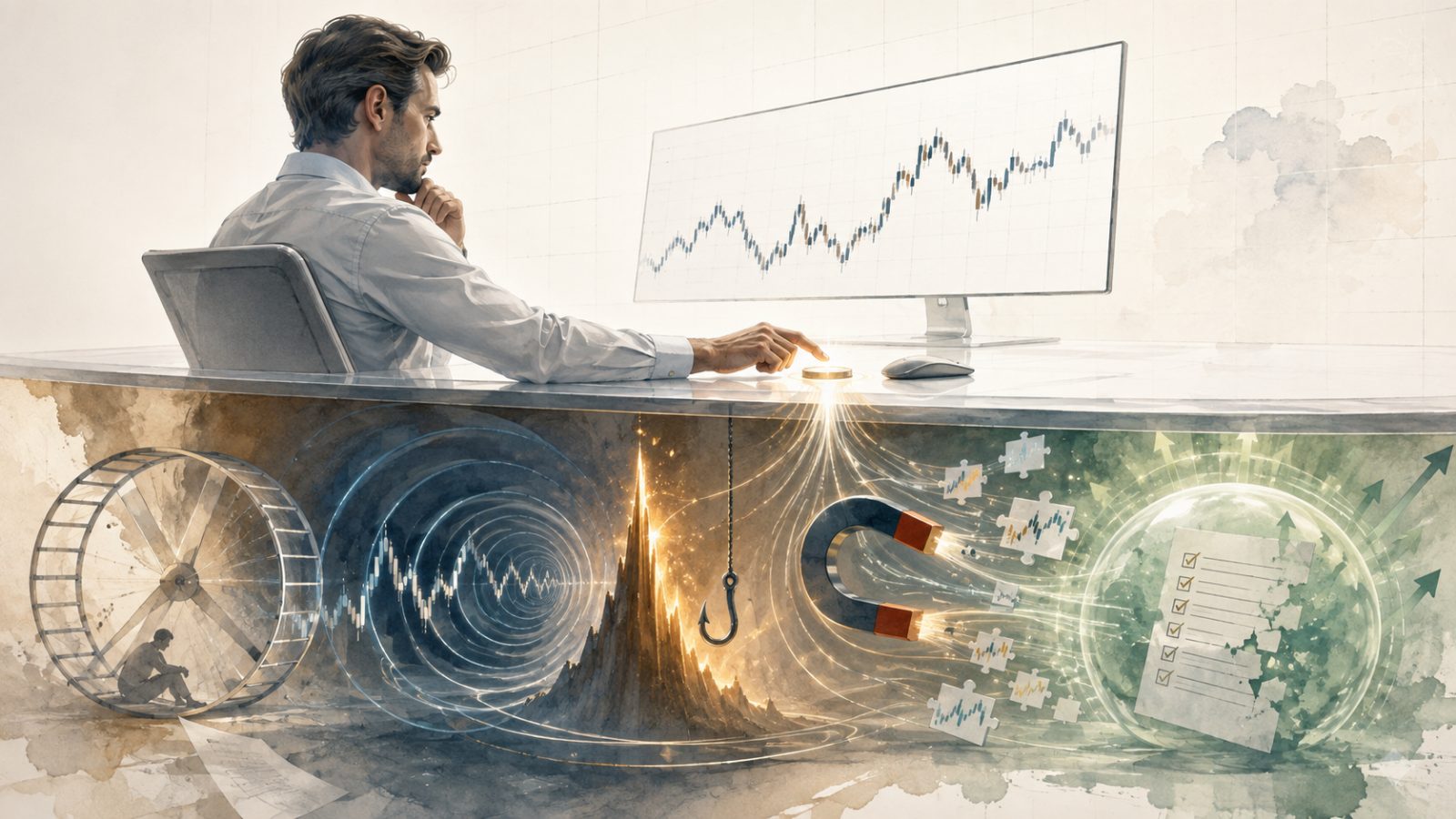
Where the random trades actually come from
They don't come from analysis. They come from state. A short list of the moods that generate untracked trades:
- Boredom. The tape is slow, so you invent a trade to have something to be doing.
- Recency. The last one worked, so the next thing that vaguely rhymes gets the same size.
- Anchor pain. You missed a mover twenty minutes ago and now you're hunting a facsimile to reclaim what you didn't take.
- Confirmation hunger. You already have an opinion on the ticker, so anything that flickers on the tape reads as evidence.
- The green-day expansion. You're up. Rules feel like a tax on genius. You stop checking the list and start freestyling.
None of these show up on a chart. All of them show up in your fills. The mood engine is invisible because it runs on the same neurons as your good instincts, and it uses the same vocabulary. It says this looks like the ones that work whether or not it looks like the ones that work.
A random trade doesn't feel random. It feels like the trade you were born to take. That's why it keeps costing you.
THE FILTER
Rule-based execution is supposed to feel boring
Traders resist filters because filters kill trades. That's the point. A filter's job is to make you sit out the ninety percent of the day that isn't yours, so the ten percent that is doesn't get diluted by the noise of the other ninety.
A working filter has three properties, and if yours doesn't have all three, it's not a filter, it's a preference:
- It's pre-committed. Written down before the session. Not adjusted mid-morning because "today is different." Today is never different in the way you think it is.
- It's binary. The conditions are either present or they're not. "Kind of" is a mood word. If your criteria admit "kind of," you don't have criteria, you have vibes with a checklist glued on top.
- It's auditable. After the trade, you or someone else can read the ticket and confirm the conditions were actually there at entry. Not "in the general area." There.
Traders who run this kind of filter take fewer trades and sleep better. They also do something the mood-driven trader almost never does: they can tell you, on a slow Tuesday, exactly why they didn't press. That sentence — "the conditions weren't there" — is the sentence that separates a professional from a talented amateur. It is not a glamorous sentence. It is the whole game.
THE HARDEST PART
Confirmation is not hesitation
The trader who has been burned by mood trades develops a second problem: they start to distrust their own signal even when it's clean. They wait for one more candle. They wait for the retest. They wait for the retest of the retest. Now they're missing the trades that were actually on their sheet.
Waiting for confirmation is not the same as being scared. Confirmation is what a rule looks like when it's being obeyed. Hesitation is what happens when you don't trust the rule in the first place. If you're second-guessing a trade that meets every criterion you pre-wrote, the problem is upstream — your rules aren't yours yet. They're borrowed. Rules become yours the way a language becomes yours: reps, out loud, until you stop translating.
The way you get there is not by writing better rules. It's by keeping honest score on which trades were rule-based and which were mood-based, day after day, until the pattern is undeniable and the mood trades start to feel physically wrong to place.
The system you keep describing
Every time a trader tells me they "just need to be more disciplined," what they're actually describing is a review layer they don't have. A thing that watches the tickets and separates the rule-based trades from the mood-based ones, without letting the trader be the judge — because the trader is the defendant.
That's the layer MAKETZO builds around your execution. Not another indicator. Not a signal. A behavioral audit that keeps a truthful count of when you're trading your system and when you're trading your state, and interrupts you before the mood becomes a position. If you've read this far, you already know which bucket most of your damage lives in. The next step is deciding to actually see it.