
A trader I respect once told me she doesn't trust herself before 10am. Not because she's bad in the morning — because she knows she's a different person at 7am than at 2pm, and she refuses to let the 7am version make size decisions for the 2pm version.
That sentence stuck because it named something I'd been doing wrong for years. I was treating every morning like a blank page. Coffee, scanner, vibes, go. Some days the vibes were good. Some days I was tilted by 9:45 and didn't know why. The common denominator wasn't the market. It was me — a different operator showing up every session with no handoff notes from the last one.
What separates traders who compound from traders who oscillate isn't talent or screen time. It's whether they're running a system or running a mood.
THE PROBLEM
You already have a system. It's just invisible.
Every trader has an operating system. The question is whether you built it on purpose or whether it assembled itself out of habits, superstitions, and whichever YouTube video you watched last Thursday.
The invisible OS looks like this: you wake up, you check the overnight gappers, you form an opinion based on how yesterday went emotionally, you size based on how confident you feel in the first fifteen minutes, you stop trading when you're either up enough to feel safe or down enough to feel sick. There's a logic to it. It's just not a logic you'd defend out loud.
A real operating system is one you could hand to another trader and say: run this. Here's what I look at before the open. Here's what qualifies as a setup. Here's what size I take and why. Here's when I stop. Here's what I write down. Here's what I review tomorrow morning.
If you can't hand it over, you don't have a system. You have a habit loop with better days and worse days.
THE FRAME
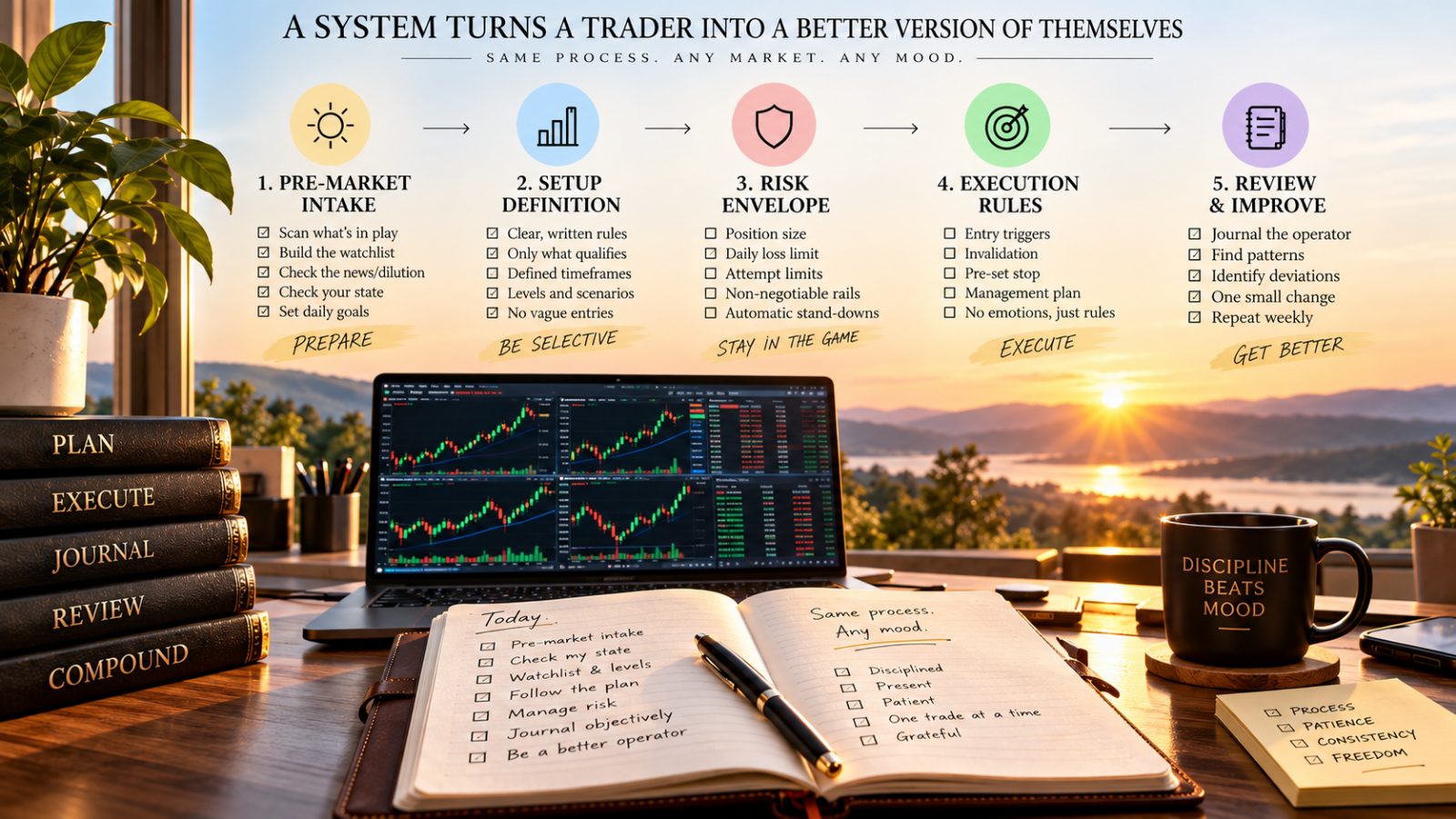
An OS has five layers, and most traders only have one
When I started treating my process like software instead of a feeling, I noticed it had layers — and that I'd only ever built the fun one. Here are the five, in order of how often they get skipped:
- Pre-market intake. What's in play today, what's noise, what's your watchlist, and — the part everyone skips — what's your state. Did you sleep. Did you fight with someone. Are you still carrying yesterday's red day in your chest.
- Setup definition. Written, finite, and boring. Not "I take breakouts." More like: "I take a continuation entry on a stock that has already made a clean higher low on the one-minute after a morning push, with relative volume above a threshold I've written down." If a friend read it, they'd know what to click.
- Risk envelope. Max loss per trade, max loss per day, max number of attempts on the same name, max consecutive losses before a mandatory stand-down. These are rails, not suggestions. The rail exists so you don't have to negotiate with yourself in the moment.
- Live execution rules. What triggers an entry, what invalidates it, where the stop lives before you click, what you do if it goes immediately your way, what you do if it chops. Pre-decided. Written. Not vibes.
- Post-market review. Not "did I make money." More like: did I follow the system, where did I deviate, what state was I in when I deviated, and what should tomorrow's version of me know before the bell.
Most traders live inside layer four. They obsess over entries. They tune their entries endlessly. And they wonder why their results stay random, because the entry is the one layer where improvement compounds the least.
A system you can't hand to another trader isn't a system. It's a habit loop with better days and worse days.
THE CHECKLIST
The checklist is the point, not the paperwork
Pilots don't run checklists because they forgot how to fly. They run checklists because the cost of forgetting one small thing when the adrenaline hits is catastrophic, and because a checklist is the only tool that performs equally well on your best day and your worst.
A trader's pre-trade checklist should be short enough to run in under thirty seconds and specific enough that "yes" and "no" are the only honest answers. Mine lives on an index card taped to the edge of my monitor. It has six questions. If I can't answer yes to all six, I don't take the trade. Not "I take it smaller." I don't take it.
The resistance to checklists is always the same: it feels like admitting you need training wheels. That resistance is the ego protecting a story about being an intuitive trader. The intuitive trader loses money for years before admitting the checklist would've saved most of it. Skip that part. Write the card.
THE JOURNAL
Journaling isn't about trades. It's about operators.
Most traders journal wrong. They write down the trade — entry, exit, P&L, maybe a chart screenshot — and they call it done. Three months later they have a scrapbook. What they don't have is a model of themselves.
The journal that changes things logs the operator, not the operation. What state were you in before the first trade. What did you do when the first loss came. Did you add to the plan or add to the pain. When you deviated, what was the feeling that preceded the deviation — was it fear of missing, was it needing to get even, was it boredom around the midday dead zone.
After enough entries, patterns show up that no trade log alone would reveal. You find out you break rules on Wednesdays. You find out your worst sizing decisions come after two green days, not two red ones. You find out the real risk isn't the market — it's a version of you that only shows up under specific conditions, and now you can see them coming.
THE REVIEW
Continuous improvement, or you're just logging
A system that doesn't update is a museum. The weekly review is where the OS actually evolves — where you look at thirty or so sessions and ask what's still earning its spot, what's drift, and what's a rule you've been secretly breaking so often it needs to either get enforced or get rewritten.
Three questions, every Sunday, for twenty minutes:
- Where did I follow the system and lose — and does that mean the system needs tuning, or does it mean losing was the correct outcome of a correct process?
- Where did I break the system and win — and am I honest enough to count that as a loss, because the behavior is what compounds, not the single result?
- What one small change to the OS this week would've prevented my worst session?
That third question is where the compounding lives. Not a redesign. One small change. Fifty-two of those a year is a different trader.
The quiet turn
What you're describing, if you've been nodding along, is a cockpit. A place where your pre-market intake, your setup definitions, your risk envelope, your execution rules, your operator-state journal, and your weekly review all live in the same room — talking to each other, flagging you when you drift, holding you to the version of yourself you were when you wrote the rules down.
Most traders try to build this out of six browser tabs, a Notion doc, a spreadsheet, and willpower. It falls apart by Wednesday. MAKETZO is the cockpit — intake, rails, live accountability, journal, and review stitched into one surface that treats you like an operator running a system, not a mood looking for a market. If you've been trying to assemble this out of parts, the parts are the problem.