
Every trader is running an operating system. Most of them didn't write it.
It got assembled in the background — a rule from a book, a habit from a mentor, a superstition from a red Tuesday, a shortcut from the day you were tired. It runs every session. It decides what you look at, what you skip, when you size up, when you flinch. You call it "my style" or "my read" or "just feel." It isn't feel. It's code. The problem isn't that you don't have a system. The problem is you didn't author the one you're running.
THE DEFAULT BUILD
What runs when you don't write the rules
The unwritten OS has a signature. You know it by now even if you've never named it. It sizes bigger after two greens. It hunts for a re-entry inside sixty seconds of a stop-out. It talks you into a fourth trade because the P&L is "almost back." It grades a losing trade by outcome and a winning trade by feel, then tells you both were fine.
None of that is you. That's the default build. It got shipped with the account. Everyone starts with it. Some traders spend four years upgrading it and some traders spend fourteen years defending it. The ones who upgrade write things down. The ones who defend it call writing things down "too rigid."
A system you didn't write is still a system. It just runs on your worst instincts instead of your best thinking.
THE STACK
What an operating system actually contains
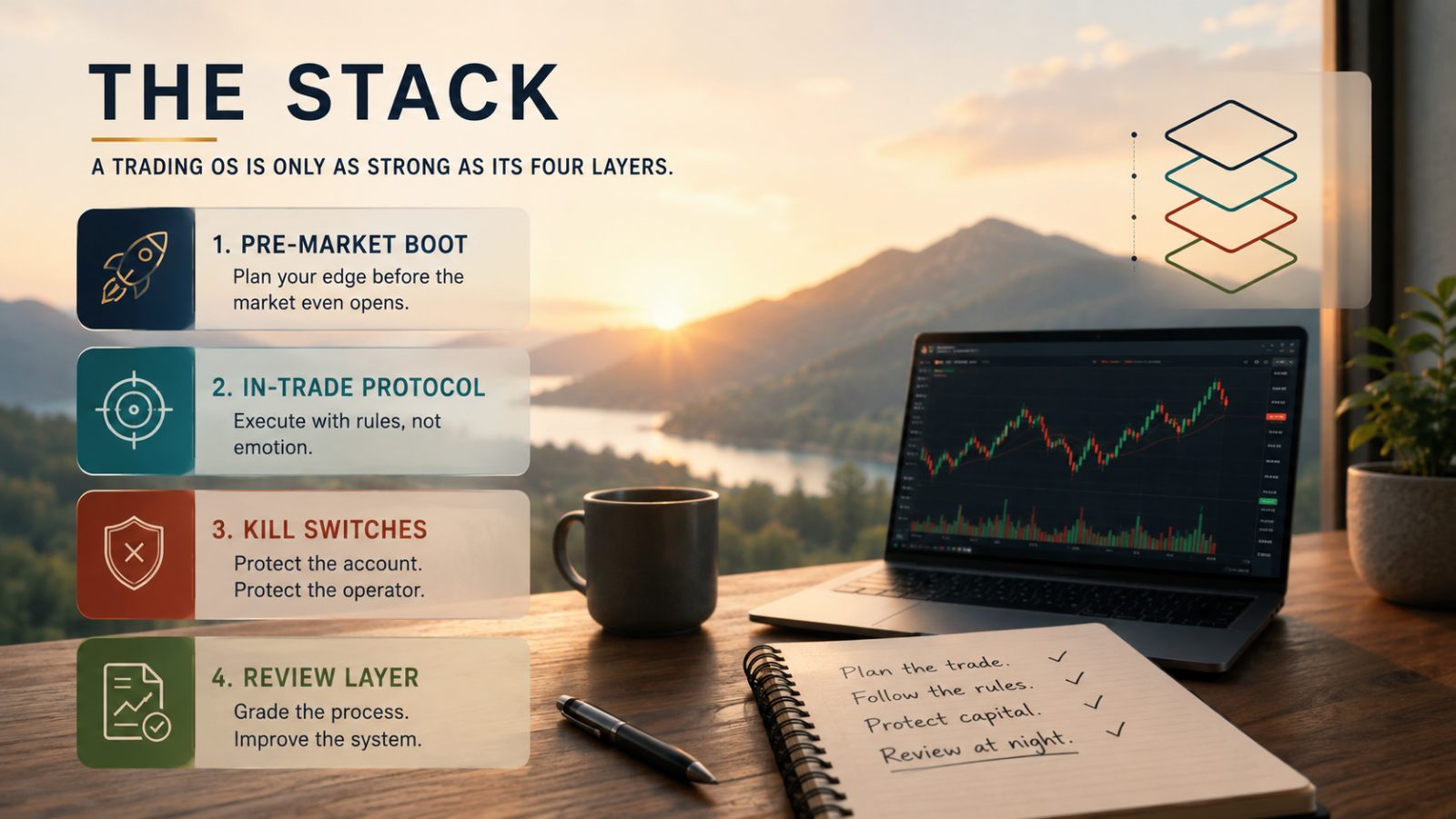
An operating system is not a checklist. A checklist is one file inside it. The full stack has four layers, and if any of them is missing the whole thing runs on mood.
- Pre-market boot sequence. The exact order of operations before the bell — scan, levels, catalyst read, size decision, max loss for the day, one sentence describing what you have to see to press. Not aspirational. Actual. Written the night before or the morning of, but written.
- In-trade protocol. The rules that fire while you're live — where the stop actually is (not where you'd like it to be), what invalidates the thesis in real time, when you're allowed to add, when you're required to be flat. These are the rules that get renegotiated in the moment. That's why they have to exist outside the moment.
- Kill switches. The conditions under which the session ends regardless of what the tape is doing. Two full stops. A loss threshold in dollars. A third emotional trade. The specific behaviors — not the specific losses — that mean the operator is compromised and the machine has to shut down. Small-cap traders die on the third trade after a stop-out. Not the first. The third.
- Review layer. The nightly pass where the trades get graded on process, not outcome. A green trade that violated the OS is a bad trade. A red trade that followed the OS is a good trade. Until you can say that sentence out loud and mean it, you don't have a review layer. You have a mood journal.
THE PARTS YOU DON'T WANT TO WRITE
The rules that would have saved the account
Ask any trader four years in what killed their best month and they'll tell you a specific behavior. Not a bad read. A behavior. Sized in on a low-float without a plan for the halt. Chased the second push because they missed the first. Held past the close because it "felt like" a hold. Took a Friday afternoon trade against their own written rule that Friday afternoons are review-only.
Every one of those has a rule that would have vetoed it. And every one of those rules is the exact rule the trader didn't write because writing it felt like admitting the weakness. The rules that would save the account are always the ones that feel personally insulting to write down.
Write them anyway. "I do not add to a small-cap position that's already red." "I do not take a first trade in the first four minutes." "I do not open a chart of the ticker that stopped me out." If the rule feels unnecessary, you don't need it. If the rule feels like it's calling you out, that's the one that goes in the OS.
WHY IT FEELS BORING
The point is that it runs the same way twice
Traders resist the OS because a system executed correctly feels like nothing. There's no story. No hero moment. You saw the setup, you pressed the button, you managed the stop, you booked it, you moved on. The whole trade takes up less real estate in your nervous system than a single revenge trade takes up in an hour.
That's the feature, not the bug. A trading day should be boring in the way a pilot's checklist is boring. The excitement in the cockpit means something has gone wrong. The excitement in your session means the OS isn't running — you are. And you, running without a system, are the least reliable component in the entire setup.
If your best days feel dramatic, you're not trading a system. You're auditioning for one.
The traders who compound don't have more discipline than you. They have a smaller surface area for their discretion to touch. Every rule they wrote is one less decision they have to make at 10:19 when the tape is fast and the dopamine is loud. Discipline is not a muscle. It's an architecture. You don't get more disciplined. You get fewer places where discipline is required.
BUILDING IT
The OS you can actually run tomorrow
You don't need a fifty-page trading plan. You need four documents, each one page, each written in your own words: a boot sequence, an in-trade protocol, a set of kill switches, and a review template. Write them tonight. Print them. Put them where the mouse is.
Then run them for twenty sessions without editing. Not because they're perfect. Because the only way to know what's broken in an OS is to run the version that exists. Edit on Sunday, never during the week. Never at 10:19. Never after a loss. The rules get written in the calm and executed in the fast. Reverse that order and you're back to the default build.
This is the whole game. Not a better read. Not a better setup. A written system, executed the same way twice, reviewed on process, and upgraded on evidence. Everything else is decoration.
What you're describing to yourself right now — a written operating system that catches you before the third trade, tracks whether you followed your own rules, and grades you on process instead of P&L — is what MAKETZO was built to be. The Strike System is your kill switch. The Focus Room is your boot sequence. COACH SAYS is the in-trade protocol talking back. The journal is a review layer that scores you on the parts that actually matter. If you've spent four years running an OS you didn't write, this is where you start writing one.