The Trade That Felt Free
Picture a small cap trader on a Thursday. At 9:38 AM a low-float gapper on the watchlist breaks its premarket high on heavy volume. The entry is clean, the exit is at the planned level, and by 9:45 the day's goal is made. One trade, by the book.
At 10:10 a second runner starts to climb. It was never on the list, and the trader would not normally touch a stock already up that far. But the morning is already paid for, so the entry feels like a free look. It fails, and a third of the morning goes with it.
Now the job has quietly changed. The goal was hit 25 minutes ago, and a third of it is already gone. At 10:40 the trader chases the same name on a bounce to get back to the goal, then again at 11:05. By 11:30 the day is red, and every rule broken came after the best trade of the week.
Nothing about the chart caused that morning. The first trade changed how the second one felt.
The trade to watch hardest is the one right after a big win, not the one after a loss. That is when the plan feels optional.

Why Is Psychology Important in Trading?
Because the same chart reads differently depending on your last trade, and the difference is measurable.
In 1990 Richard Thaler and Eric Johnson ran experiments with real money. People who had just won took bets they would otherwise refuse, which the authors called the house money effect. People who had just lost were drawn to bets that offered a way back to even.[1] That Thursday morning shows both halves in one session: house money on the second runner, then the pull back to even on the chase after it.
Professionals are not exempt. A study of the Taiwan index options market found "a strong positive relationship between prior trading outcomes and subsequent risk taking," with market makers taking above-average risk in the afternoon after a morning gain.[2] Those are people who trade full time, with every tool a firm can buy.
That is why psychology matters more than a new setup. Your plan stays the same all day, and your feeling about risk shifts with your P&L.
The rule to carry to the open is the flat test. Before any entry after a win, ask one question: would I take this exact trade if I were flat on the day? If the answer is no, the morning's profit is making the decision, and you skip it.
How a Green Morning Turns Red
The giveback rarely looks like one bad decision. It runs in three steps, and each step feels reasonable while you are in it.
- The win goes in a separate pile. Money made this morning gets filed as the market's money, not yours. It is the same dollars in the same account, but it no longer feels earned.
- The next loss comes out of that pile. A loss taken from house money barely registers, so a trade you would skip at flat suddenly seems worth a try. Small caps make this worse, because a big morning usually means the scanner is full of runners asking to be chased.
- The goal becomes a number to get back to. Once part of the pile is gone, the goal you already hit turns into a debt. Now every trade is about returning to the peak, and that is the break-even pull from the 1990 experiments.
The useful part of seeing the steps is knowing which one you are in. If you catch yourself calling profit "the market's money," you are at step one, and that is the cheapest moment to end the day.
Much of the rest of trader psychology comes back to the same gap: you knew the rule at the open, and the P&L talked you out of it half an hour later.
Rules That Keep a Good Morning Green
None of these rules ask you to feel differently after a win. They work because they are decided before the win can change you.
- Use the flat test on every entry after a win. Same question, every time: would you take this trade at zero on the day? A no ends the debate.
- Write a floor for green days before the bell. Decide in the morning how much of the day's peak you will give back before you are done, and write it down. When the floor is touched, the day ends, however tempting the next runner looks.
- Keep the same list and the same entries. A win does not add names to your watchlist or loosen your entry. The setups that made the morning are the only ones allowed after it.
- Step away after the day's biggest win. Five minutes off the screen before the next order lets the rush settle before it gets a vote.
Rules like these work only if they exist before the win does, and that is the job of the Morning Lock-In in MAKETZO, which is built for traders who know their rules and break them under pressure. In the Lock-In you sign the day's rules before the first order: your floor for a green day, the list you will trade and the setups you will take. Later, when a runner off that list starts to look easy, you have already signed a rule against it. The Strike System warns you before your last strike, and COACH SAYS puts a plain instruction on your screen after each P&L you type, when you near a limit you set.
Grade the Day by How It Ended, Not by Its Peak
Judge a green day by how it ended against your plan, never by its high. A morning that peaked early and closed at your floor, exactly as you wrote it, was a good day. A morning that peaked early and closed green only because the last chase happened to work was a bad one with a lucky ending.
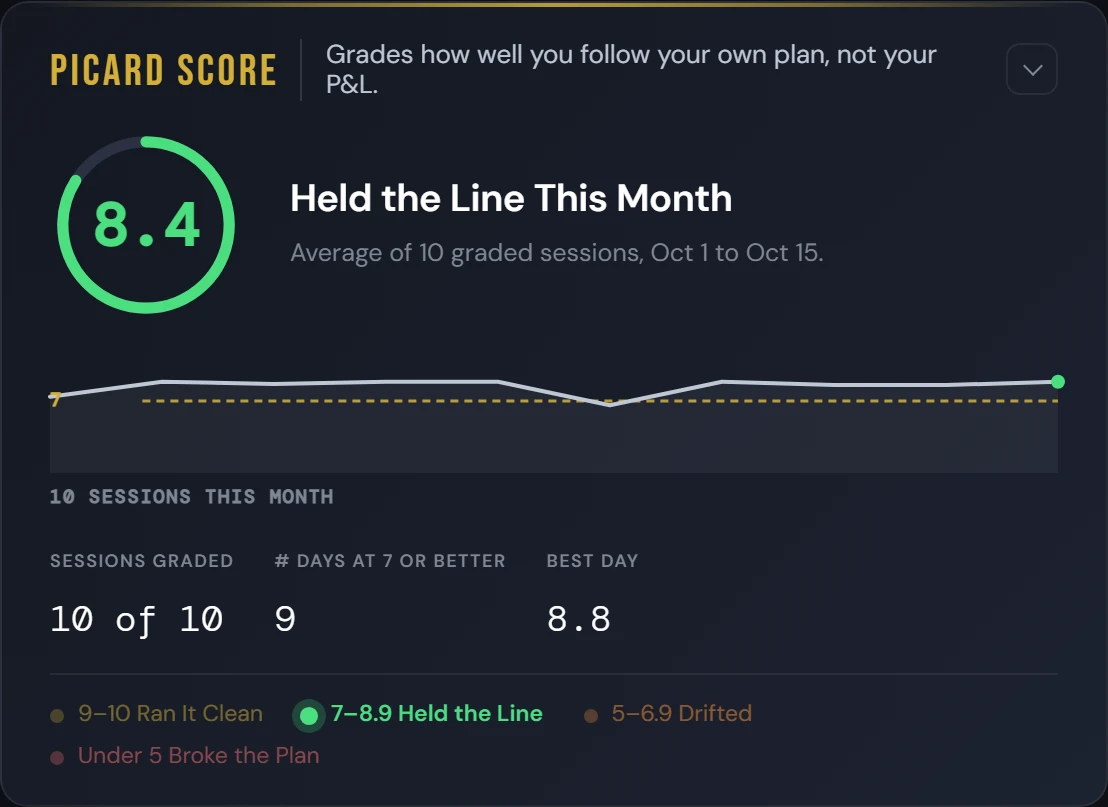
Your P&L screen cannot tell those two days apart. MAKETZO's Picard Score can, because it grades how you ran your process, independent of P&L. That Thursday reads as a broken plan however good 9:45 looked, and a day you ended at your floor as planned reads as a clean one, even though it closed under its high. Read your Picard Score before you look at the money, and the giveback no longer looks like bad luck. The journal and reports then turn each of those days into feedback you can read back before the next open.
Run that Thursday again with the flat test. When the second runner starts to climb, it fails: at flat, the trader would never chase a stock already up that far. No entry. The day ends on the first trade, green and by the book, and the chase back to the goal never happens because there is nothing to win back.
So why do traders hand back a big win? Because the win makes the next trade feel paid for. Money from the morning no longer counts as yours, losses out of it feel cheap, and once some of it is gone, getting back to the peak feels like the job. The fix is not more willpower after the win. It is rules written before it.
Before tomorrow's open, write one line under your plan: the floor at which a green day ends. Then use the flat test on the first trade after your first big win.
[1] Thaler and Johnson, Gambling with the House Money and Trying to Break Even: The Effects of Prior Outcomes on Risky Choice, Management Science 36, no. 6 (1990): 643-660.
[2] Liu, Tsai, Wang and Zhu, Prior Consequences and Subsequent Risk Taking: New Field Evidence from the Taiwan Futures Exchange, Management Science 56, no. 4 (2010): 606-620.
Photo by Michał Parzuchowski on Unsplash