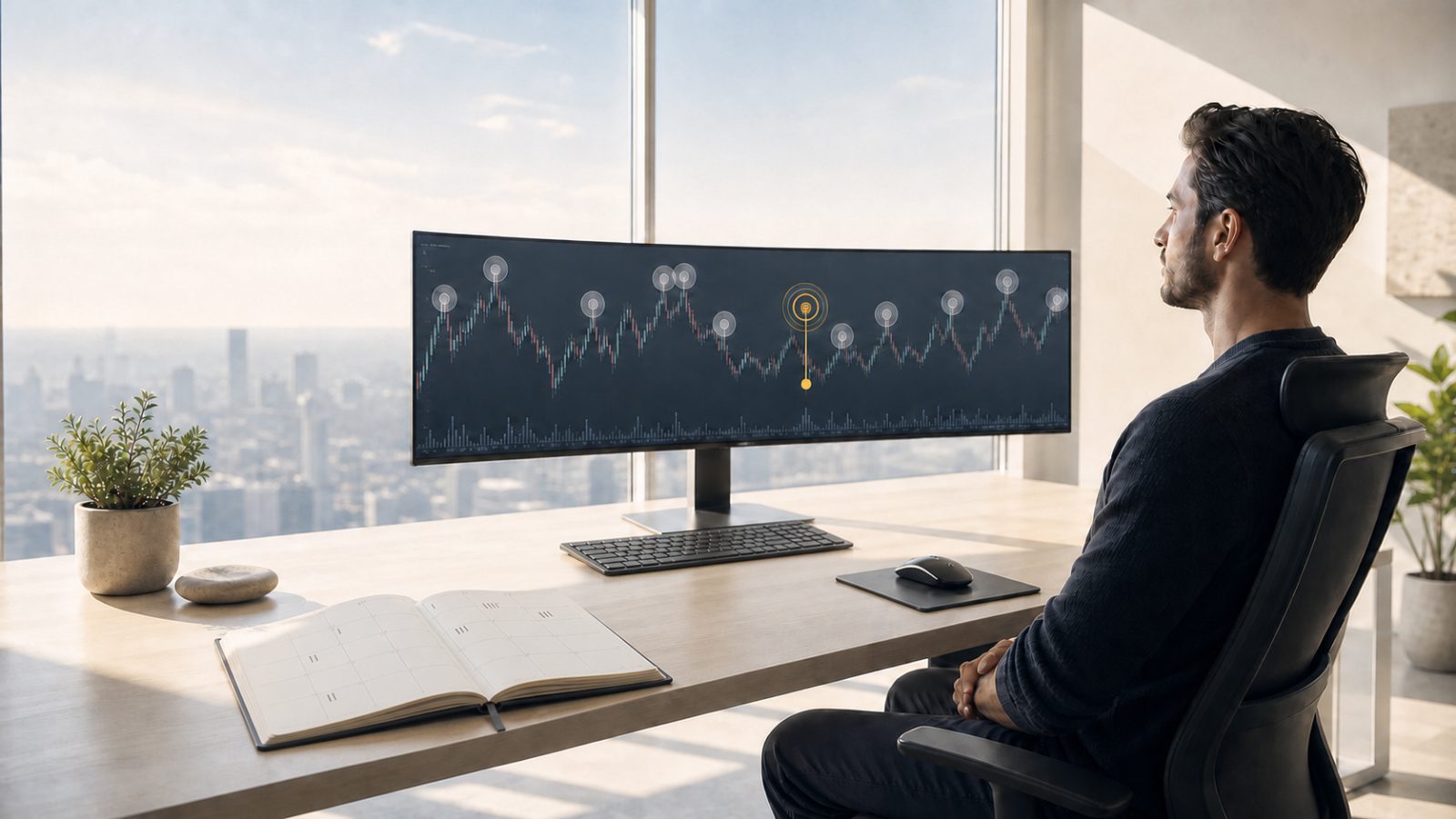
A trader I respect once told me his best month of the year was the one where he took eleven trades. Not eleven a day. Eleven. Total. Twenty-one sessions, ten of them completely flat, no fills, no clicks, nothing to journal except the fact that nothing happened.
He said it like a confession. He knew how it sounded. He also knew it was the truth.
The gap between the trader you are and the trader you want to be is almost never on the trades you took. It's on the ones you didn't skip.
THE MATH NOBODY WANTS
Selectivity is the whole edge
You already know the numbers on your own tape. Pull up your last hundred trades and sort them by setup grade, your A-plus reads versus everything else you clicked into. The A-plus row is almost certainly green. The rest of the tape is where the account bleeds.
This is not a mystery. It is not a skill deficit. You know what your best setup looks like. You've drawn it in your journal a dozen times. The problem is that between the A-plus setups, there are four hours of market to survive, and survival means not touching anything that isn't the read you actually train for.
Every trade you take that isn't your setup is a tax on the trades that are. It costs you focus, it costs you sizing capacity, it costs you the mental cleanliness required to see the real one when it finally shows up. By the time your A-plus prints at 11:52, you've already put on three B-minus scalps, taken a small loss on one, given back the winner on another, and now you're too rattled to press the trade that would have paid for the week.
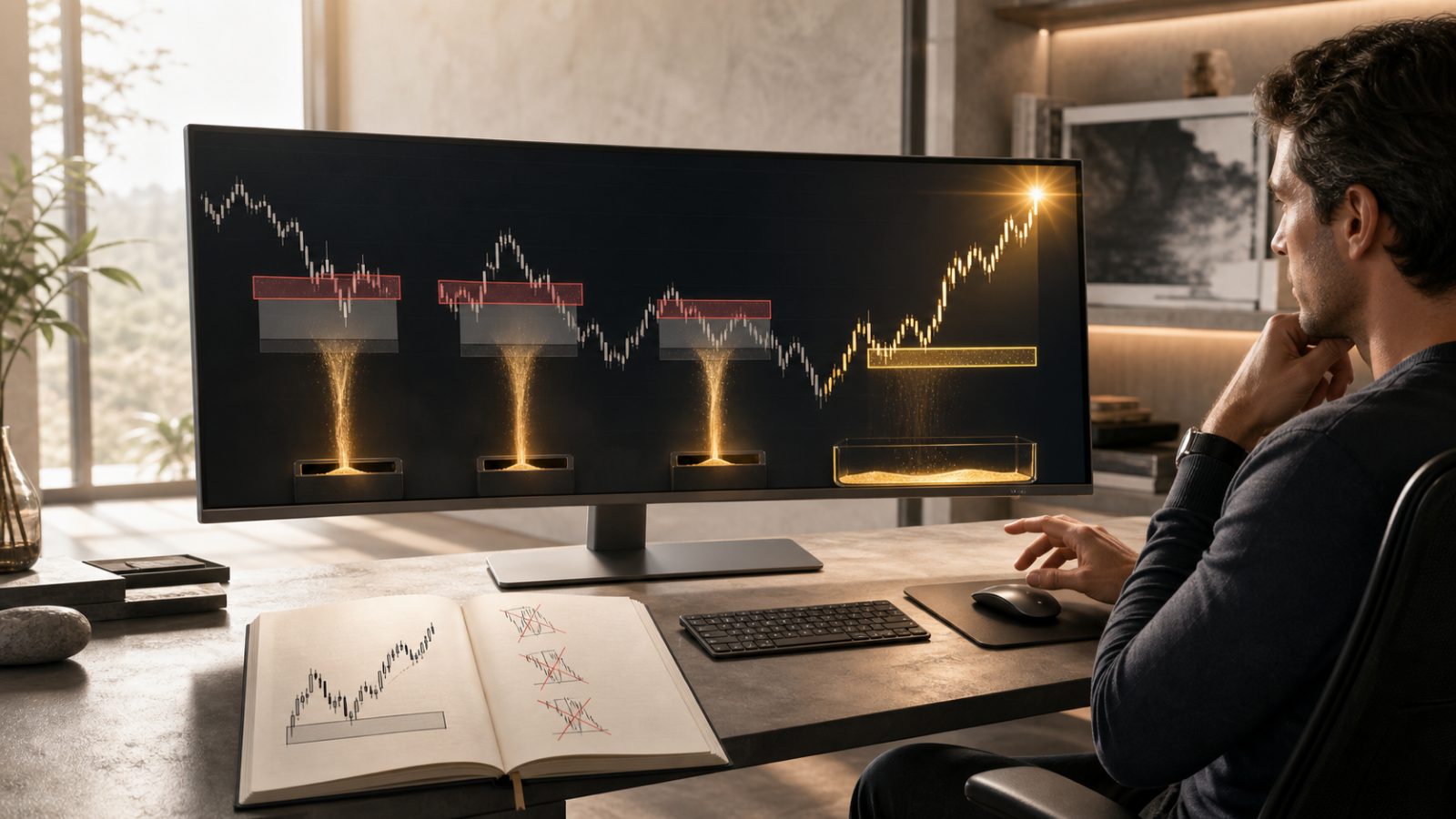
Every trade you take that isn't your setup is a tax on the trades that are.
THE BEGINNER TELL
Beginners hunt. Professionals wait.
Watch a new trader for a session and count how many times their eyes move across the watchlist. It's constant. Every ticker is a candidate. Every red-to-green flip is a maybe. Every halt resume is a heart-rate spike. The whole session is scanning behavior, hunting.
Watch a seasoned trader and the posture is different. Most of the tickers on the list get one glance and get ignored. The focus narrows to two or three names by 9:50. By 10:20 it's often just one. The rest of the session is patience on that one name, waiting for it to either give the read or take itself off the list. That's it. The whole day.
The beginner is doing more work and getting worse outcomes because the work itself is the problem. Every additional name you track is another surface where a marginal setup can trick you into a click. Professionals aren't smarter about what to take. They are ruthlessly better about what to look at in the first place.
- The beginner's watchlist grows through the day. The pro's shrinks.
- The beginner takes the ninth-best setup because it's the one in front of them. The pro passes on it because the first-best hasn't shown yet.
- The beginner treats a slow morning as a problem. The pro treats it as information.
WHY SITTING FEELS WRONG
The screen trains you against your own edge
Here's the honest part. Skipping trades is hard not because you don't understand the math. It's hard because the screen is designed to reward action. Every tick is a stimulus. Every green candle you didn't ride is a small dose of regret. Every red one you avoided is invisible, you get zero credit from your own brain for the losses you didn't take.
The reward architecture is upside down. The behavior that protects the account gives you nothing back in the moment. The behavior that damages the account gives you a hit of engagement every single click. So of course you overtrade. The environment is doing its job. You are doing yours. The two jobs are in direct conflict.
This is why willpower fails. You cannot willpower your way through a stimulus loop that runs six and a half hours a day. You need something outside your own head that keeps score on the trades you didn't take, so that the invisible good behavior becomes visible.
THE BROWN BELT LESSON
Most of the round is not throwing anything
In grappling there is a phase every intermediate goes through where they try to attack constantly. Every position is a submission attempt. Every transition is a scramble. They gas out in four minutes and get tapped by someone who barely moved.
The higher belts spend most of the round doing almost nothing. They frame, they breathe, they wait for the opponent to overcommit, and then they capitalize on one specific mistake with something they've drilled a thousand times. The whole round is patience punctuated by one or two decisive actions. It looks lazy from the outside. It is the opposite of lazy.
Trading is the same shape. The session is long. The market gives you maybe two or three real openings. Your job is to be present enough to recognize them and disciplined enough to have skipped everything that came before, so that when the real opening arrives you have the size, the focus, and the emotional flat to actually take it.
WHAT ACTUALLY HELPS
Making the skips count
The change that moves the needle isn't a new setup or a new indicator. It's building an accountability layer around the trades you don't take, so that skipping stops feeling like nothing and starts feeling like the work.
Practically, that means a few things a serious trader can implement today:
- Log the skip. Every trade you considered and passed on gets a one-line entry. What was the setup, why did it not clear the bar, what happened after. This turns invisible discipline into visible data.
- Cap the click count. Pick a number of trades that reflects your actual A-plus frequency and treat it as a hard ceiling, not a target. Most traders overshoot their own honest number by three to five times.
- Grade by patience, not P&L. A green day where you took six marginal setups is a worse day than a flat day where you took one A-plus and skipped nine B-minuses. Score yourself the way a pro would score you.
The trader who does this for ninety days looks different at the end of it. Fewer clicks. Cleaner tape. Larger size on the reads that matter, because the account isn't nickel-and-dimed to death by the reads that don't.
None of this is new information. You know your A-plus setup. You know that most of what you click into isn't it. What you're missing is a system that keeps score on the skips, that flags when your click count is drifting past your honest frequency, that puts a piece of friction between your hand and the mouse when the setup in front of you is a B-minus dressed up in a green candle.
That's exactly the layer MAKETZO is built to be, a trade intelligence and behavioral accountability platform that treats the trades you don't take as first-class events, not empty space in the journal. If sitting on your hands is the hardest skill in this job, you deserve tooling that finally rewards you for it.