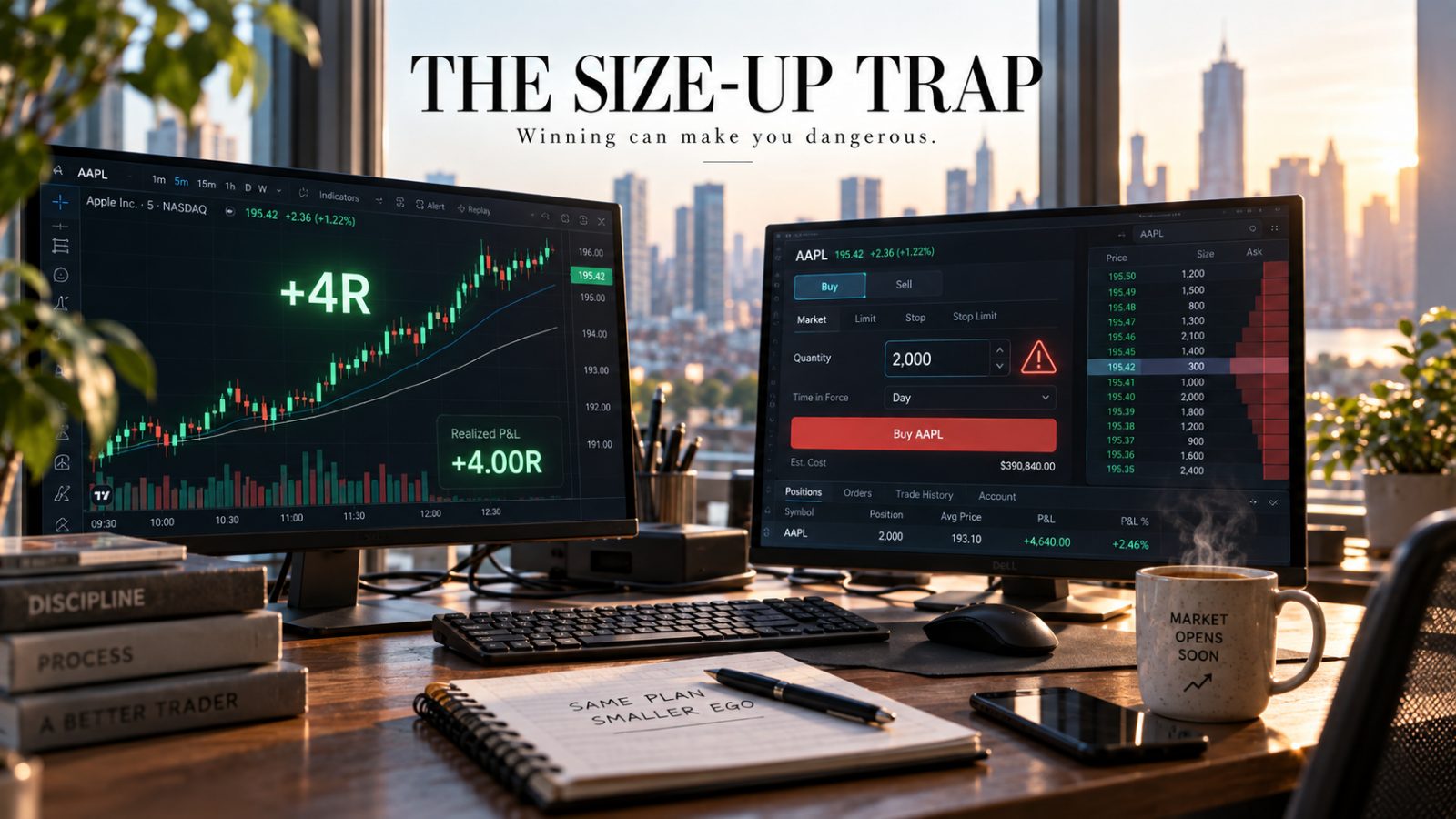
Nobody blows up on a red streak. They blow up on the trade right after the green one.
Every small-cap trader has lived a version of it. You catch a clean move. The size felt right, the entry felt inevitable, the exit was crisp. You closed 4R and the account line ticked up like it was supposed to. Twenty minutes later you're scanning for the next setup, and something has shifted that you did not authorize. The share count in your order ticket is bigger. Not double. Just bigger. Enough that a normal stop is now a not-normal dollar figure. You don't remember typing it.
The green trade did that. Not you.
THE MECHANISM
A winning streak is a size-up streak in disguise
The math is boring and the psychology is not. After a clean win, three things happen inside the same skull at the same time. Your read on the tape feels sharper. Your tolerance for risk-per-share loosens because the account can "afford it now." And the memory of the last loss — the one that taught you why you size the way you size — gets quietly filed under old data.
None of those three shifts are decisions. They're weather. And the position size that comes out of that weather is not the size your written plan called for. It's the size your dopamine called for.
The trap is that the setup that just worked will probably show up again in the next two hours. Small caps run in families. You will get a second look, and a third. The version of you that takes those second and third looks is not the same version that took the first one. That version is bigger, faster on the entry, and slower on the stop.

THE GIVE-BACK
The trade that undoes the week
Watch what actually happens on the give-back day. It is almost never a bad setup. It is usually a decent setup taken at a size that only makes sense if you assume the read is right. Which, on a green streak, you always assume.
The stop hits. And because the size crept up 40% without you noticing, the dollar loss is not 1R against yesterday's win. It's 2.3R. Or 3R. You do the mental math while the fill prints and realize the whole week just narrowed to a coin flip on the next trade. That is where the real damage starts — not from the loss itself, but from the position size you now reach for to "get it back," which is the same inflated size that got you here.
The position that made you 4R yesterday is the same position that takes you to break-even today. It is not a different trade. It is the same trade, sized by a different person.
The account doesn't die on the red day. The account dies on the green day, three sessions earlier, when share size drifted upward by 15% and nobody flagged it.
WHY IT'S INVISIBLE
You cannot see your own size drift in real time
Here's the part that isn't a character flaw. Position size drift is invisible from inside the trade because every individual step feels rational. You didn't jump from 3,000 shares to 10,000. You went 3,000 → 3,500 → 4,200 → 5,000 → 6,500, with a winning trade justifying each bump. At no single moment did you break your rule. You just quietly walked past it.
Journaling catches this a week later. The P&L curve catches it after the give-back. Neither of those is fast enough. By the time you're reviewing on Sunday, the account has already paid the tuition.
What actually catches size drift in the moment are three things most traders don't have running:
- A live baseline of what your normal size looks like for this specific setup, updated by your own recent behavior — not a static number you wrote in a plan six months ago.
- A flag that fires the instant your working order deviates from that baseline by a meaningful percentage, before you click send.
- A friction step — even a two-second one — between the flag and the fill, so the decision has to be re-confirmed by the version of you that is thinking, not the version that is riding.
Without those three, the size-up trap is not something you can willpower your way out of. Willpower is the thing that has already been compromised by the win.
THE RE-FRAME
Treat the green trade as a risk event
The re-frame that changes everything: a winning trade is not a reward. It is a risk event. It is the moment your risk management is most likely to fail, because the failure will feel like confidence.
Traders who last a decade in small caps do one thing consistently that newer traders don't. After a clean win, they get smaller for the next trade, not bigger. Not because the next setup is worse — it might be better — but because they know the version of themselves that is about to take it is the compromised one. They are paying a small tax on the next trade to protect the win they just made. It looks like leaving money on the table. It is actually the only reason there is a table.
You do not have to become that trader by force of personality. You have to build the environment that makes size drift visible the instant it starts, so the compromised version of you has to argue with a system before it argues with the account.
Where MAKETZO fits
The Strike System inside MAKETZO exists for this exact moment. It watches your working position size against your own recent behavior and flags the size-up before the order fills — not after the trade, not on Sunday review, not in a journal entry you write when the damage is already done. It puts a small, deliberate piece of friction between the version of you that just won and the version of you that is about to give it back.
Most traders don't need a better setup. They need something standing between their green streak and their next click. If the trade that just made you 4R is quietly writing the size for tomorrow's give-back, you deserve to see that in the moment it's happening.