
A prop trader once told me his best month came the week he didn't take a single trade on Tuesday or Thursday. He wasn't sick. He wasn't on vacation. The tape just wasn't offering what he trades. He watched it. He went for a walk. He came back.
I remember thinking that sounded insane. Two full days of screen time and nothing to show for it. Now I think it sounds like the whole game.
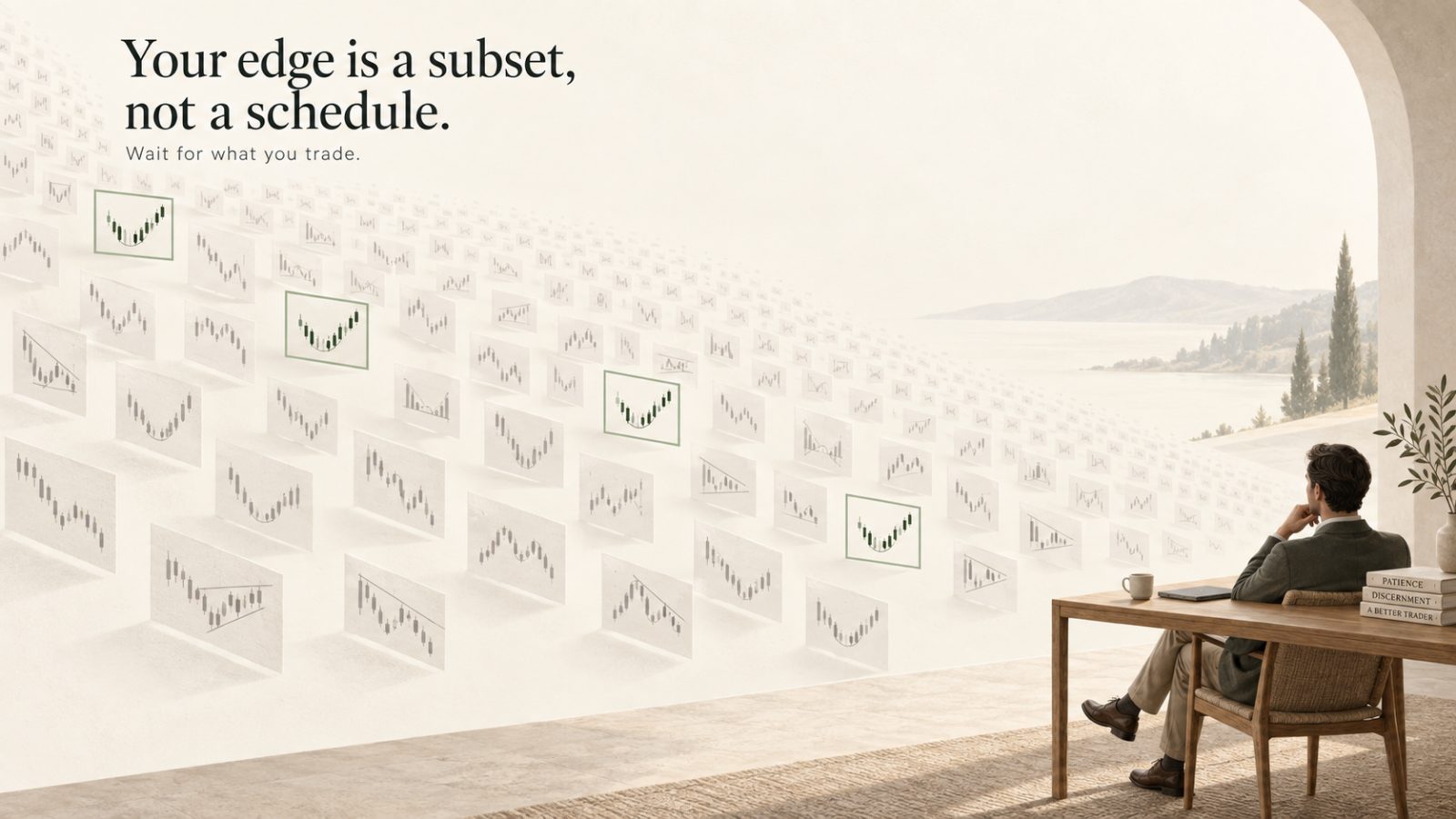
THE MATH NOBODY DOES
Your edge is a subset, not a schedule
Most retail traders treat the market open like a shift. Bell rings, you clock in, you produce. If you didn't take trades, you didn't work. If you didn't work, you didn't earn. The logic feels airtight until you write down the actual math.
Pick any setup you claim as your bread and butter. A specific low-float pattern, a specific reclaim, a specific failed-move reversal. Count honestly how many times that exact setup — with your exact criteria met — printed last week. For most small-cap traders the real number is somewhere between four and nine per week. Not per day. Per week.
Now count how many trades you actually took last week. If the second number is three times the first, congratulations, you've identified where your account is going. You're not trading your edge. You're trading the leftover time between instances of your edge.
THE PROFESSIONAL DIFFERENCE
Beginners hunt. Professionals wait to be handed something.
Watch a new trader's session and you'll see a hunter. Scanner up, eyes darting, alt-tabbing between three platforms, looking for something — anything — that resembles a reason to click. The posture is forward. The breathing is shallow. The nervous system is producing trades because the nervous system needs to produce trades.
Watch someone four or five years in and the posture is different. They're leaned back. The scanner is filtered down to a handful of names they actually understand. They're not looking for a trade. They're waiting for one specific arrangement to appear, and if it doesn't, they're comfortable closing the laptop at 11:30.
The pro isn't more patient than you because they have more discipline. They're more patient because they've priced the cost of the trades they didn't need to take.
That reframe matters. Patience isn't a virtue you summon. It's a conclusion you arrive at after enough repetitions of the same expensive mistake — taking the trade adjacent to your setup, the one that rhymed with it, the one that shared a shape but not a soul.
OPPORTUNITY COST, INVERTED
The trade you skip is not the trade you miss
The reason skipping feels so bad is that retail traders have opportunity cost backwards. You think the cost is the trade you didn't take that would've worked. In reality, the cost you're paying every day is the trade you did take that shouldn't have been there.
Consider what a marginal trade actually costs you, beyond the ticket:
- It burns a slot in your daily loss limit that you'll want back at 10:45 when the real setup shows.
- It occupies the working memory you need to evaluate the next tape objectively — you're now managing a position instead of reading the market.
- It tilts your baseline. Now the next trade is a reaction to this one, not a fresh read.
- It teaches your brain that clicking is the reward. Not being right. Clicking.
Every marginal trade is a small tax on the trade you actually needed to take. Skip enough of the marginal ones and the good ones get bigger, cleaner, and more decisively sized — because you arrive at them fresh, unbothered, and inside your loss limit.
WHY IT'S SO HARD
Sitting on your hands is unpaid labor
Nobody prepared you for how boring elite execution looks. The books show you charts with arrows on the good entries. They don't show you the four hours of nothing between them, the guy staring at level 2 without clicking, the mental cost of watching three okay-ish setups go without you because they weren't the one.
That waiting is the actual job. And it's uncompensated in every way that matters to the human nervous system. No dopamine. No P&L movement. No story to tell the group chat. Just the quiet work of remaining a professional while the market offers you amateur trades.
The traders who win long term are the ones who figured out how to make waiting feel like working. They log the setups they skipped and why. They mark the tape at moments they were tempted. They treat a well-skipped trade with the same respect as a well-taken one, because both required the same underlying skill: seeing the setup clearly enough to know what it wasn't.
A skipped trade you can name is worth more than a winning trade you can't explain. One is skill. The other is weather.
THE FILTER YOU DON'T HAVE
Selectivity is a system, not a mood
Here's the uncomfortable part. You already know all this. Every trader who's been at it more than a year has heard the sit-on-your-hands sermon. Knowing it doesn't help. The gap between knowing you should skip and actually skipping is where accounts die.
What closes that gap isn't more willpower. It's structure that makes the skip the default and the trade the exception. A pre-defined checklist that a setup either passes or doesn't. A cap on daily attempts that forces you to spend your clicks like they're rationed. A record of every trade you didn't take, so the skips become visible work instead of invisible restraint. A read on your own state before you're allowed to size up.
Without that structure, selectivity is a mood you're in on good days and lose access to on bad ones. With it, selectivity becomes a system that runs whether you feel like it or not.
The trader you're trying to become
Somewhere in the middle of writing this I realized what I was describing. Not a personality trait. Not a mindset. An operating environment that makes patience the path of least resistance — that scores your skips, flags the state you're in before you click, caps you when you shouldn't be clicking at all, and gives you back the receipts at end of day so you can see the shape of your own restraint.
That's the trader MAKETZO is built for. Not the one hunting more trades. The one trying to take fewer, better ones — and needing a system that makes the skip feel like the win it actually is.