
A trader I respect once told me his best month in two years had eleven trades in it. Not eleven a day. Eleven, total. Twenty-one sessions, ten of them he didn't press a single button.
He said it like a confession. Like he was embarrassed that the thing that worked was mostly not doing the thing.
That's the part nobody writes about honestly. The headline is always the entry. The screenshot is always the fill. Nobody posts the four hours they sat with their hands off the keyboard watching setups form and dissolve and form again, and did nothing, and were right to do nothing.
THE INVISIBLE SKILL
The skip is the trade
Every trade you take has a shadow — the trade you didn't take. You can't see it on your P&L. It doesn't show up in your journal unless you force it to. But it's doing work in your account the entire session.
The profitable trader and the breakeven trader are usually looking at the same setups. The difference is what they do with the ones that are almost there. Not the A+ ones. Everyone takes those. The B- ones. The setup that has three of the five things you want. The one where the float is right but the catalyst is thin. The one where price is at your level but the tape underneath is sloppy.
The breakeven trader takes it, because being in feels like working. The profitable trader skips it, because being flat is working.
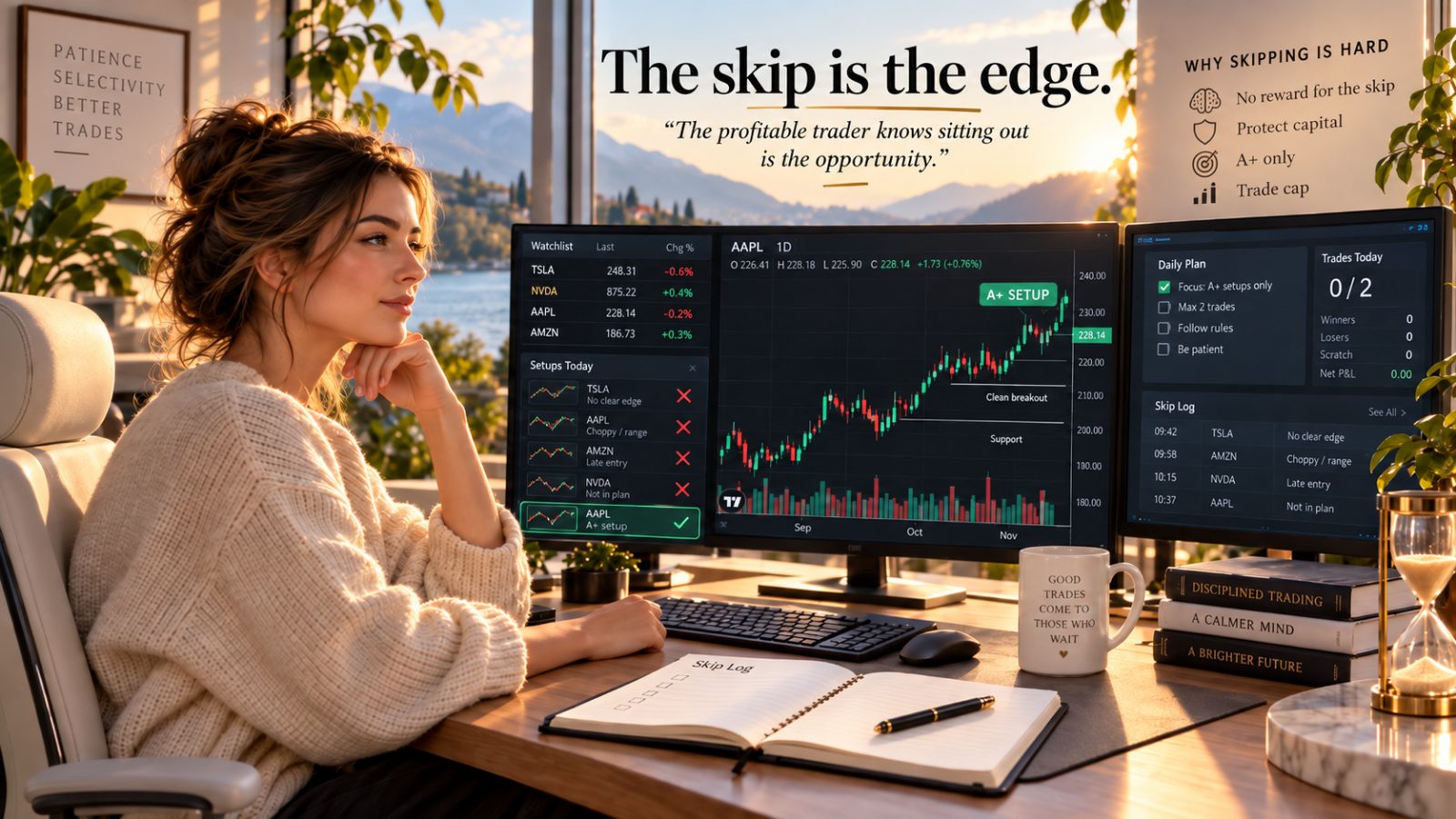
WHY SKIPPING IS HARD
Nothing in your body rewards a skip
Here's the honest problem. When you take a trade and it works, you get a hit. Dopamine, pride, the little rush of being right in public even if the public is just you. When you take a trade and it fails, you at least get the clean story of a loss — a thing happened, you can journal it, you can move on.
When you skip a trade and it would have worked, you get regret. When you skip a trade and it would have failed, you get nothing. No reward, no story, no closure. Just a flat chart and a nagging feeling that you should be doing more.
So the entire reinforcement loop of a trading day is built against the skip. Your brain is being paid, in neurochemistry, to click. It is being paid in silence to sit still. Guess which signal wins by default.
The breakeven trader thinks sitting out is lost opportunity. The profitable trader knows sitting out is the opportunity.
THE MATH NOBODY SHOWS YOU
Opportunity cost cuts both ways
Beginners talk about opportunity cost like it only runs in one direction — the cost of not being in. There's another direction, and it's the one that empties accounts.
The cost of being in a mediocre trade isn't just the loss on that trade. It's:
- The capital tied up when the real setup prints twenty minutes later and you're already down and tilted.
- The mental bandwidth you burn managing a position you shouldn't have taken, which is bandwidth you now don't have for the clean one.
- The size you can't put on the A+ because you already took a half-size swing at a C+.
- The emotional residue — a small loss on a bad setup feels worse than a bigger loss on a good one, and it bleeds into the next decision.
A mediocre trade doesn't cost you the mediocre trade. It costs you the next good one. That's the math. And it's invisible on any single-session P&L, which is why it takes most traders years to feel it.
THE PRO/BEGINNER SPLIT
What selectivity actually looks like
The beginner's day is wide and shallow. Twenty-two tickers on the watchlist. Fourteen alerts fired. Nine trades taken. Three winners, four losers, two scratches, one that ran without them that they're still mad about at dinner.
The pro's day is narrow and deep. Three tickers, maybe four. Two alerts that actually matter. Zero to two trades. On the days they take two, both are planned to the dollar before the open. On the days they take zero, they close the laptop at noon and nothing in their body registers it as failure.
The difference isn't information. The pro isn't seeing anything the beginner can't see. The difference is that the pro has internalized that a day with no trades is not a wasted day. It's a day they successfully defended their capital and their head from a market that didn't offer them an edge.
The beginner can't accept that framing because the beginner is still being paid by activity. The pro is being paid by selection.
HOW TO GET THERE
You can't white-knuckle patience
You will not become more selective by telling yourself to be more selective. That's the first lie. Discipline is not a mantra. It's a structure that makes the wrong move harder than the right one.
What actually moves a trader toward selectivity is some version of this:
- A pre-defined list of what you take. Not vibes. A written definition of your setup, specific enough that you can look at a chart and answer yes or no in under five seconds. If the answer isn't a clean yes, the answer is no.
- A skip log. Every setup you considered and passed on, logged with a one-line reason. This is the ledger that makes skipping visible — because without a ledger, skips vanish and only trades count.
- A cap on trade count, not just loss. Most traders have a daily loss limit. Fewer have a daily trade cap. The trade cap is often the more useful one, because it forces you to spend your few shots on the best setups and not on the first ones.
- An honest post-session review of trades you shouldn't have taken. Not just the losers. The winners that didn't meet your criteria too. Those are the most dangerous ones, because the P&L lies to you about them.
None of this is glamorous. None of it feels like trading. That's why it works.
The quiet account
The traders I know who are actually making it look boring from the outside. They skip more than they take. They close flat more days than they'd admit publicly, because admitting it on social media would get them unfollowed by the people who want to believe the dream looks louder than it does.
If you want to become one of them, the path isn't more setups, more screens, more alerts. It's a system that respects the skip the same way it respects the trade. Something that logs what you passed on, flags when you're drifting into B- territory, and quietly reminds you — on the days your hands are itching — that the trader who doesn't press is doing the work.
That's the gap MAKETZO is built around. Not helping you find more trades. Helping you honor the ones you were already right to skip, and protecting you from the ones you were about to take anyway.