
The coffee is not the routine. The coffee is the excuse for the routine.
By the time the bell rings, the trader who is going to have a clean session has already made every decision that matters. The scan is done. The names are ranked. The plan is written down where they can see it. Their nervous system knows what it's about to be asked to do. None of that happened by accident, and none of it happened in the last four minutes.
The reason most retail traders don't have a pre-market routine is that a real one doesn't feel like trading. It feels like homework. It feels slow. It feels like you're going to miss something by not being in the chat, not refreshing the scanner, not chasing whatever ticker just went vertical in the pre. So you skip it, and then you spend the first forty-five minutes of the session paying tuition for a class you already knew how to prepare for.
THE MYTH
The zone is not a vibe you catch
Traders talk about "getting in the zone" like it's weather. Some mornings you wake up locked in, some mornings you don't, and if you don't, well, that's just the day you got. This is a very expensive way to think about it.
The zone is a state. States have inputs. If you sit down at 9:29 having spent the previous forty minutes half-watching a livestream, half-answering texts, half-eating cereal standing up, you did not fail to catch a vibe. You built the wrong state, on purpose, with your hands. The morning is a machine that takes what you feed it and hands you back a nervous system. Feed it noise, get noise. Feed it sequence, get sequence.
The morning is a machine that takes what you feed it and hands you back a nervous system. Feed it noise, get noise.
This is why "just try harder to focus" never works and never has. Focus isn't a willpower output. It's a downstream effect of doing four specific things in a specific order before the market opens. When the order is right, focus shows up on time. When it isn't, focus is somewhere else and you're negotiating with it while your fills go against you.
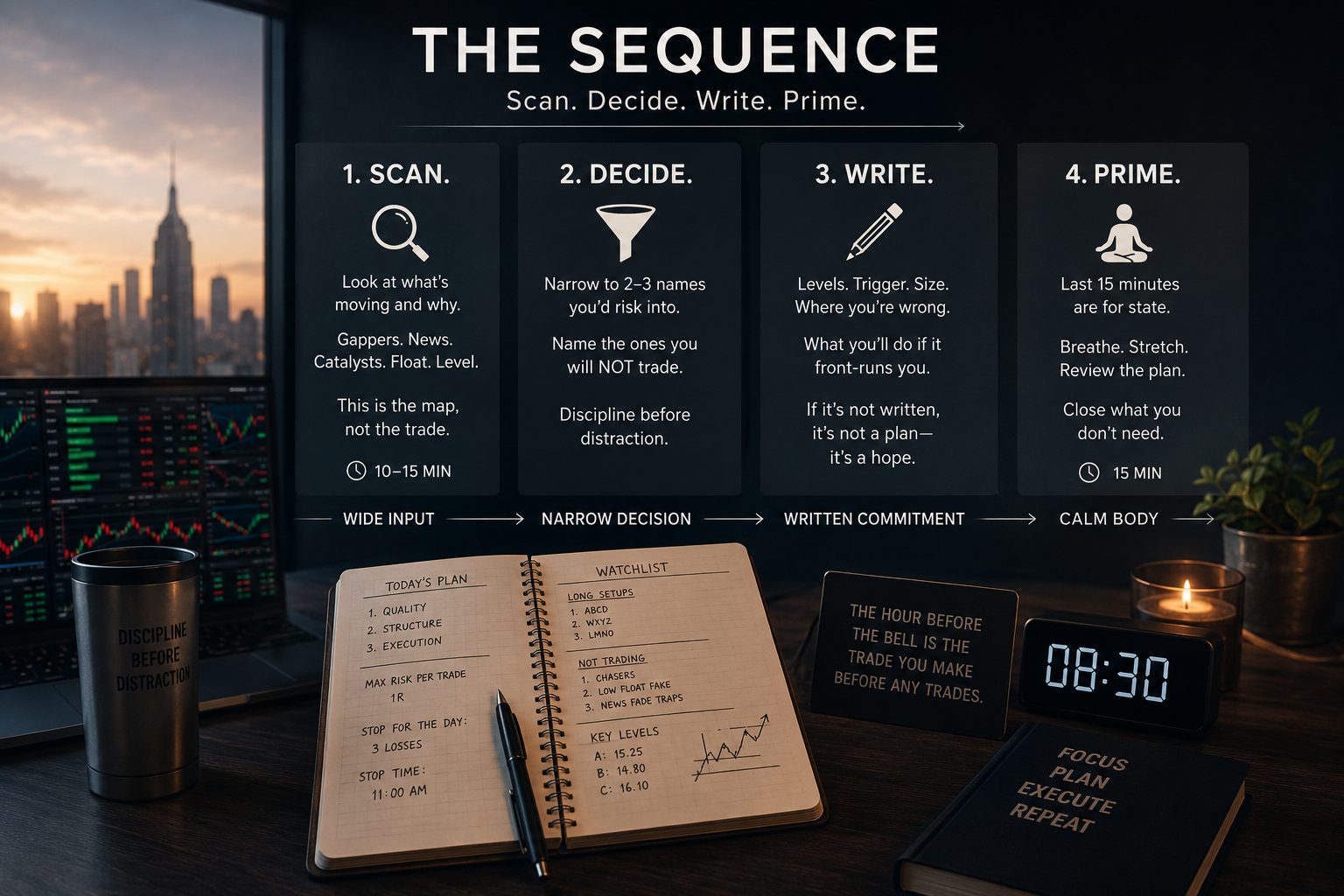
THE SEQUENCE
Scan. Decide. Write. Prime.
A pre-market routine that actually gets you in the zone has four moves. Not five, not seven, not a Notion template with color-coded tabs. Four.
- Scan. Look at what's moving and why. Gappers, news catalysts, float, level. This is the wide net — the point is not to pick your trades yet, it's to know the map. Ten to fifteen minutes, max. If you're spending forty-five minutes on the scan, you're not scanning. You're avoiding the next step.
- Decide. Narrow the list to the two or three names you'd actually put risk into today, and — this is the part people skip — the ones you would NOT trade even if they run. Naming what you're passing on is half the work. It's what keeps you from getting sucked into a ticker at 9:47 that you had already privately disqualified at 8:15.
- Write. On paper, in a doc, in the platform — somewhere your eyes will return to. Levels. Trigger. Size. Where you're wrong. What you'll do if it front-runs you. If it's not written, it isn't a plan, it's a hope you told yourself in the shower.
- Prime. The last fifteen minutes before the bell are not for more research. They're for state. Breathe, stretch, look at the plan one more time, close everything you don't need. This is the part that feels the most like doing nothing and matters the most.
If you notice, the sequence gets quieter as it moves. Wide input, narrow decision, written commitment, calm body. That shape is not accidental. It's the shape of a mind that's about to execute instead of react.
THE INTERRUPTIONS
What actually breaks the sequence
Nobody's pre-market routine dies because they don't know it matters. It dies because the sequence has enemies and the trader hasn't named them.
The phone is the biggest one. A single doomscroll through X between the scan and the decide step and you've swapped your own read of the tape for whoever posted loudest in the last ninety seconds. The chatroom is a close second. Not because chatrooms are bad — some are excellent — but because passively watching other traders' pre-market opinions is not the same activity as forming your own, and your body can't tell the difference. It just feels like you prepped.
Life is the third one, and this one is real. Kids need breakfast. The dog needs out. Somebody has to sign the permission slip. The trader who accepts that the first hour of the day is contested territory — and builds the routine around that reality instead of pretending it isn't there — has a routine that survives Tuesdays. The trader who designs a routine for an imaginary quiet monk-life version of themselves has a routine that collapses the second real life shows up. Which is every day.
The fix isn't more discipline. The fix is a shorter, tighter sequence with fewer moving parts, protected by a wall you actually enforce. Twenty focused minutes beats ninety distracted ones. Every time.
THE LAST FIFTEEN
The waiting room is where the zone actually locks in
The window between finishing your plan and the bell is the most misunderstood part of the pre-market. Most traders fill it with more input — one more scan refresh, one more chart flip, one more scroll through the watchlist. This is exactly backwards.
The last fifteen minutes are for closing loops, not opening them. Your plan is done. Your names are set. Adding information now doesn't sharpen the plan, it dilutes it. Every new data point you take in during that window is a small argument with the decisions you already made when you were calmer. By 9:29, you should be reading your own plan, not the market's noise.
The last fifteen minutes are for closing loops, not opening them. By 9:29 you should be reading your own plan, not the market's noise.
The traders I know who consistently execute — not the loud ones, the boring consistent ones — all have some version of this. A quiet moment. Plan on the screen. Breath in the body. Nothing new coming in. When the bell rings, they don't have to find the zone. They're already inside it, and the market walked to them.
This is infrastructure, not motivation
Here is the part that took me too long to accept: the pre-market routine is not a productivity habit. It's not a self-improvement project. It's not something you do because disciplined traders do it and you want to be one. It's the actual first trade of your day, and every trade after it inherits its quality.
Which is why building it inside your platform matters more than building it in a journal app you'll forget to open. The scan, the decision, the written plan, the primed state, the quiet last fifteen — all of that wants to live in one place, in a sequence you don't have to reinvent every morning. A Focus Room that walks you through get-in-the-zone before the bell. A Waiting Room that holds the space between plan and open without letting you fill it with noise. Infrastructure that makes the right sequence the path of least resistance, so life can interrupt it and it still survives.
MAKETZO is built for the trader who already knows the pre-market hour matters and is tired of running it on willpower. If that's the routine you keep meaning to have, this is where it lives.