What Counts as a Penny Stock, and Why the Venue Matters
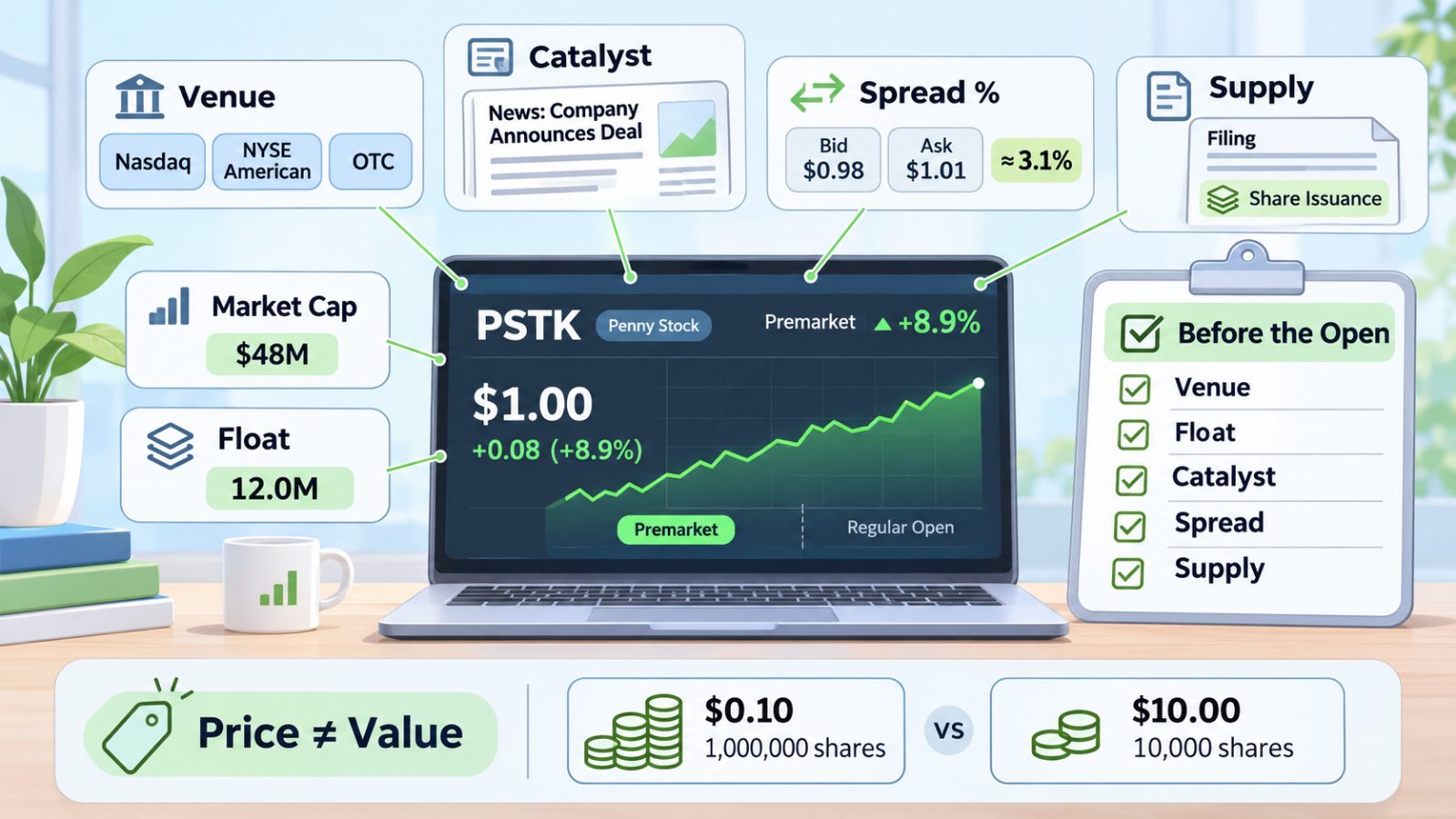
Check where a stock trades before you check what it costs.
Under the SEC's penny stock rule, the term generally covers a stock priced under $5 that is not listed on a qualifying national exchange, from a company without enough assets or revenue to be excluded. So a $0.60 stock on Nasdaq generally falls outside the legal definition, even though every trader on the desk calls it a penny stock.
The split matters at the open because the two kinds of stock come with different information.
- Listed on Nasdaq or NYSE American. The company has listing standards to meet and reports to file, and the exchange can halt or delist it.
- Over the counter. OTC Markets sorts these names into tiers by how much the company discloses, from OTCQX and OTCQB down through OTCID to Pink Limited. Near the bottom, a stock can be quoted with little or no involvement from the company.
Then forget the price. A low price is a fact about share count, not about value. A $0.40 stock with 500 million shares is a $200 million company. A $12 stock with 2 million shares is a $24 million company. The cheap one is worth more than eight times as much.
Before your next trade in a low-priced name, write down the venue, the market cap and the float. If you cannot name all three, you do not know yet what you are trading.
How to Build a Penny Stock List Before the Open
It is 9:12 and a ticker is up 180% premarket. You have eighteen minutes, so run the same six checks every morning, in the same order.
- Venue. Nasdaq, NYSE American or OTC.
- Float and average volume. Float tells you how violently the stock can run. Volume tells you whether you can get out.
- Catalyst. Read the actual headline or filing. "No news" is an answer, and so is a contract with no dollar figure in it.
- Who is talking. Look for a paid-promotion line on anything that reached you unasked.
- Spread in percent. Divide the spread by the price.
- Supply. Can the company sell stock today, and has it been doing so?
Two blanks and the name comes off today's list. A ticker and a price is not a plan, and a name you could not finish checking by the bell will be replaced by another one tomorrow.
Keep the six answers beside each name in one line. By Friday you will have a record of which kinds of low-priced stock you read well, and that record is worth more than any list a stranger sends you.
How to Tell a Promoted Stock From a Real Runner
Read the bottom of the pitch first. A line saying the writer was "compensated by a third party" means someone paid for your attention, and that someone usually has shares to sell.
A pump runs in four stages:
- Insiders accumulate quietly at low prices.
- A promotion or press release ramp manufactures demand.
- A crowd of retail buyers chases the move.
- Insiders and promoters sell into that crowd, and the price collapses.
The only question you control is which stage you are buying into. Buy near the highs after the blast and you are the late buyer the early holders needed.
Three more tells show up on the tape.
- The daily shape. Many manipulated names ramp at the open to pull a crowd in, then grind lower all afternoon as the shares get distributed.
- The borrowed move. A weak name running only because a sector leader is hot has no catalyst of its own, and it fades first when the leader cools.
- The value story. "It is up 300%, so it cannot go higher" and "it is down 80%, so it is cheap" are the same mistake. Price on a pumped name reflects promotion and float, not worth.
Betting against it is not the easy answer. Shorting an obvious pump can bury you, because the squeeze can run further than you can survive and the borrow is often scarce and expensive.
There is also a way to lose the exit entirely. Between September 26 and October 22, 2025, the SEC suspended trading in nine Nasdaq-listed companies over suspected social-media schemes to inflate price and volume. When those suspensions ended, Nasdaq kept the stocks halted until the companies answered its requests for information. Before you buy a name running on a group chat, ask what the trade looks like if you cannot sell for a month. Sitting that one out is a good result.
Under a Dollar, the Spread Is the Trade
Count every low-priced trade in percent, because cents will lie to you.
A penny of spread sounds like nothing. On a $50 stock it is 0.02%. On a $0.50 stock it is 2%, so if you buy at the offer and sell at the bid with no change in price, you are down 2% before the stock has done anything.
Per-share commissions stack on top. If your broker charges half a cent a share, that is 1% of a $0.50 price going in and 1% coming out. On a $100 stock the same half cent barely registers. Check your own fee schedule tonight, then do this arithmetic once. It changes which trades look worth taking.
Under a dollar, quotes can run to four decimals, so another order can step ahead of yours for a hundredth of a cent. Slippage comes next. When your order is bigger than the shares resting at the quote, it walks through the book and your average fill lands worse than where you clicked.
Four rules cover most of it.
- If the spread is a large share of what you expect to make, you have no trade.
- Let liquidity set your order, not conviction.
- Get out of a thin name in pieces and into strength. Selling everything at market walks the bid down against you.
- Count every marginal re-entry as one more spread and one more commission.
Where the New Shares Come From, and Why a Dollar Is a Deadline
A company that needs cash sees your breakout as a financing window. That is why good news on a low-priced name can rip 60% and bleed lower all day on heavy volume.
New supply arrives in a few recognizable shapes.
- A plain offering sells fresh shares, often priced right into the move you are chasing.
- A registered direct sells registered shares to funds at a discount, so those buyers can turn around and sell into the open market at once.
- A unit offering pairs each share with a warrant, which means two waves of supply: the shares now and the warrant shares later.
- Convertible notes and warrants sit as overhang, and holders sell or hedge into strength.
- A climbing share count is the fingerprint of a serial diluter. A company that goes from 20 million shares to 120 million in two years makes last year's chart a poor guide.
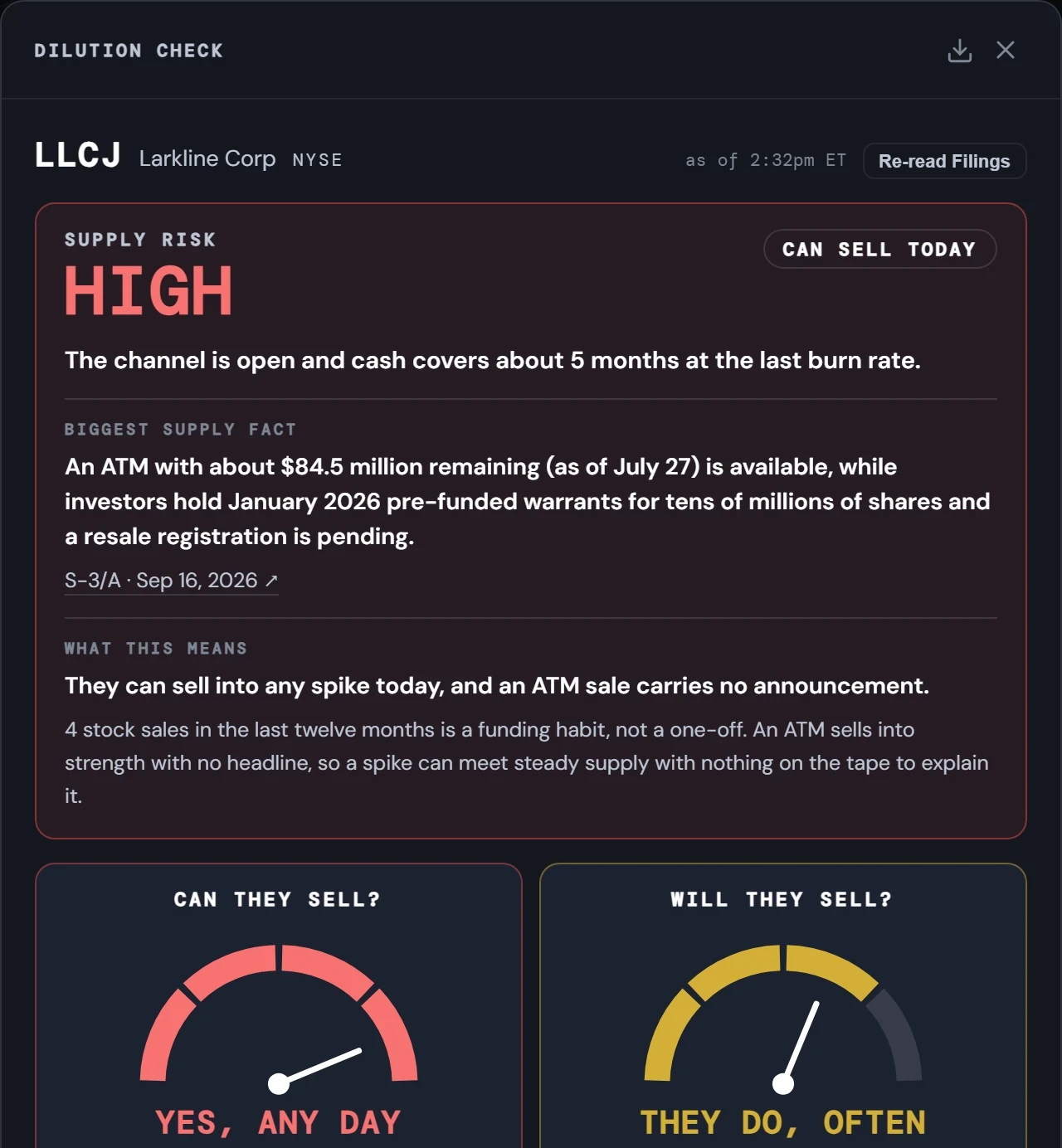
Before the bell, type the ticker into Dilution Check. It reads the company's SEC filings and returns a supply risk from low to high, then answers three questions: is a selling channel open, how many stock sales landed in the last twelve months, and how long does the cash last? Each form code links to its filing, so you can read the source yourself. A low reading describes what is on file and says nothing about where the stock goes next.
Under a dollar, a Nasdaq company is also on a clock. A closing bid below $1 for 30 straight trading days brings a deficiency notice and 180 calendar days to fix it, sometimes with a second 180. A company that did a reverse split in the prior year gets no automatic 180 days. And since January 19, 2026, a closing bid at or below $0.10 for ten straight trading days brings an immediate suspension.
The fix is usually a reverse split or a raise, and the tape tends to sell both. Before you trust a bounce near a dollar, look through the company's filings for an 8-K with Item 3.01, where these notices get reported.
Write Your Penny Stock Rules While the Screen Is Quiet
Every expensive mistake on a low-priced runner gets made in a few seconds: the chase, the re-entry after a loss, the stop you drag because you are sure it comes back.

So write your rules tonight, each one answerable yes or no.
- I do not buy a name until I can say which stage of a pump it is in.
- I do not enter when the spread is a large share of what I expect to make.
- I do not trade a name whose pitch carries a paid-promotion line.
MAKETZO is a trading discipline system for small cap day traders, built on one idea: you set the rules while you are calm, and it enforces them when you are not.
- The Morning Lock-In is where you commit to those rules before your first trade.
- The Strike System and COACH SAYS call out the drift as it happens, in direct language, when you want back into the name that just cost you.
- The Focus Room is where you run a reset after a tilt.
- The journal grades your discipline on every trade. Your Picard Score, a daily grade from 1 to 10, is scored independently of your P&L, so a lucky spike on a broken rule cannot pass for a good day.
If you execute on DAS Trader, your trades can be imported from there. It is the only import MAKETZO takes, and a net P&L you type by hand works for the accountability side. MAKETZO never tells you what to buy, and it gives no stock picks or financial advice. Every plan starts with a 7-day free trial, and MAKETZO's pricing page lists the plans.
Common Questions
What are the best penny stocks right now?
Any list that answers that goes stale within hours, because float, spread and filings keep changing, and a low price says nothing about quality. MAKETZO gives no stock picks. Treat a ready-made list as a place to start your checks: find out who wrote it and whether anyone paid for it, then run each ticker for venue, float, catalyst, spread in percent and supply. A name that clears all of them is worth watching, and whether it is worth trading is your call.
Can you make money trading penny stocks?
Some traders do, and a low price does nothing to improve the odds. Costs run higher in percent, supply can appear in the middle of a run, and a halted stock cannot be sold. Answer it with your own record: take your last 30 sessions in low-priced names and compare your average win with your average loss after spread and commissions, then count how many of the losses came on days you broke a written rule. If the math does not work there, a lower price will not fix it.
What is the typical price range for a penny stock?
Under $5 is the line most U.S. traders use, and the SEC rule uses the same figure, while many names trade under $1. The price alone will mislead you, because a stock under $5 can be a far larger company than one at $12, and a low-priced name on Nasdaq generally falls outside the legal definition. Use the price band to estimate your costs: the lower the price, the more a penny of spread costs you in percent.