Count Your Last Ten Losses

The alert fired. You knew the setup, you knew the level, and you knew what you were supposed to do if it broke.
It broke, and you stayed in.
You have the scanner. You have watched the lessons. You could walk a beginner through that pattern while it prints. And last week you lost money the same way you lost it last month.
Go back and count your last ten losing trades. Beside each one, answer a single question: did I lose this because of something I did not know? If most of your answers are no, more information is not going to fix it.
Then why does the next scanner still look like the answer?
Tim Sykes Already Told You Why You're Struggling
A better screen shows you more trades. It has never once kept your hand off a bad one.
That is no knock on the screen. StocksToTrade is built for exactly what it does. Custom screeners and strategy scans build your watchlists, news and SEC filings stream beside the charts, and paper trading lets you rehearse without risking a dollar. Its Oracle scanner narrows the field to a daily list with suggested signals and support and resistance levels. Sykes and Zak Westphal started the company in 2012, Westphal runs it as CEO, and Tim Bohen is its lead trainer. Its pricing page lists $179.95 a month or $1,899.50 a year, and both plans include StocksToTrade University, its library of training videos.
The trouble is the belief you bring to it. I lost because I did not see it soon enough or know enough, so the fix is a faster alert or one more course. That belief is comfortable, because a subscription takes a minute to buy and changing what your hand does under pressure takes a great deal longer. Knowledge is easy to sell. It was never what you lacked.
The people who built the screen do not believe it either. Bohen calls its scanners "unbeatable" and adds, "I use them every day," and then writes this about managing risk in a piece on what every trader learns too late: "Without this, no strategy, no scanner, and no chart pattern will keep you in the game for long." Sykes, whose biography describes an approach that "emphasizes small gains and cutting losses quickly," gives the diagnosis in one line of his rules for optimal trading: "If you're struggling right now it's probably because you aren't following your rules."
He takes it far enough to throw out your P&L as evidence. "But just because I made money doesn't mean it was a good trade," he writes in a post on daily habits, and then, "You can't base a trade's success or failure on profit or loss."
Try that before the open. Take your last loss and write down the rule you broke, not the setup you wish you had seen.
So the co-founder of a scanner company is telling you to look at your rules, and you are shopping for a better scanner. You probably agree with every word of his number-one rule: "I cut stock losses quickly. Period." The question is what happens to that rule between agreeing with it and needing it.
You Saw the Setup. You Knew Your Stop. You Moved It Anyway.
Nobody breaks a rule in one decision. It takes four, and each one feels reasonable.
The alert fires on a small cap with fresh news. You have your level written down, you take the trade, and for a minute you are right. Then it slips through your level.
The first decision is not selling. It might be a shakeout, you tell yourself, so you give it a few seconds. Those few seconds are when the trade changes owners. The person who wrote the plan is gone, and the person at the mouse wants one thing, which is not to have been wrong. Listen for that sentence at the open. When you hear yourself say give it a second, the first decision is already made.
The second decision is the stop. It goes a little lower to give the trade room, and now you are in a trade nobody planned.
The third decision is the add. You buy more to bring your average down, because a lower average needs a smaller bounce to get you out even. It feels like skill. It is the same refusal with more shares.
The fourth decision comes after you finally sell, for far more than you agreed to lose this morning. You want it back, right now, from the next alert on the screen. Bohen defines revenge trading as "engaging in impulsive and high-risk trades immediately after experiencing a loss," and by then you are doing it with your rules still taped to the monitor.
If that reads like an accusation, Sykes has published the same sequence about himself. In a post on his own mistakes he writes, "I added shares and lowered my average," then "But I should have cut the loss when I first recognized the chart breaking down," and he names it plainly: "I got undisciplined and I paid the price for it." Publishing that takes nerve, and it proves the point better than anything else on the subject. The person who wrote the rule knew the rule. "We try to stay disciplined and to follow our strategy for profits," he wrote. "But we're only human."
You write your rules with a calm, rational brain. The decision gets made by a different system once money and emotion are in play. A rule built only for your calm self fails in the ninety seconds it exists for.
Three Rules That Will Cost You Trades
Discipline is not a feeling. It is a few things you can check after the close, and every one of them will cost you trades that would have worked.
Write the exit before the entry, and count any change to it as a broken rule. The price that proves you wrong goes on paper beside the ticker before the order goes in. Once you are in, the only thing you can do with that number is honor it. "Don't change your plan in the middle of a trade," Sykes writes. If you lowered it and the stock came back and paid you, that is still a broken rule, and it gets logged as one. This is the rule that hurts, because the winner is the evidence against you.
No order without one spoken sentence. Before you click, say out loud why this trade and who else can sell into it. Sykes has the test for it: "If you can't explain why you're in a trade, you shouldn't be in it." If your sentence is that it is running or that an alert fired, you pass on the trade.
After a loss, the next order waits. Decide the length of the wait in the morning, and decide what you will do during it, because a wait you have to invent in the moment does not happen. It applies when you feel fine, since feeling fine is the first thing revenge tells you. Sykes gives the rule for that minute in capitals: "NEVER try to break even." And if the wait ends and you are still replaying it: "If you're dwelling on a loss, you need to take a break."
All three fit on a sticky note. A sticky note has never once caught you breaking one.
A Rule Nobody Checks Is a Wish
Rules change behavior only when something can see whether you kept them.
That is the job MAKETZO was built for: turning the rules you wrote into behavior you can see, review and answer for. It finds no stocks and gives no picks, so it sits beside whatever scanner you already use.
The commitment happens before the bell. In the Focus Room, the Morning Lock-In has you pick the state that fits the day from nine, read the rules that come with it and accept that contract before the first trade, and a mode like A+ Only Day makes "no setup, no trade" a rule you signed while calm. The Focus Room comes with Pro and Elite, and the pricing page lists every plan, each with a 7-day free trial.
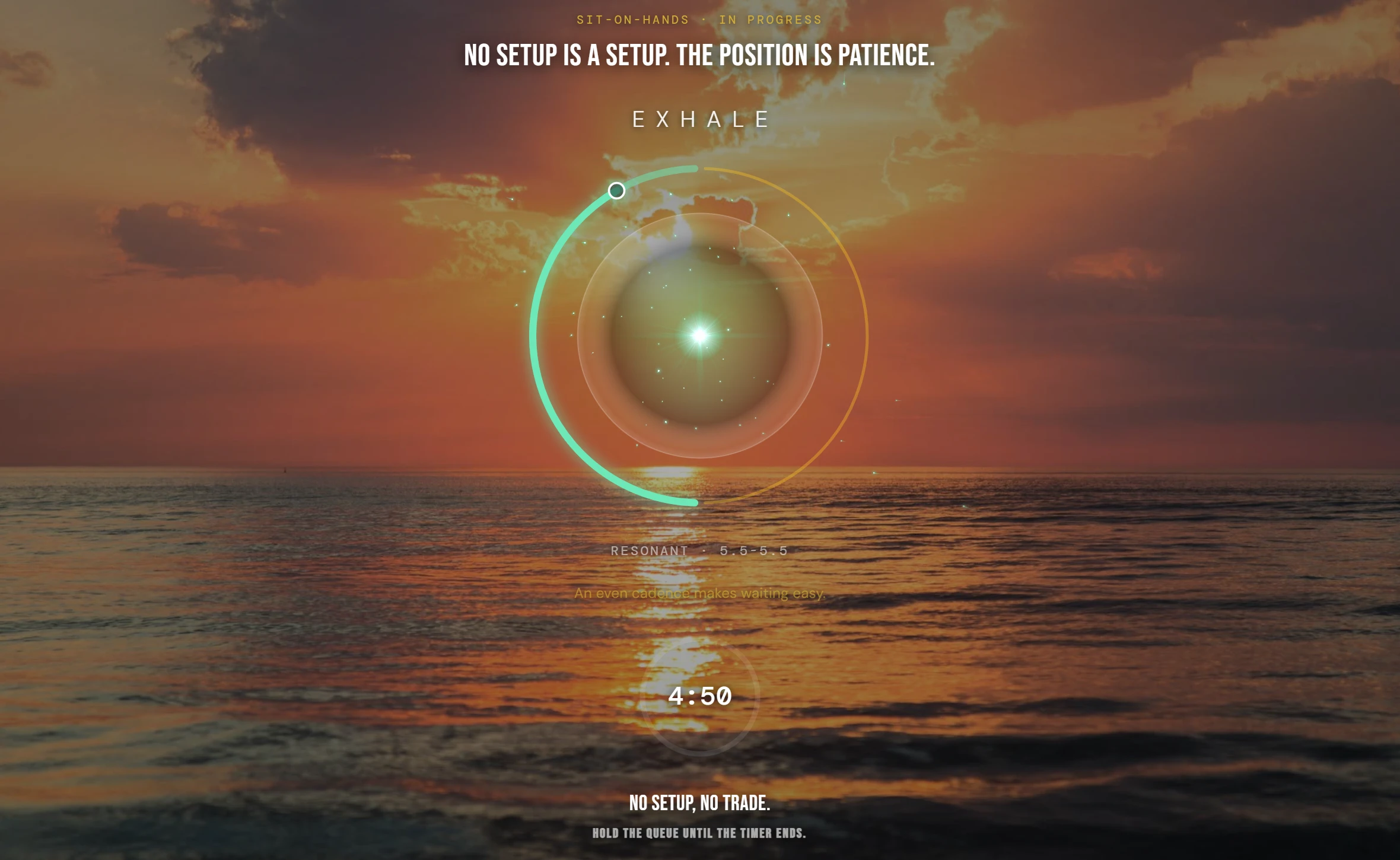
The interruption happens in the moment. When a contract rule fires, your P&L updates pause and you are taken to a guided reset. Stop Negotiation is for the stop you want to change, Loss Reset is for the money you want back, and FOMO Reset is for the run you missed. Each one is paced by a breathing ring, and the shortest takes 60 seconds. COACH SAYS steps in when your behavior starts drifting from the rules you set, in a direct voice with no excuses in it.
The sentence about who else can sell has a tool too. StocksToTrade streams filings as they land, and Dilution Check reads one company's filings on SEC EDGAR and returns a single card: SUPPLY RISK from low to high, whether a shelf or an at-the-market program is open, how many stock sales landed in the last twelve months and how long the cash lasts. Every form code links to its filing, and anything the card could not confirm is marked that way, because unknown never means no. Dilution Check is part of Pro and Elite, and a free trial includes 15 company reads.
The review happens after the close. If you execute through DAS Trader, the only import MAKETZO takes, your fills come straight in and the journal grades discipline on every trade. The Picard Score rates the day from 1 to 10 for how well you ran your process, scored independently of whether you made money, which is the Sykes test with a number on it. A 9 or 10 means you ran it clean, and under 5 means the plan broke. Log the broken rule honestly, even on a winner, and the score rewards it. The Debrief closes the day with a note for tomorrow, and the note is waiting when you pick your state the next morning.
MAKETZO is not affiliated with or endorsed by StocksToTrade or Tim Sykes. The quotes come from their published writing. StocksToTrade's own site says "Past performance is not indicative of future returns and financial investing is inherently risky," and what you trade and how much is your decision alone. MAKETZO teaches and keeps traders accountable, and it never gives stock picks or financial advice.
You Don't Need Another Setup
StocksToTrade was never why you were losing, and the next scanner won't fix it. You are losing in the gap between the rule you wrote and the click you made, and that gap was there before you bought anything.
You don't need another setup. You need to become the trader who actually follows one.
Tomorrow, before the first alert, write the exit for your first trade on paper and leave it alone. At the close, mark that trade by whether you kept it, before you look at the money.
Stop studying your mistakes. Start correcting them.
Common Questions
Is StocksToTrade legit?
It is a real company selling real software. StocksToTrade.com Inc. is based in Austin, Texas, and in November 2026 it had a 4.3 on Trustpilot across more than 1,100 reviews, with praise centered on its teaching and complaints centered on support response times and a busy screen. The company says it "is not registered as a securities broker-dealer or an investment adviser," so treat its alerts and lessons as education. Read the current plan and cancellation terms on its site before you pay.
What are the 3 best stocks to buy right now?
No honest answer fits your account at this moment, and MAKETZO does not publish stock picks. A name someone else wrote down has usually run by the time you read it, and Tim Sykes tells his own students, "Never follow alerts from anyone (including me)." What you can build is your own list each morning: stocks with real news and unusual volume, a float you have looked up, a check on whether the company can sell more shares, and a price that proves you wrong, written down before the order goes in.
Can I make $1000 per day from trading?
Nobody can promise you that, and the research is sobering. The SEC warns that "Day traders typically suffer severe financial losses in their first months of trading,"[1] and a study of day traders in Taiwan from 1992 to 2006 found, "Less than 1% of the day trader population is able to predictably and reliably earn positive abnormal returns net of fees."[2] Sykes's own site says that "most day traders lose money."[3] A daily dollar target also tempts you to keep trading on the days you are behind it, so judge the day by whether you kept your rules.
Sources
[1] U.S. Securities and Exchange Commission, Day Trading: Your Dollars at Risk.
[2] Barber, Lee, Liu and Odean, The Cross-Section of Speculator Skill: Evidence from Day Trading, Journal of Financial Markets 18 (2014): 1-24.
[3] Timothy Sykes, About.
Photo by Compagnons on Unsplash