Before You Compare Tools, Read Your Five Worst Days

Traders leaving Tradervue complain about the same five things: price, broker count, AI features, trade replay and how old the screen looks. Those are fair complaints. A Reddit thread asking for a replacement opens with a trader saying Tradervue "feels ancient."
All five share one limit. An import, a report, a replay and an AI summary can only read trades you already took.
On a small cap, the expensive minutes come before any of that. You take the first loss of the morning, then re-enter the same name seconds later because you want the money back. You chase a runner you swore you would leave alone. You drag your stop lower, just this once. You knew better each time, and the report showing it arrives after the close, when the damage is already in your account.
So before you compare features, look at your five worst days and answer one question. Did you lack information, or did you have it and break the rule anyway? If you lacked information, a stronger analytics journal is the right purchase, and the other tools listed on this page are worth testing. If you broke the rule, you need something working before your first order and during the session.
Use this at the open tomorrow. Rewrite your most expensive habit as a rule you can answer yes or no in the moment. "Be patient" cannot be graded. "No re-entry on the same ticker after a loss without a new setup" can.
What MAKETZO Does Before and During the Session
MAKETZO is a trading discipline system for small cap day traders, for the trader who knows the rules and still breaks them under pressure. Set your rules when you are calm, and MAKETZO enforces them when you are not.
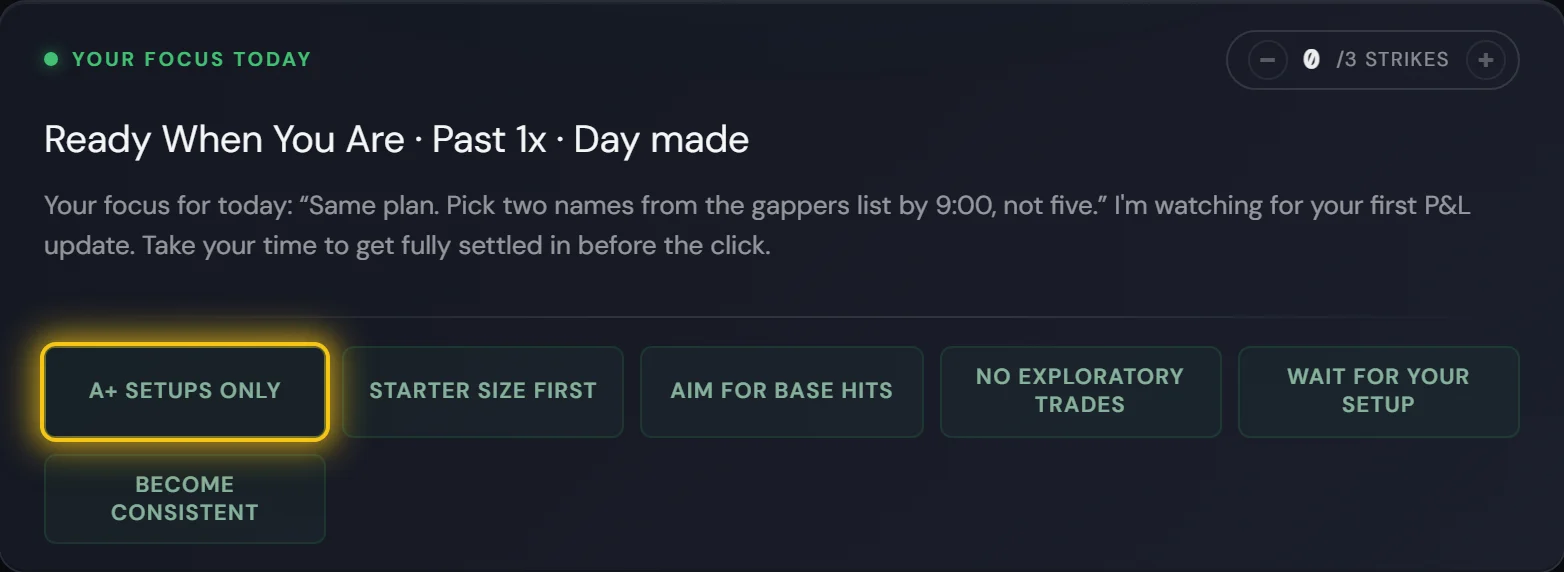
- Before your first trade. The Morning Lock-In is where you commit to your rules for the day, while nothing is at stake yet.
- When you start to drift. The Strike System and COACH SAYS catch you the moment your behavior leaves the rules you set. COACH SAYS is direct, and it comes with a specific response: two strikes in a session can open a breathing reset, and touching your drawdown line can bring up an anchor image and offer a longer reset.
- When you tilt. The Focus Room is where you reset instead of taking the next trade out of anger.
- After the close. The COACH SAYS feed keeps the day's slips and resets on record, so you review what happened instead of what you remember.
You can copy the core of this without any software. Before the bell, write down what ends your morning, in your own numbers, for your own account. MAKETZO keeps you to the line you set, and it will never tell you where that line should be. It teaches and keeps you accountable. It never gives stock picks or financial advice.
Why MAKETZO Grades Your Process, Not Your P&L
Most journals sort your trades by money: P&L by day, by tag, by hour. That view has a flaw on any single day, because P&L is mostly noise. A sloppy entry catches a squeeze. A clean setup gets stopped on a fluke. Sorted by dollars, the sloppy trade looks like the good one.
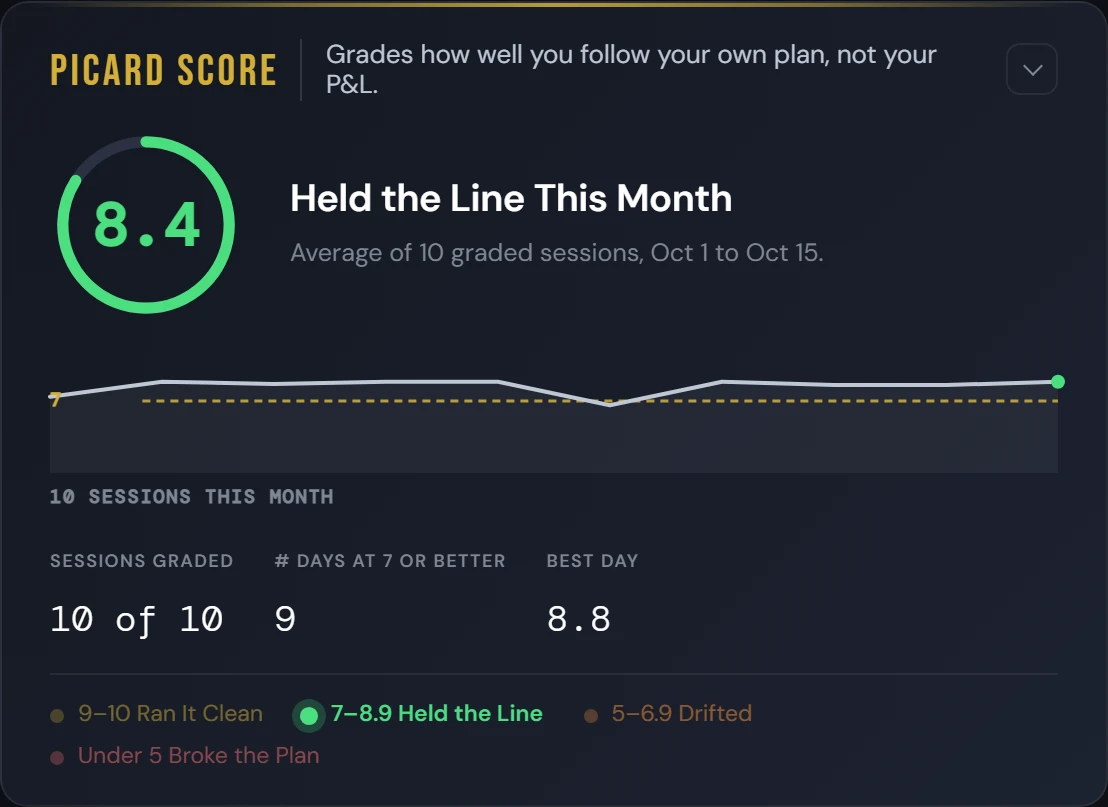
The Picard Score is a daily grade from 1 to 10 of how well you ran your process, scored independently of your P&L. The biggest part is whether you kept the rules you committed to that morning. How you traded, your discipline and your self-awareness come next. A part you skip does not count against you. It just carries no weight.
- 9 to 10, Ran It Clean. The standard. Repeat it.
- 7 to 8.9, Held the Line. Small slips with the plan intact.
- 5 to 6.9, Drifted. One habit separates you from Held the Line.
- Under 5, Broke the Plan. Read the day back before tomorrow.
That splits two days a dollar report treats as the same. A green day full of broken rules reads as a warning, not a trophy. A red day where you kept every rule counts as a win for your account's future.
Use this at the close. Grade the process before you look at the money. Write one honest line on what you would repeat and one on what you would fix, then name a Focus for Tomorrow. The next morning the journal shows it back to you and asks whether you honored it.
Tradervue vs MAKETZO: Where Each One Wins
Tradervue is a web-based trading journal that imports your executions, groups them into trades and reports on them by instrument, day, tag and time. It does that job well, so start with where it is the better choice.
Choose Tradervue if:
- You need automatic import from many brokers. Tradervue counts more than 80. MAKETZO imports from DAS Trader only.
- You trade futures, forex or options as well as stocks. Tradervue's plan table lists all of them.
- You want a community to share trades with, plus mentors inside the product. MAKETZO's Share button emails a journal entry to your mentor or accountability partner instead.
- You want a free tier for light use.
Choose MAKETZO if:
- Your losses come from breaking rules you already know. You set the rules before the open, and the coaching arrives during the session.
- You want a grade that can be high on a red day and low on a green one.
- You trade on DAS and want exact records. A DAS import reconciles your numbers to the cent and stamps the day DAS Verified. A day you typed in by hand shows Manual Estimate, so you always know where a figure came from. Manual entry is enough for the accountability side.
- You still want the numbers. Reports covers win rate, day win rate, average win and loss, the R-Ratio between them and average cents per share, with plain-language Insights drawn from your full history.
Import alone should not decide this if you are on DAS, because Tradervue imports from DAS Trader Pro as well.
What it costs. Tradervue lists Silver at $29.95 a month and Gold at $49.95 a month. Exit analysis, max potential P&L analysis and commission and fee support appear on Gold. New users get a trial on either plan, and the card is charged when it ends unless you switch to the free plan first. MAKETZO Journal is $19.95 a month, $10 less than Silver, or $199 a year. Pro and Elite are on the pricing page, and every plan starts with a 7-day free trial.
Other Tradervue Alternatives and Who Each One Suits
If your worst days came from missing information, these are the tools to test. The descriptions draw on Tradervue's own roundup of the category and each company's site. Prices and limits change, so confirm them before you pay.
- TraderSync for AI coaching, tick-level replay and backtesting, with more than 700 brokers and platforms by Tradervue's count.
- TradeZella for trade replay, backtesting, playbooks and a mentor mode.
- Edgewonk for psychology and mistake tracking on logged trades, sold on annual billing.
- TradesViz for a wide feature set at a low price, with a free plan.
- TradeTally for a free, open source journal you can host yourself.
- Ghostfolio comes up often, but it is a general portfolio tracker, not a tool for reviewing day trades.
Use the same test on each one. Import one real week, then see whether the tool answers the question you need answered on Monday morning. After that, ask what it does at 9:47 when you have just taken your second loss. For most of this list, the answer is a report on trades you already took. Edgewonk and TradeTally get closest, tracking behavior such as rule breaks and revenge trading, but they read it from trades already logged.
Three Checks Before You Switch From Tradervue
1. Your platform. If you trade on DAS, export one day, open Import Trades in MAKETZO, choose the DAS import and upload the file. Confirm the trades landed on the right account and date. If you trade anywhere else, expect to enter your daily numbers by hand.
2. Your filings. A report on past fills cannot tell you what a small cap trader most needs to know when a stock is running: can this company sell stock into the run, and has it been doing so? Dilution Check reads a company's SEC filings and returns a supply risk on a four-step scale from low to high, with every form code linked to the filing behind it. When a filing cannot confirm something, the card says so, because unknown never means no. It reports what companies have filed and recommends nothing.
3. Your own week. Use the 7-day free trial for one full trading week. Keep Tradervue if you like its reports, and add MAKETZO for the hours when you are actually in the market. At the end of the week, compare your Picard Scores with your memory of those days. Any day you remembered as cleaner than it scored is a day worth reading back.
Common Questions
Does Tradervue have a free plan?
Yes. It has a free plan with a monthly limit on imported trades, and the paid plans remove that limit. Tradervue's own pages disagree on the figure: its help center says 30 trades a month and other Tradervue pages say 100, so check your account before you count on either. The limit applies to grouped trades rather than individual executions, and it resets each calendar month. MAKETZO is a paid system, and every plan starts with a 7-day free trial.
Is Tradervue worth paying for?
It is worth paying for if you read your reports every week and change something because of them, or if you need broad broker sync across several asset classes. It is a poor fit if your losses come from breaking rules you already know, because a better report on a broken rule is still only a report. Look at your last ten red days and count how many came from a decision you knew was wrong when you made it. If most of them did, spend the money on accountability rather than analytics.
Can I bring my Tradervue history into MAKETZO?
No. MAKETZO does not import from Tradervue or any other journal, and DAS Trader is the only import it takes. If you trade on DAS, export the days you want from DAS and import those files, and each reconciled day carries the DAS Verified badge. If you trade elsewhere, a net P&L you type in each day is enough for the accountability and discipline side. Before you cancel Tradervue, save whatever your plan lets you export.
Photo by Mike Tinnion on Unsplash · Photo by Mykyta Kravčenko on Unsplash