What the Zella Score Actually Measures

A score decides what you train yourself to chase. So before you weigh TradeZella's price, broker list, replay or AI, look at the number it puts on your dashboard.
TradeZella publishes the weights in its help center:
- Profit factor, 25%
- Average win against average loss, 20%
- Maximum drawdown, 20%
- Trade win percentage, 15%
- Recovery factor, 10%
- Consistency, 10%
All six come from the money. TradeZella explains consistency as a sign of steady habits, but the calculation runs on daily profits.
That makes it an honest report card on results, and it says nothing about behavior. Picture a morning on a low float runner. You re-enter after a loss, chase the second leg, drag your stop lower, and one squeeze bails you out. Profit factor improves and the score can climb. Now picture a morning when you waited, took the two setups you planned and cut both at your line. The numbers dip and the score can fall. The first morning is the habit that costs you later, and the number on the dashboard just rewarded it.
TradeZella does give you places to record rules. Its Progress Tracker shows daily rule adherence and a heat map, and its blog teaches tagging trades Rules Followed or Rules Broken. Those sit beside the Zella Score. The six published weights do not include them.
Before the bell tomorrow, open your last ten green days and mark every one that included a broken rule. A results score cannot show you that count, and it tells you whether your green days are safe to repeat.
How the Picard Score Grades the Same Two Mornings
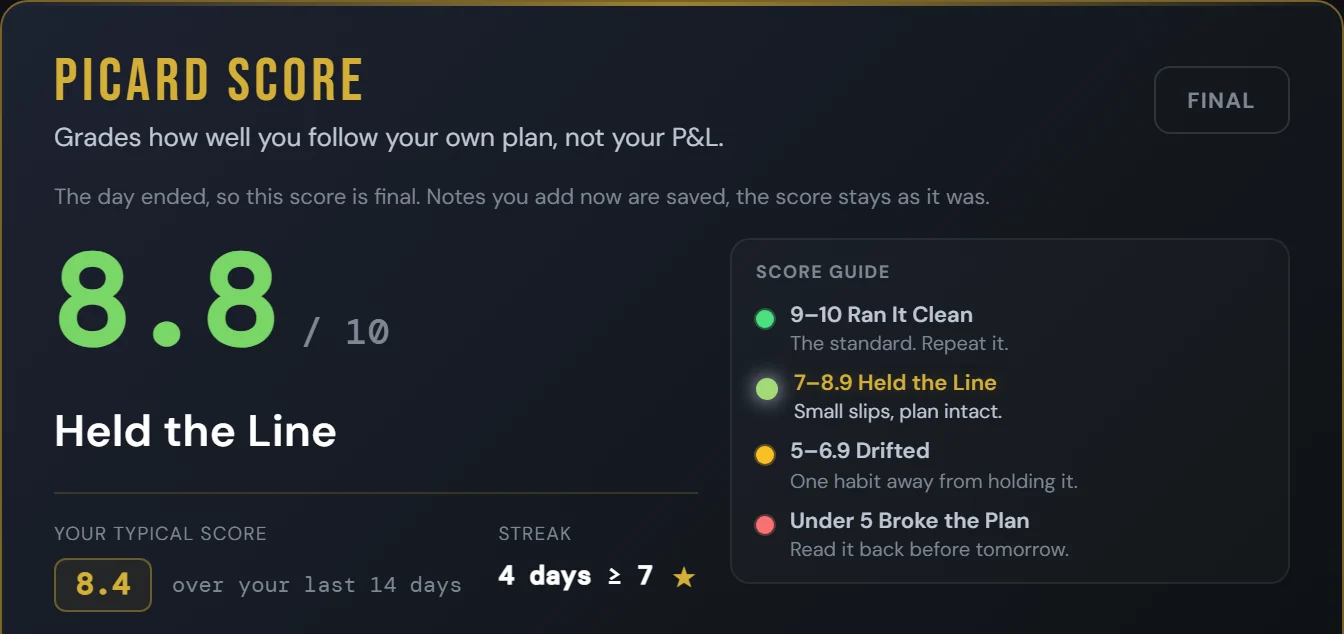
MAKETZO's Picard Score is a daily grade from 1 to 10 of how you ran your process, scored independently of your P&L. The biggest part is whether you kept the rules and the contract you signed that morning. How you traded, your discipline and your self-awareness come next, and how much you filled in counts for little.
Run those same two mornings through the Picard Score and the grades reverse.
- The bailed-out runner. Green on the account, and broken rules and strikes on the record. It reads as a warning.
- The two clean losses. Red on the account, every rule kept. It can land at 9 to 10, Ran It Clean.
The rest of the scale is Held the Line at 7 to 8.9, Drifted at 5 to 6.9 and Broke the Plan under 5.
One mechanic matters more than it looks. When you click Sign Off on Today, the score is final. You can reopen that day and keep writing, and the page shows when you edited it, but the score stays what it was. You cannot talk yourself out of a bad morning at 8 p.m.
Write your In-Trade Rules before the open tomorrow, then at the close answer each one as Followed, Broke or N/A before you look at your P&L. The money still gets read. It just no longer gets the first word.
What TradeZella Says It Does During the Session
TradeZella has been building toward the hours that hurt most. Its Zella AI page describes in-session monitoring that "checks every execution against your plan and nudges you in real time when behavior drifts." The agents it details elsewhere work before the open and after you finish: a game plan in the morning and a Session Review when you are done. Its May 2026 article on agents says they do not "monitor your screen."

Both can be true of different parts of the product, and neither page says which plan includes the nudge or how it reaches you. Before you pay, ask TradeZella support one question in writing: what appears on my screen, on which plan, and how soon after I break a rule? A check on an execution also starts after the order has filled, so ask what happens before the next one.
MAKETZO is built for that gap, on one idea: set your rules when you are calm, and MAKETZO enforces them when you are not.
- Before the first trade, the Morning Lock-In commits you to the day's rules while nothing is at stake.
- When you drift, the Strike System and COACH SAYS step in with a brief, direct message at the moment of the urge: the re-entry after a loss, the chase, the stop you want to drag "just this once."
- When you tilt, the Focus Room is where you run a reset instead of the next trade.
- After the close, the COACH SAYS feed shows the day's slips and resets in one place.
Write down the time of day your last three rule breaks happened. If they cluster right after your first loss, that is the minute you need something on your screen, and the minute to test in any tool you try.
TradeZella Pricing After the July 2026 Change
TradeZella changed its plans on July 14, 2026, and older comparisons still quote $29 and $49. The current list:
- Essential: $35 a month, or $315 paid yearly. One active account and 500 AI credits a month.
- Pro: $59 a month, or $531 paid yearly. Up to 50 active accounts, 1,500 credits and Zella Agents.
- Ultra: $99 a month, or $891 paid yearly. Unlimited active accounts, 3,000 credits and 100 automated AI backtests a month.
Paying yearly works out to $26, $44 and $74 a month. Three details decide what you really pay.
Replay sits at Pro. Unlimited replays and the one-second replay chart start there, so a trader who came for replay is shopping at $59, not $35.
An old price is fragile. If you subscribed before July 14, you keep your rate only while you stay on your current plan. TradeZella says switching your billing cycle, upgrading, downgrading, or canceling and coming back all mean the new prices apply. Test any replacement before you cancel.
DAS gets no auto sync. TradeZella advertises more than 500 brokers and platforms, and its broker list shows DAS Trader Pro under file upload. If you execute on DAS, you export and upload either way, so sync should not be the reason you pay. Run that export once tonight and you will know exactly what any tool has to work with.
MAKETZO Journal is $19.95 a month, or $199 a year, against Essential's $35. Pro and Elite are on the pricing page, and every plan starts with a 7-day free trial.
TradeZella vs MAKETZO for a Small Cap Day Trader
TradeZella is a trading journal with broker imports, playbooks, trade replay, backtesting and an AI assistant. Here is when it is the better buy.
Choose TradeZella if:
- You need automatic sync from a wide range of brokers. MAKETZO takes imports from DAS Trader and nothing else.
- You want to replay and backtest setups in the same product you journal in.
- You run several accounts and want them in one place.
Choose MAKETZO if:
- Your worst days come from rules you already knew and broke anyway.
- You trade on DAS and want records you can trust. A DAS import reconciles your numbers to the cent and stamps the day DAS Verified, and a day you typed by hand shows Manual Estimate, which is enough for the accountability side.
- You still want the math. Reports covers win rate, average win and loss, the R-Ratio between them and average cents per share.
- You trade small caps and want the supply side read for you.
No results score can touch the supply question: can this company sell stock into this run, and has it been doing so? Dilution Check reads a company's SEC filings and returns a supply risk on a four-step scale, then shows whether a selling channel is open, how many stock sales landed in the last twelve months and the company's cash runway. Every form code links to the filing behind it. It tells you what has been filed and never what to do about it.
On your next runner, read past the verdict to the cadence. "They can sell today" and "they sold three times this year" are different situations, and the second one is a habit. When something could not be confirmed from a filing, treat it as unknown. Unknown never means no.
Other TradeZella Alternatives, and How to Switch
If your worst days came from missing information rather than broken rules, one of these may suit you better. Prices change, so confirm them before you pay.
- Edgewonk lists $197 a year or $35 a month with a 14-day money-back guarantee, and sorts mistakes by entry, exit and trade management.
- Tradervue lists Silver at $29.95 and Gold at $49.95 a month, with a limited free plan, for traders who mostly want reports.
- TraderSync is a frequent pick in reviews for replay and phone apps.
- TraderWaves advertises a free plan with no card and native phone apps.
- TradeTally is a free, open source option you can host yourself.
Leaving takes more care than joining.
Save your records first. TradeZella's help center says "there isn't a direct option to back up or export all data," and its CSV export works on the trades you select and cannot be uploaded back in. Open the file and confirm what came across before you count on it.
Bring trades the way MAKETZO takes them. MAKETZO does not import from TradeZella or any other journal. If you trade on DAS, export the days you want from DAS, open Import Trades, choose the DAS import and confirm each day landed on the right account and date. If you trade elsewhere, type your daily net P&L.
Run both for one week. Use the 7-day trial on real sessions. At the end, set each day's Picard Score next to its Zella Score and read the days where they disagree first.
Common Questions
Does TradeZella have a free plan or free trial?
TradeZella's pricing page lists three paid plans and no free plan, and it does not state a free trial or refund terms. Reviewers disagree on refunds, so read the terms at checkout before you enter a card. If you are comparing, MAKETZO is a paid system, and every plan starts with a 7-day free trial.
Is there a free alternative to TradeZella?
Yes. TraderWaves advertises a free plan, Tradervue has a limited free plan, TradeTally is free and open source if you host it yourself, and a spreadsheet costs nothing but your time. Check each one against your broker first, because free tiers tend to limit imports or features. A free tool replaces the record keeping. It will not sit with you at the moment you want to re-enter after a loss, so decide which of those two problems you are paying to solve.
Is TradeZella worth its current price?
It is worth it if you use replay and backtesting every week and change something because of them, which means Pro at $59 a month or $531 paid yearly. It is harder to justify if you mostly log trades and read the score. Add up what you lost last month on days you broke a written rule. If that figure is bigger than a year of any subscription on this page, the purchase that matters is the one aimed at that behavior.
Photo by Clay Banks on Unsplash · Photo by 2H Media on Unsplash