What the Halt Codes Mean
At 10:14 a small cap goes quiet in the middle of a run. Read the code before you read the chart, because the code tells you whether the wait is five minutes or two months.
Nasdaq posts its list of current halts with the time in Eastern, the market, the reason code and the resumption quote and trade times. Its full code table runs past 30 entries, and a small cap trader meets these.
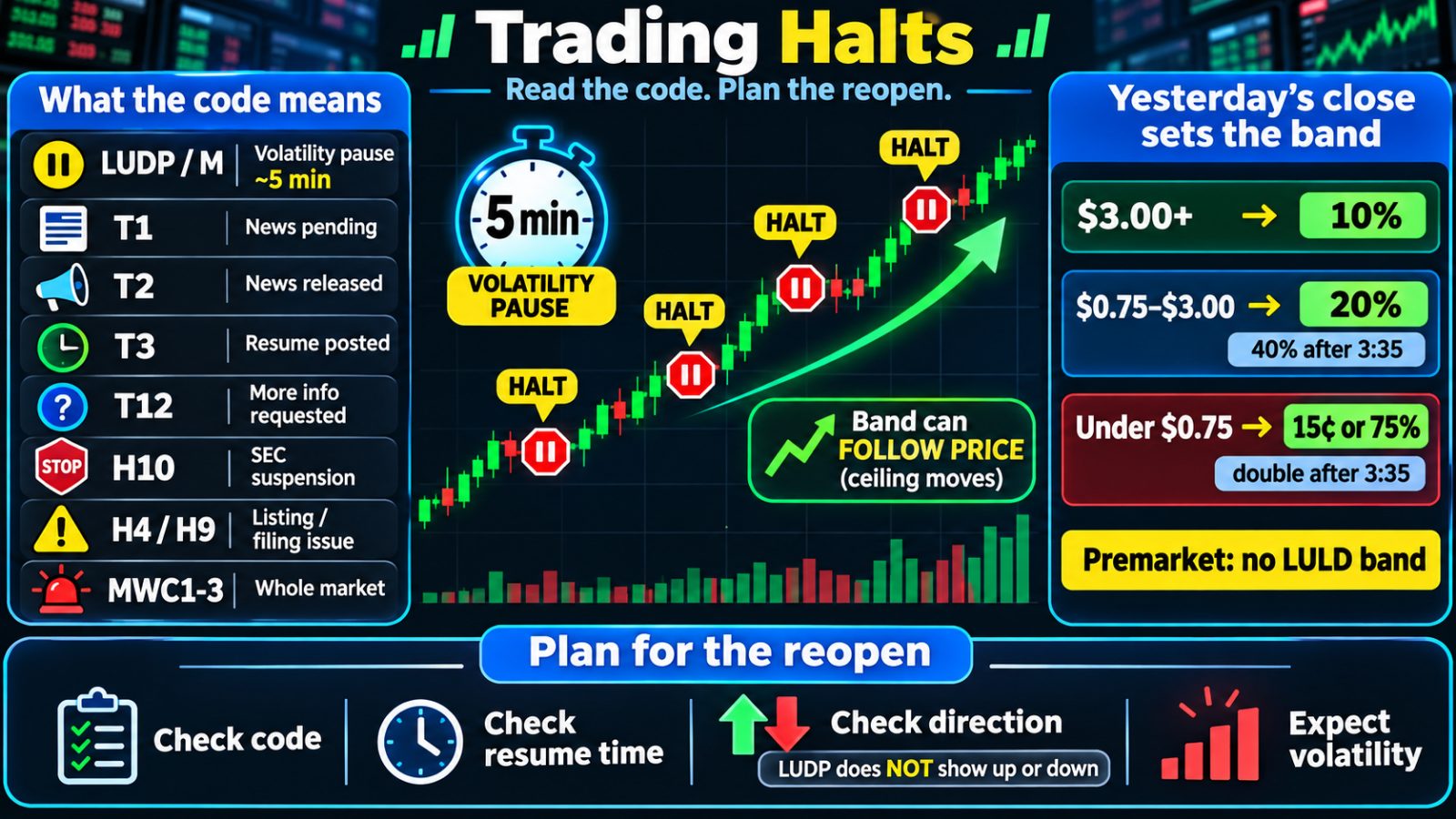
- LUDP or M. A volatility pause under the limit up, limit down rules. Five minutes at the minimum, and the stock comes back the same day.
- T1. News pending. The company has material news on the way.
- T2. The news has begun going out.
- T3. The all-clear. The news is out and the quote and trade times are posted.
- T12. Nasdaq has asked the company for more information. There is no timer on this one.
- H10. An SEC trading suspension, the heaviest code on the list.
- H4 and H9. Listing trouble. H4 is non-compliance with Nasdaq's requirements, and H9 is a company behind on its filings.
- MWC1, MWC2 and MWC3. A market-wide circuit breaker, set off by the S&P 500 falling 7%, 13% or 20% from the prior close. Levels 1 and 2 pause everything for 15 minutes if they trigger before 3:25 p.m. Level 3 ends the day. Either way it says nothing about your stock.
The code leaves out direction. A halt up and a halt down carry the same LUDP, so check which side of the band the stock reached before you decide what the pause means for you.
Limit Up, Limit Down: Why Small Caps Halt So Often
Look up yesterday's close before the open, because that one number sets the width of a stock's band for the entire day.
From 9:30 a.m. to 4:00 p.m., exchange-listed stocks trade inside a band set around the average of their last five minutes of trades. When the best bid sits on the upper band, or the best offer sits on the lower band, for 15 seconds, the listing exchange calls a five-minute pause. Nearly every small cap is a Tier 2 stock, and its band depends on the prior close.
- Closed over $3.00. 10% from the average, all day.
- Closed from $0.75 to $3.00. 20%, widening to 40% after 3:35 p.m.
- Closed under $0.75. The lesser of 15 cents or 75%, doubling after 3:35 p.m.
The rule is locked at yesterday's close. A stock that closed at $0.70 and reaches $2.00 by 10:00 still has a 15-cent band, about 7.5% of its price, so it can freeze again and again on tiny legs. A stock that closed at $2.95 gets twice the band of one that closed at $3.05.
The open gets no wider band. Doubled bands from 9:30 to 9:45 ended in February 2020, so 20% at 9:31 is the same 20% at 11:00. The doubling that remains comes at the close, and for a small cap it applies only if the stock closed at $3.00 or less.
The ceiling chases the price. The band follows a five-minute average, so in a fast run it trails the last trade. The stock reopens, climbs into a ceiling that has been pulled up behind it, and freezes again. A name that halts a dozen times in a morning has no settled price yet, and that is the opposite of a controlled entry.
Before 9:30 there is no band. A premarket runner has no volatility pause to slow it. News halts still apply, and Nasdaq generally calls them from 7:00 a.m. to 8:00 p.m.
When a Halted Stock Reopens
The gap between the halt price and the indicative price sets the wait, so compare those two numbers before you look at the clock.
On a Nasdaq listing, a volatility pause starts with a five-minute window when orders can be entered and nothing trades. The reopening auction runs inside a collar. On a halt up, the top of the collar starts at the band where the stock froze, plus 5%, or plus 15 cents if that band price is $3 or less. A halt down mirrors it. If the auction's price falls outside the collar, or if market orders would go unfilled, the pause extends five minutes and the collar widens one more step. Later extensions end at the first point the imbalance clears, so the stock can reopen between the five-minute marks.
Take a stock with a five-minute average of $5.00 and a 20% band, frozen at its $6.00 upper band with an indicative price of $7.20.
- Minutes 0 to 5. The collar tops out at $6.30.
- Minutes 5 to 10. It widens to $6.60.
- Minutes 10 to 15. It widens to $6.90.
- Minutes 15 to 20. It reaches $7.20, and the auction can clear.
A 20% gap means a wait of roughly 15 to 20 minutes, if the indicative price stays at $7.20, and it rarely does. Nasdaq recalculates its imbalance data every five seconds during the pause, so find out whether your platform carries it. The bottom of that same collar is the lower band from the moment the stock froze, here $4.00. That is how a halt up reopens under the price where it froze.
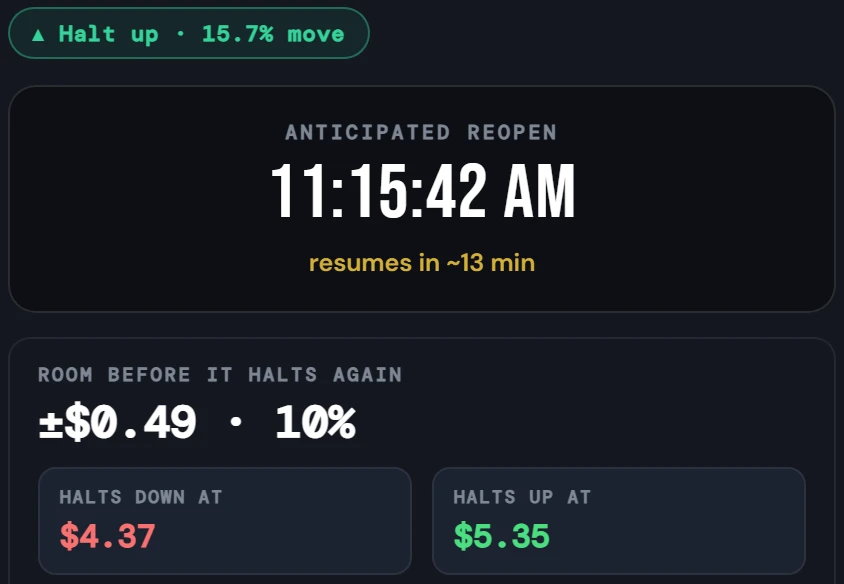
MAKETZO's Halt Clock turns that gap into a time you can plan around. It covers volatility halts in regular hours, comes with every plan and pops out into its own window beside your charts. The moment a stock freezes, tap Now to stamp the halt time, then enter the last price and your broker's indicative price. It works from a rule of thumb, about 5% of price for each five-minute halt, and updates as you type.
- Anticipated reopen. The clock time the stock is likely to trade again, with a countdown running to it.
- The length of the wait. How far the price is set to travel, the rough total time frozen and how many five-minute halts that adds up to.
- The next bands. The upper and lower band the stock would reopen into, so you know where the next halt sits before it trades.
- The red panel. At ten minutes the whole panel turns red, because the auction can now release the stock at any second. From there, treat the estimate as a floor.
- The 3:50 cutoff. An estimated reopen at or after 3:50 p.m. shows as going to the 4:00 bell.
Keep the indicative price current, because the estimate follows it. If your broker shows no indicative or imbalance data, the reopen time is a guess.
News halts and the last minutes of the day run on different timing. Nasdaq says news halts normally resume about thirty minutes after the announcement goes out, and it can vary that. And if a pause's auction would end after 3:50 p.m., the listing exchange skips it and runs a single closing auction at the bell, so an exit planned for the reopen gets one print at the close.
What Your Orders Do During a Halt
Treat your stop order as switched off the moment a stock freezes.
No trade can print during a pause, so a stop order has nothing to trigger against. The first print after the reopen can set it off, and the fill lands wherever the market is. A sell stop order at $3.80 on a stock that froze at $4.00 and reopens at $3.20 sells near $3.20 or worse, and a stop limit order may not fill at all.
Open orders stay on Nasdaq's book during a pause unless you cancel them, and Nasdaq accepts new orders in the stocks it lists. Past that, everything depends on your broker and the route. Some queue the order into the auction. Others reject it or refuse to touch it until the stock reopens. Get three answers before the morning you need them.
- Which of my routes let me place, change or cancel an order during a halt?
- Does an order on that route join the reopening auction?
- What happens to my stop order at the reopen?
The auction cuts both ways. It gives you a way to line up an exit before the stock trades again, with no promise of a full fill or a good one. A market order sent into the pause takes whatever price the auction sets, and a pile of unfilled market orders is one of the two things that extends the wait.
Do not enter or add while a stock is halted. You would be taking on a trade you cannot manage until an auction you do not control has set the price.
T12 and SEC Suspensions: The Halts You Cannot Time
Once the code reads T12 or H10, the arithmetic is over. Assume any shares you own are frozen for weeks.
A T12 lasts until Nasdaq is satisfied with what the company sends back. Two Nasdaq small caps halted under T12 in June 2026 both reopened on July 31, one after 53 days and the other after 57. It tends to follow a run nobody can explain, when price and volume have done something the public record does not account for. Your exit plan and every rule you follow assume a market to trade in, and a T12 takes that market away. When Nasdaq is done it posts a T3 with the resumption times, and the stock comes back through an auction priced on everything the market worked out while you were locked in.
An SEC suspension runs up to 10 trading days, and the last day may not be the end of it. Bloomberg Law counted 14 suspensions of Asia-based public companies between September 2025 and February 2026, followed by open-ended exchange halts. On the day one suspension ran out in June 2026, Nasdaq halted the same stock until the company answered its request for information. For a stock that trades over the counter, quotes do not come back on their own when the suspension ends.
Read an SEC suspension as a reason to stay out. It is never a dip.
What to Do With Five Frozen Minutes
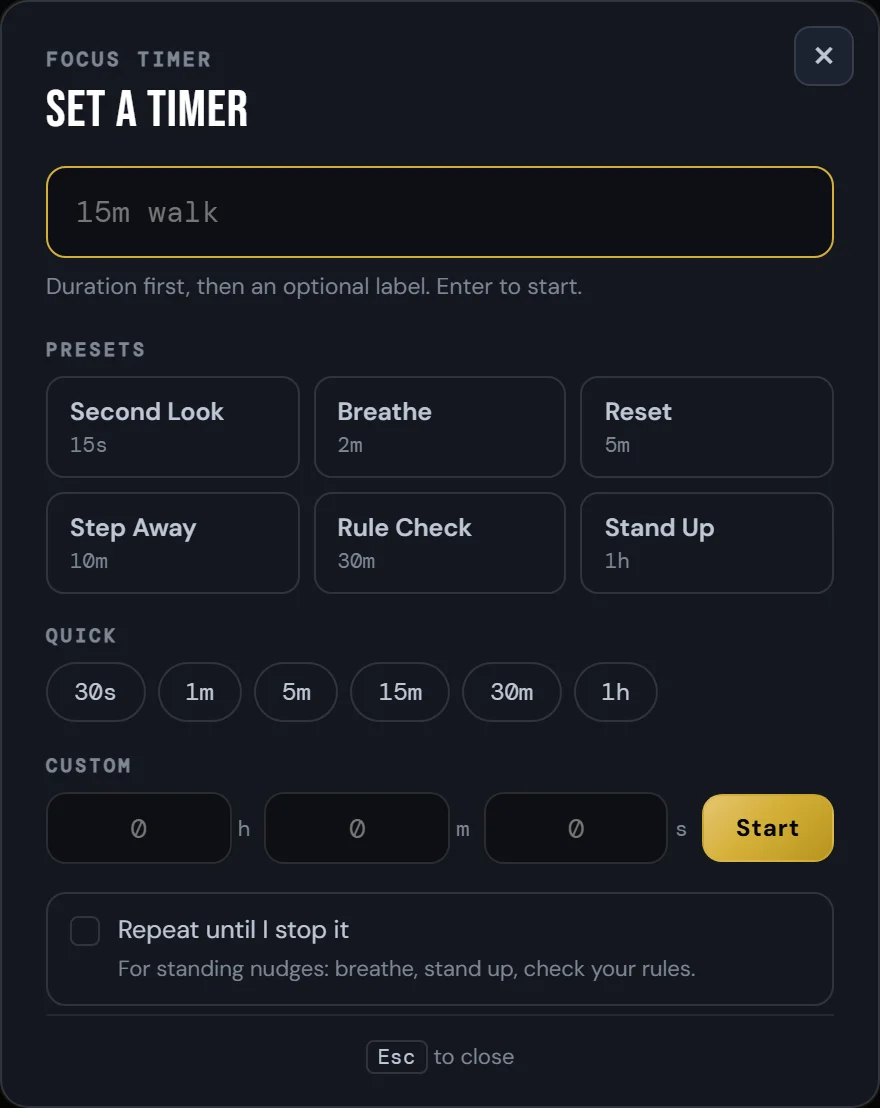
A frozen stock hands you the one thing a fast run never gives you, which is time to read. Spend it in this order.
- Find the code and the side. Volatility or news, halt up or halt down.
- Start the Halt Clock. Stamp the halt time and keep the indicative price current, so you know whether you are looking at a ten-minute wait or an hour.
- Name the reason. Open the headline or the filing. If you cannot say why it ran in one sentence, you have your answer about adding to it.
- Check who can sell into the reopen. Run the ticker through Dilution Check. It reads the company's SEC filings for dilution risk, then shows whether a selling channel is open and how recently the company used one. A company with an open channel can sell new shares into whatever price the auction sets.
- Decide what you will do if it reopens against you. Once it prints, you will have seconds and a racing pulse.
The better version of that decision gets made at 8:00 in the morning. Write halt rules you can answer yes or no.
- I read the code before I do anything else.
- I do not enter or add while a stock is halted.
- I know how my broker handles a halt before I trade a name that can freeze.
- I treat an SEC suspension as a reason to stay out.
A rule written at 8:00 is easy to break at 10:14, and that gap is the whole reason MAKETZO exists as a trading discipline system for small cap day traders. You commit to your rules in the Morning Lock-In, COACH SAYS coaches you in real time when your behavior drifts from them, and the Focus Room gives you a place to reset after a reopen goes badly. The journal grades discipline on every trade, so a month of records shows whether you kept your halt rules when it was hardest.
DAS Trader users get their trades imported, and DAS Trader is the only import MAKETZO takes. It teaches and keeps you accountable, and it never gives stock picks or financial advice. The pricing page lists the plans, and each one begins with a 7-day free trial.
Halted and halt-prone small caps are among the most dangerous corners of the market, and most traders are better off staying out of them. Nothing here is a suggestion to trade one or financial advice, and your decisions are your own.
Common Questions
What does it mean when a stock is halted?
It means no trades can print in that stock until the listing exchange or a regulator lets it resume. Your broker may still accept orders, and none of them fill during the pause. The reason code tells you why it froze: LUDP is a volatility pause measured in minutes, T1 is a news halt, T12 is a Nasdaq information request with no set end, and H10 is an SEC suspension.
Can you sell a stock during a trading halt?
No. Nothing executes until the stock reopens. Many brokers let you enter, change or cancel a sell order during the pause so it can join the reopening auction, and others reject it, depending on the route. A stop order does not fire during the halt and can trigger on the first print, at a price far from the one you set. Find out how your broker handles all of this on a quiet day.
Do stocks go up or down after a halt?
Either, and the side it halted on does not settle it. A halt up can reopen lower and a halt down can reopen higher, because the auction sets the price from the orders that arrived during the pause. Watch the indicative price if your platform carries it, and treat the first minutes after the reopen as a new market, since a stock can run into a fresh band and freeze again.
Photo by Veri Ivanova on Unsplash