The List Ross Cameron Wrote About Himself

Every trader has a list of the ways they have broken their own rules. Ross Cameron published his.
In How to Day Trade: The Plain Truth, he writes that in his first two and a half years, on some days he would break every rule he had set for himself. He would get green and give half of it back. He would sit past his max loss hoping for a bounce, average down into a loser, trade through his daily limit, keep going after three straight losers, revenge trade, and then chase the top out of frustration. His summary takes six words: "In short, I got emotionally hijacked."
If that list reads like your last bad month, you are in good company. Knowing what to do was never what he lacked. "I knew what I needed to do," he writes. "Now I just had to execute." His day trading guide says it even more plainly: "The hard part is holding yourself to the rules."
So he built guardrails. He limited himself to a two-hour window, and the day ended the moment he got green, the window closed or one of his rules ended it. He gave that discipline a mantra you could write on a sticky note: "Get green and shut it down."
That belief runs through what Warrior Trading teaches about the trader's mind, and it is the same belief MAKETZO was built on.
Warrior Trading Built a Psychology Team Around It
A school shows you what it believes by who it hires to teach.
Warrior Trading's course list includes Trading Psychology: Developing the Trader's Mindset, taught by psychotherapists Ted Walls and Diane Hicks, who are leaders on the company's psychology team. Walls has been Ross's personal trading psychology coach for more than a decade. The chapters read like a tour of a hard trading week: Self-Doubt, Hesitation, Impulsivity, and Overconfidence. Working With Inner Critics. Radical Acceptance and Compassion. How the Market Conditions Traders.
Trader Rehab, which Ross teaches with Walls, is the course for a trader in a slump. You work out whether the block is technical or emotional, work through it and leave with a plan for managing risk. Ross's own Strategies & Scaling course gives a full chapter to Trading Psychology, Building Discipline, and Recovering from Loss, and its troubleshooting chapter has an entry titled Emotional Hijack.
Ross is the best advertisement for the work. "The biggest obstacle is having the discipline to follow the rules of your strategy," he says of their coaching, and he credits the presence of mind and radical acceptance he learned from them with keeping him grounded when the market frustrates him. A founder who says that out loud, and brings his own coach onto the faculty, is telling you where he thinks the money gets lost.
What Ross Stresses, the Picard Score Grades
If a habit costs you money, it belongs on your report card, even on a green day.
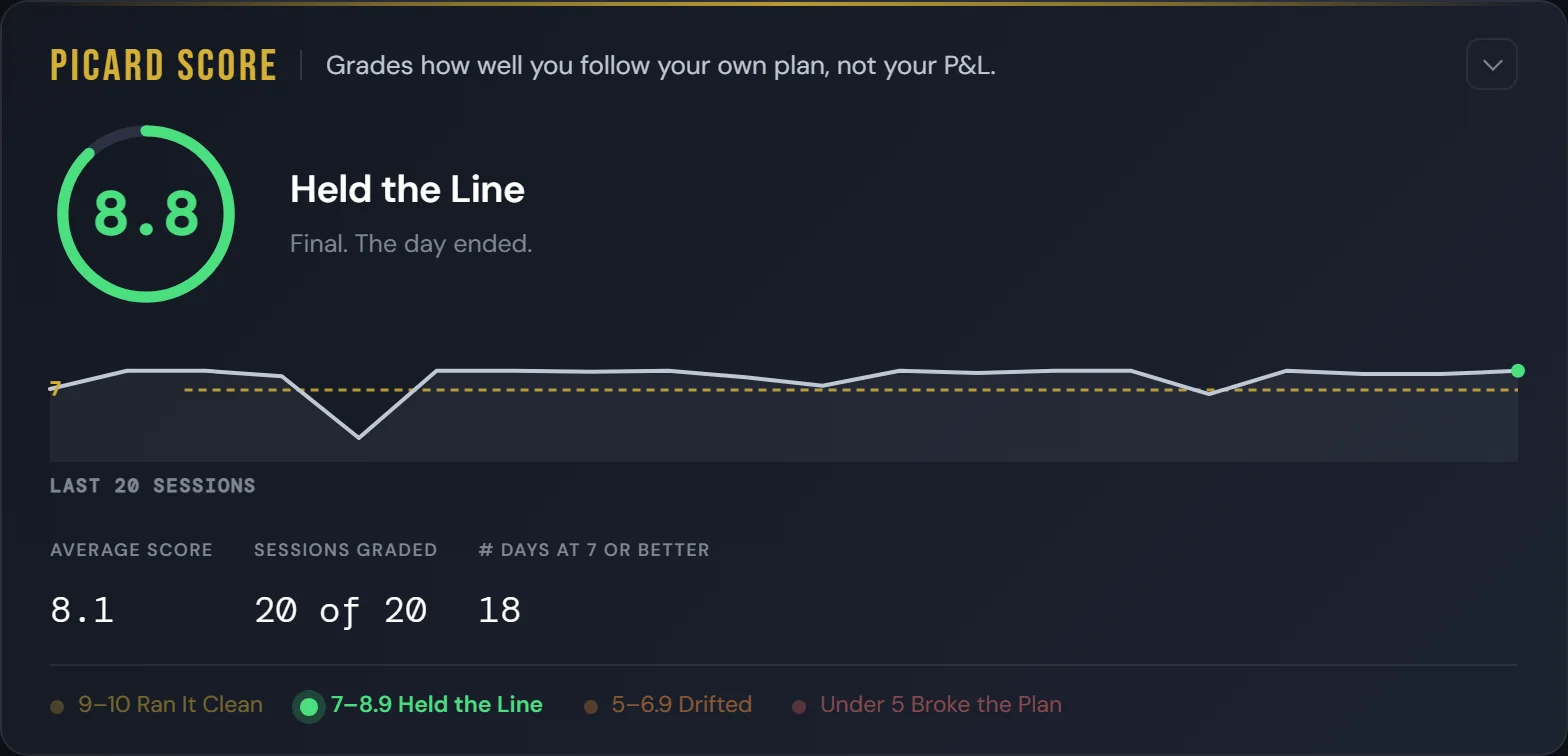
MAKETZO starts from the same place Ross does: traders rarely lose for lack of information. Its Picard Score grades each session from 1 to 10 for how you traded and not what you made, so a green day can grade low and a red day can grade high. Set it beside what Ross stresses and the two line up almost point for point.
- Holding losers and cutting winners. Ross writes that a trader who does both "has the habits of a failing trader." The Picard Score reads your trades and shows it to you in one line: losers held 9 minutes on average, winners only 4.
- Trading past your limit. His rule is blunt: "It is always best to walk away instead of attempting to trade in a compromised emotional state." Keep trading after your own rule ended the day and your grade pays for it.
- Too many clicks. He names over trading as what follows when emotion overtakes your thinking. Take more trades than your own limit and that lowers the day as well.
- Impulse and revenge. He writes that "my biggest losses were spontaneous trades I jumped into on an impulse." In MAKETZO you tag a chased entry or a revenge trade for what it was, and the tag counts against the day.
- Knowing your own state. Ross urges traders to journal their emotions, because "The first step to changing your behavior is becoming aware of your emotional patterns." The Picard Score has you rate your own composure and patience, and those answers go into the grade.
"Discipline is very much like a muscle," he writes, "that can be strengthened when exercised or atrophy when ignored." A muscle needs a measurement. A number every session shows you whether this one is growing.
The Time-Out Day Trading Does Not Give You
Crash a race car and your day is over. Blow a trade and you can do it again in 30 seconds.
That comparison is Ross's. "Day trading does not come with these built-in time out periods after we make a mistake," he writes. "We have to build them into our trading plan." The Focus Room is that time-out, built in, and it runs in the same order as his day.
- The morning check-in. Every morning, Ross says, he asks himself questions such as "Did you just sleep well?" and "Am I good to trade today?" The Morning Lock-In makes the answer binding. You choose the contract that fits the day from nine, read its rules and accept them while you are calm. Some rules warn you, some cost a strike, some lock your P&L entry for a brief breathing reset, and the hardest ones close the day.
- Trading the market in front of you. Ross credits a strong year to his ability "to restrain myself and slow down to trade the market that I met." Contracts such as A+ Only Day, Cool Down Day and Off Day are that decision, made before the first order.
- Getting green and shutting it down. Lock the Green is the contract for the day you are up and the only job left is keeping it.
- The rehab stretch. MAKETZO's Trader Rehab contract shares a name with Ross's course and has the same purpose: one trade, win or lose, and the day is done.
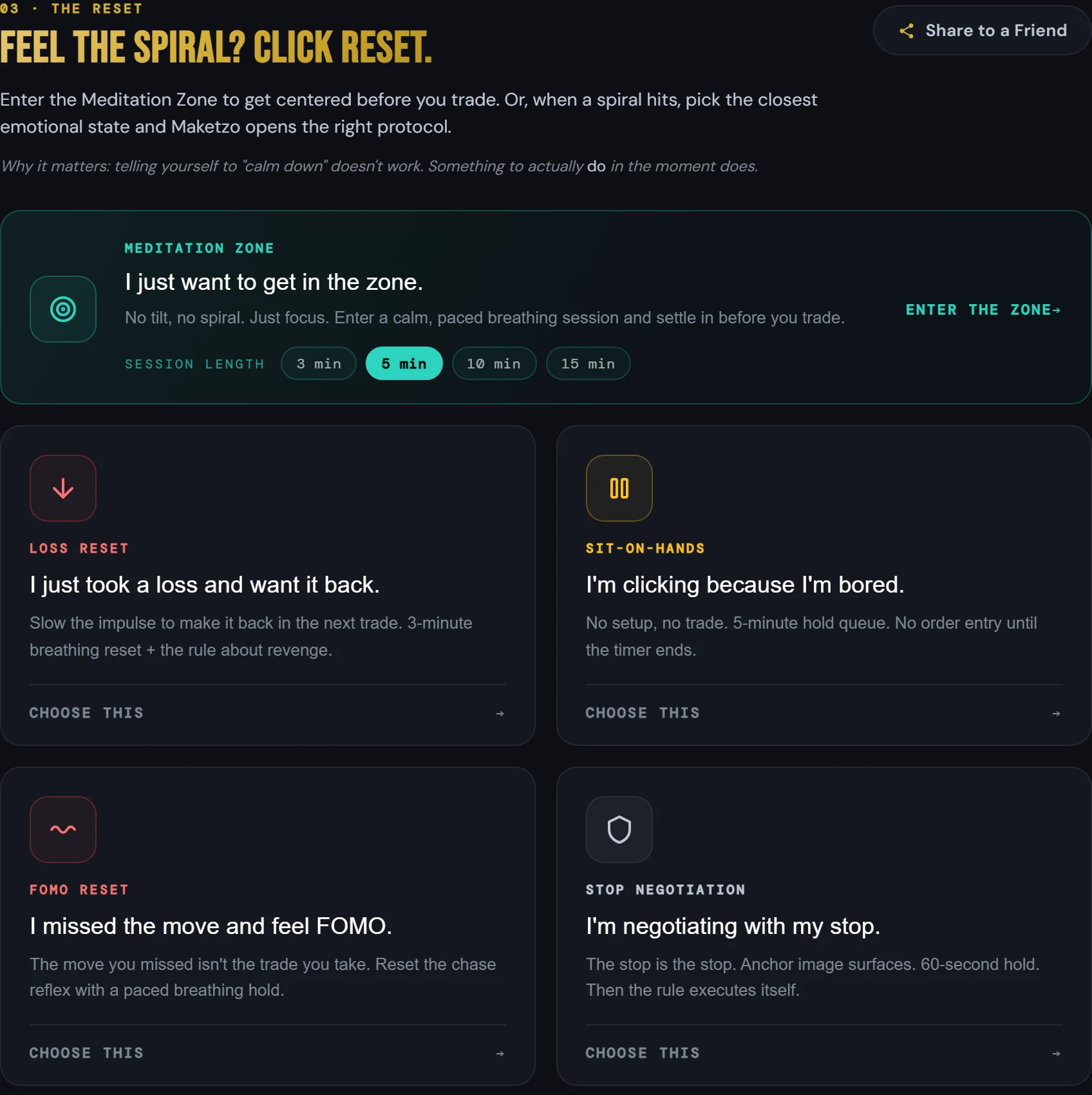
- The hijack itself. When a contract rule fires, MAKETZO pauses your P&L updates and takes you to a guided reset, and COACH SAYS comes in with brief, direct coaching. Each reset answers a line on Ross's list. HOD Heat Check is for buying the top, FOMO Reset for the run you missed, Loss Reset for the urge to get it back and Stop Negotiation for the stop you want to change. Each of those takes one to three minutes, paced by a breathing ring.
- The daily practice. Ross's guide asks students for 15 minutes of meditation every day. The Focus Room's Meditation Zone runs from 3 to 15.
- The review. Ross says you build mindfulness "by journaling while you trade and then reviewing your notes after the market closes." The Debrief does that in three steps and leaves a note waiting for you the next morning.
Scaling In and Out: Learn It From Ross, Practice It in Trade Replay
Fear shows up most when you are deciding how much to sell.
Ross Cameron is an expert at scaling in and out of trades, and he uses it as an answer to fear as much as a way to manage a trade. "Instead of selling the full position when sitting on a small profit, I combat that urge by selling a partial position and adjusting my stop," he writes. A small win gets banked and shares stay in the trade. His rule for adding is just as clean, under the heading Add to Winners Not to Losers: "I avoid adding to stocks that are below my entry price for day trades." Strategies & Scaling gives the subject whole lessons, from Scaling Strategies to Scaling Into Trades and Out of Trades.
Watching an expert scale is one skill, and doing it with your own hands is another. Trade Replay is where you close that gap with no money at risk.
- Start with a trade Ross recapped. His small account kit tells you to watch his recaps and look up the symbols. Bring up that stock's past chart.
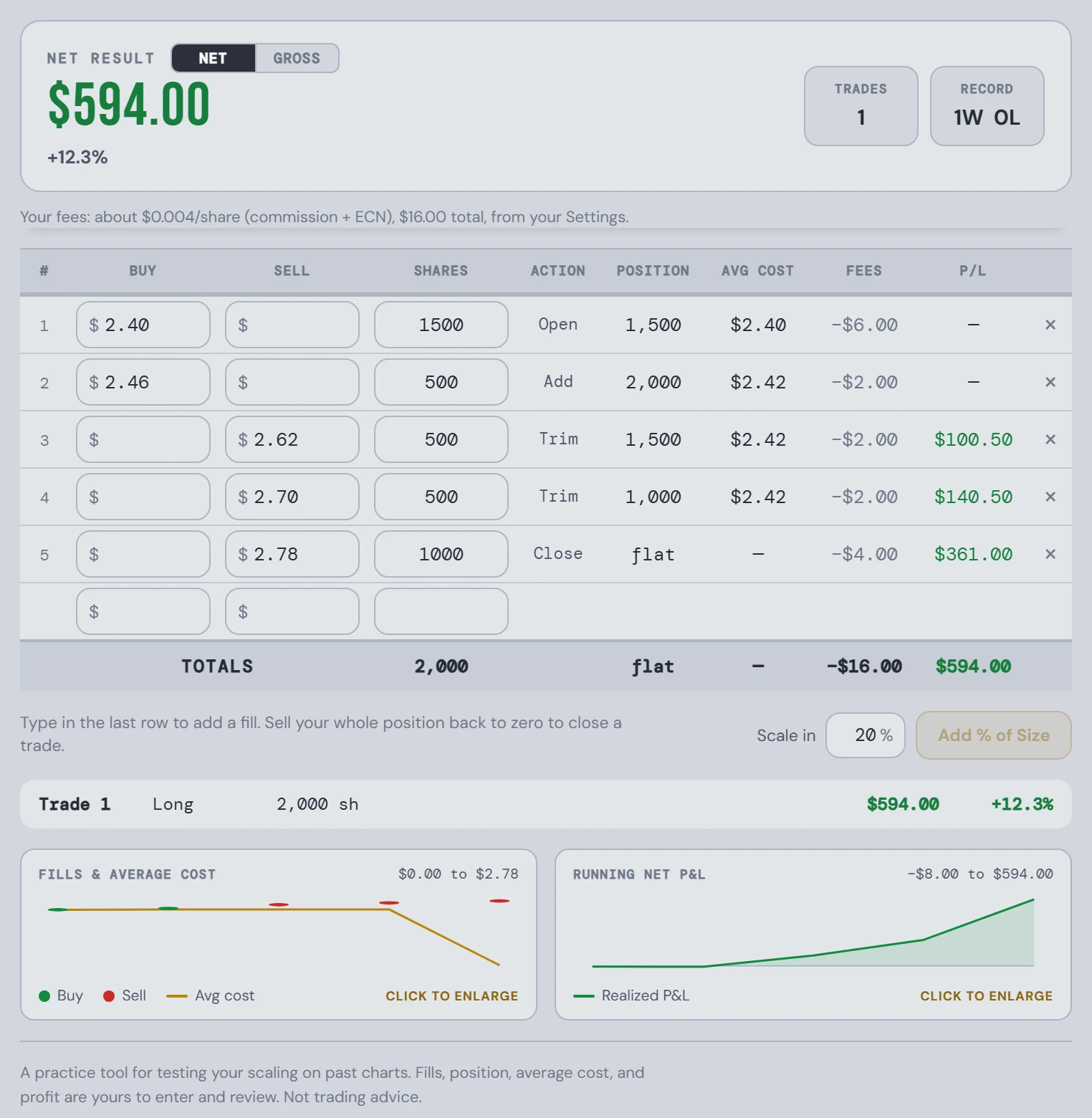
- Enter the fills you would have made. Give Trade Replay a price and a share count for each buy, add and partial sale, long or short.
- Watch what each one does. Your running position, average cost and net result update with every fill, so you see exactly how an add changes your average and how much a partial locks in.
- Run the same chart again. Try it his way, adding only over your entry and selling a partial with your stop adjusted. Then run it the way your impulses want and compare the net.
You already know how the chart ends, so judge your mechanics and not your timing. Ten replays are free with no account, and Trade Replay is unlimited inside MAKETZO.
Using Warrior Trading and MAKETZO Together
Let one teach you the method and let the other keep you to it.
Warrior Trading teaches what to look for and how to think about it. MAKETZO, a trading discipline system for small cap day traders, is there for the minute you know better and want to do it anyway. Ross's screen asks for a low float, and when you are checking a name that way, Dilution Check reads the company's SEC filings for dilution risk, so you can see the supply a float number leaves out. It comes with Pro and Elite.
If you execute on DAS Trader, your trades import from there, and it is the only import MAKETZO takes. The pricing page has the plans, and every one starts with a 7-day free trial. MAKETZO teaches and keeps you accountable, and it will never hand you a stock pick or financial advice.
MAKETZO is not affiliated with or endorsed by Warrior Trading or Ross Cameron. The quotes come from their published material. Warrior Trading says Ross's results are not typical, and what you trade and how much is your decision alone. Nothing here is financial advice or a recommendation to buy a course or trade a stock.
Common Questions
Who is Ross Cameron?
Ross Cameron is the founder and CEO of Warrior Trading, where he teaches small cap momentum day trading. He teaches Day Trading: Strategies & Scaling and co-teaches Trader Rehab, and his writing keeps coming back to one point: the hard part is holding yourself to the rules.
Does Warrior Trading teach trading psychology?
Yes, and it takes the subject seriously. Trading Psychology: Developing the Trader's Mindset is taught by psychotherapists Ted Walls and Diane Hicks, Trader Rehab is taught by Ross Cameron with Walls, and Strategies & Scaling has a chapter on building discipline and recovering from loss. Trading Psychology and Trader Rehab both come with Warrior Pro.
How much does Warrior Trading cost?
Listed prices have been $797 for Warrior Starter, $2,997 for Warrior Pro and $3,997 for Warrior Pro Special, which adds a year of Live Stream & Chat. Promotions change those numbers often, so check the company's own site before you plan around one. Warrior Starter members can upgrade later and get credit for what they paid.
Photo by Glenn Carstens-Peters on Unsplash · Photo by abdullah ali on Unsplash