Watch a trader's hand on a small loss. The shrug, the click, the move to the next thing. That same hand is the one that will or won't hold the winner later. It isn't a different hand, a different mindset, a different trader. It is one motor skill doing two different jobs.
Most of the advice around small losses frames them as defense. You take the small loss so you don't take a big one. True, but incomplete. The small loss is also an offensive skill. It is the training ground for the only hand that can sit on a runner without squeezing it off at the first green number that feels like something.

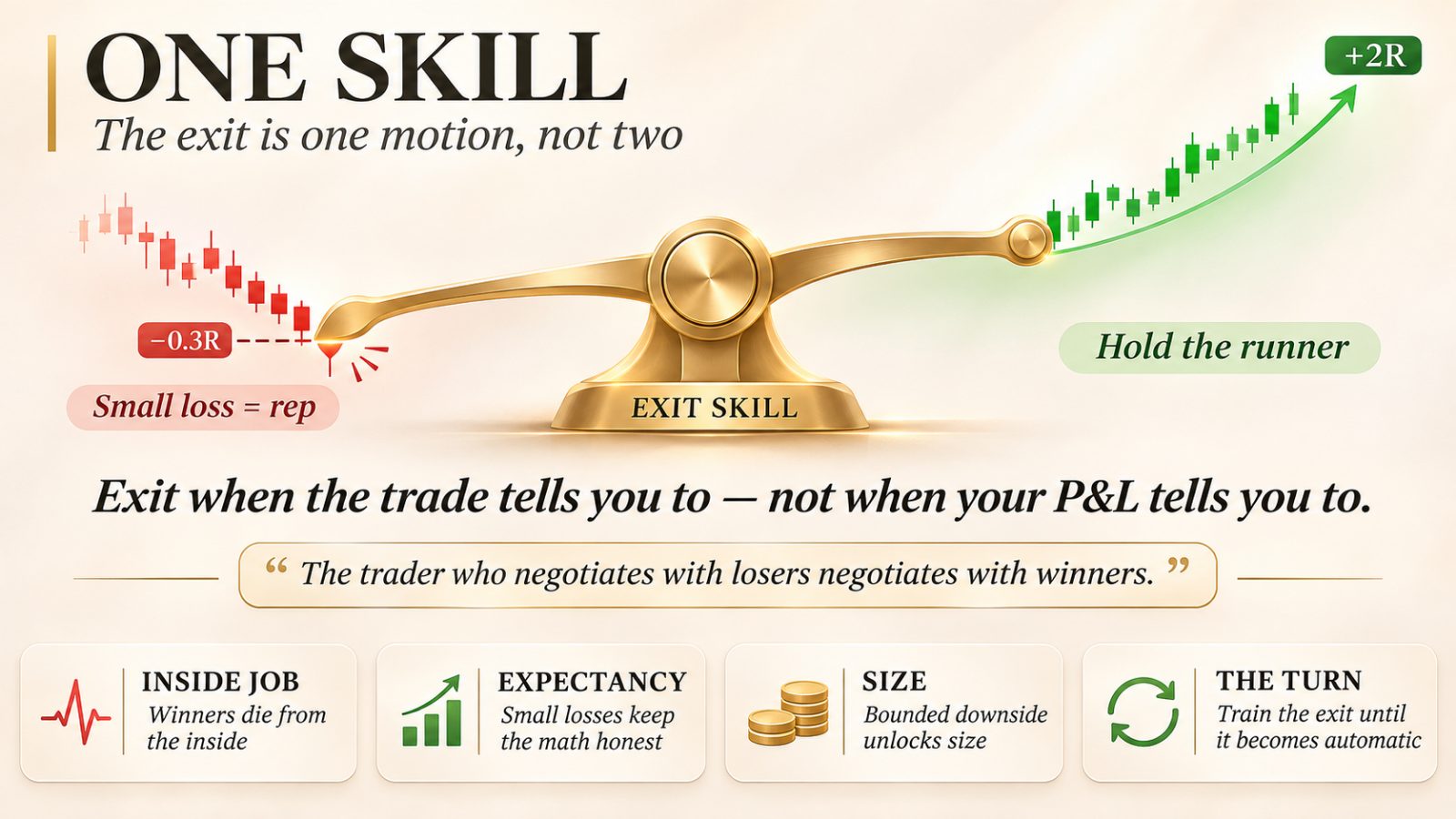
ONE SKILL
The exit is one motion, not two
You don't have a stop-loss skill and a let-winners-run skill. You have one skill: the ability to exit when the trade tells you to, not when your P&L tells you to. Train it on losers. Spend it on winners.
The trader who negotiates with a $40 loss, who whispers "maybe one more tick, maybe it bounces off this level," is the exact same trader who yanks a $120 winner off at $160 because the number finally looks like something they're willing to lose. Both exits are run by the same operator. Both exits are governed by feelings about the balance, not by what the chart is actually doing.
A clean small loss is not a sad event. It is a rep. Every clean exit on a loser is a deposit in the account that will let you hold the next runner. The traders who can sit on a +2R while it chops sideways for twenty minutes are the traders who never flinch on a -0.3R. It is the same nerve.
INSIDE JOB
Winners die from the inside
Most winners don't die because the move ended. They die because the trader exited before the move ended. The common story is "I took profits too early." The true story underneath is: the trader didn't trust the exit mechanism, so they took profit as a form of emotional insurance.
Where does that distrust come from? It comes from a history of losers that were held past their stop. Every time a stop is honored late, or not at all, the brain quietly files a new belief: my exits are not safe. Next time there is unrealized profit, that profit goes to cash fast, because cash is the only exit the brain fully trusts anymore.
The trader who negotiates with losers negotiates with winners. It's the same hand, having the same argument, about a different number.
You cannot fix early profit-taking by promising yourself to hold longer. You fix it upstream, by taking the small loss so cleanly, so unceremoniously, so many times in a row, that your brain finally updates the file. Exits are safe. Exits work. The mechanism is honest. Now the hand can relax on the winner.
EXPECTANCY
Expectancy lives in your nervous system before it lives on a spreadsheet
Expectancy on paper is simple arithmetic. Win rate times average winner, minus loss rate times average loser. Positive number, tradeable edge. Everyone nods at the formula.
In practice, expectancy lives in your nervous system. If your plan says the average loss is $50 but the actual average loss, because you let two of them run this week, is $180, the math is broken before you ever ran it. And the thing that broke it wasn't your strategy. It was a single moment when your hand wouldn't click.
The small loss, taken without ceremony, is what keeps the arithmetic honest. It isn't the floor of your risk. It is the integrity of your entire system. One honored stop protects not just capital but the statistical validity of every other decision you'll make that day. One stop that drifts invalidates all of them, because now you don't actually know what your average loss is. You know what you hoped it was.
SIZE
Small losses are what buy you size on the winner
Here is the part the defensive framing always misses. When you know, in your hands, that losers get cut small, you can size the winner with less anxiety. The downside is bounded. Size stops being an act of courage and becomes an act of arithmetic.
The trader who cannot take a clean stop ends up sized smaller than the edge deserves, because any bigger position produces a loss too emotionally expensive to accept. So the size comes down. The winners shrink to match. The math never gets to run at full scale. The edge is theoretically real and practically starved.
Clean small losses are the price of admission to meaningful size. They are not the only price. But they are a non-negotiable one, and they are paid one click at a time, on the loser nobody will ever praise you for cutting.
There is a quieter version of this that nobody writes about. When your losses are honestly small, you stop defending them. You stop telling the story of the loss to yourself for the next hour. The $40 evaporates from your attention and the next setup gets a full brain. The trader who held a $180 loser is still fighting that loser at lunch, with half the day left and only half a brain to work it.
THE TURN
What you're actually trying to build
Somewhere in this post, if any of it landed, the reader has started sketching something. A thing that makes the small-loss click an automatic motion. A thing that notices, in real time, when a stop is drifting. A thing that flags a $40 loser the moment it becomes a $90 story, because the story is where the damage actually lives.
That thing is what MAKETZO is. Not a signal service. Not a chat room full of tickers. An operating system that watches your exits for drift, flags the loser you're starting to negotiate with, surfaces the pattern where your winners are getting cut inside of a target because your losers have been eating your trust. The small-loss motor skill is the first thing it protects, because every other skill a trader has sits on top of it.
You already know the hand that cuts clean is the hand that holds long. The question is whether anything in your workflow is actually training that hand, or whether you're asking it to show up untrained, every morning, against a market that's happy to teach it the wrong lesson for free.